Click the links below to download and read our publications.
Annual Reports
Donor Newsletters
- Fall 2025
- Fall 2022
- Summer 2021
- Spring 2021
- Fall 2020
- Summer 2020
- Winter 2019
- Fall 2018
- Summer 2018
- Winter 2018
- Fall 2017
Mark, 76, lives alone and has short-term memory loss. It’s hard for him to stay on top of his bills because he often forgets to pay them.
That’s when Cynthia, a social worker with Iona’s Money Management Program, stepped into help.
In May, Mark needed to submit paperwork for his subsidized apartment. If he missed the deadline, his rent would increase from $450 to $1,750 a month—far more than his $1,200 monthly income.
During a visit in late April, Cynthia saw multiple reminder notices around Mark’s apartment. But she discovered he still hadn’t submitted all the required documents, and time was running out. So Cynthia spent hours searching through years of piled-up mail and helped Mark turn in his application—just days before the deadline.
Thanks to Iona, Mark will remain in his home, with support whenever he needs it.
By all accounts, David Brown is a big personality. A retired DC police officer, David, 75, is “a pillar of our community, mentor and friend to many, and the backbone of our family,” said daughter Thia Jackson.
So, when the man they had always counted on became increasingly forgetful, the Brown family knew something was wrong. An explanation finally came in 2018, when David was diagnosed with Lewy body dementia. “Never in a million years did we think this would be the health concern my intelligent, wise dad would face,” said Thia, adding that the diagnosis left the family shocked.
Like David, there are approximately 9,000 people in the District who are diagnosed with dementia each year.
With those numbers on the rise, Iona and Sibley Memorial Hospital joined forces (with individual philanthropy and funding from the DC Department of Aging and Community Living) to offer a citywide program to support families like the Browns.
Called Club Memory (R), the program offers a stigma-free social environment where families get both practical and emotional support. At each session, Sibley’s community dementia program managers offer thoughtfully selected and evidence-based activities such as trivia, puzzles, sing-a-longs, and sharing of resources and conversation. At the same time, embedded within the program are Iona’s expert dementia navigators, who help participants tap into the services and support they need.
“People living with dementia and their family members frequently have a hard time getting information about their diagnosis, accessing available services, and obtaining advice and support through their journey,” says Melissa Susser, one of Iona’s dementia navigators. “That’s where Iona comes in.”
With Melissa’s help, the Browns were able to “get out in front of the disease,” said Thia.
In the past year, Melissa has conducted a home assessment, created a personalized plan, helped the Browns access medical specialists, and connected David to adult day health programs and transportation resources.
“Melissa put a system in place so that our dad is getting the care he needs, and our mom is getting the support and respite she needs. As a result, we are all feeling less overwhelmed,” said Thia, who calls Melissa “our rock”. Sisters Ericka and DeAndra and mom Renee echo Thia’s appreciation.
“This is still new to us,” says Thia. “Looking back on the past year, I can see how much we have learned and grown as a family. We get strength and comfort in knowing we are not alone.”
Ann Hawkins, 81, has had a hand in some of Washington, DC’s most famous attractions as a self-employed designer and carver of stone inscriptions. Her work can be found on several major memorials, such as the Japanese American Memorial, and inside public buildings like the U.S. Supreme Court Building and the National Gallery of Art.
To supplement her income, Ann also rented rooms in her home to visiting researchers from the Carnegie Institution for Science and the Kennan Institute. “I’ve had visitors from at least 60 countries,” she says.
But when the pandemic hit, Ann’s income dried up. Her projects at DC institutions were put on hold, and it was no longer safe to welcome lodgers.
Ann went online to file for lost wages assistance and became overwhelmed. “I couldn’t deal with the complexity of the applications,” she remembers, “I tried three or four times, was repeatedly rejected, and just gave up.”
Ann remembered Iona and called the Helpline, which connected her to Care Manager Liza Chapkovsky.
“She was like a gift from heaven,” says Ann. “Liza is calm, caring, and competent, and she knows the ropes.”
Liza helped Ann fill out the application for loss of wages, which required dozens of pages of documentation. The process made Ann realize just how financially vulnerable she was. “I had been thinking that I would have to leave the house,” she says. “I could no longer keep up with monthly expenses.”
To help Ann get by in the meantime, Liza assisted her in applying for a SNAP card for groceries and connected her to a program that would allow her to keep her health insurance.
Fortunately, Community Care Management was an affordable option and the best option for Ann as it provided her a safety net. After a couple of weeks, she received news that her application had been accepted, and the benefits were retroactive to the beginning of the pandemic.
Today, Ann is on better financial footing all because of the affordability of Community Care Management. “I couldn’t be more positive about Iona,” she says. “Liza saved me.”
When she was in her forties and fifties, Maria Thompson, 66, never gave much thought to getting older. “Aging seemed a little distance away,” she says. “I didn’t take it that seriously.”
Recently, Maria retired and had to start watching her spending. Her relationships with family were also strained. “I started wondering how am I going to age by myself?” she says.
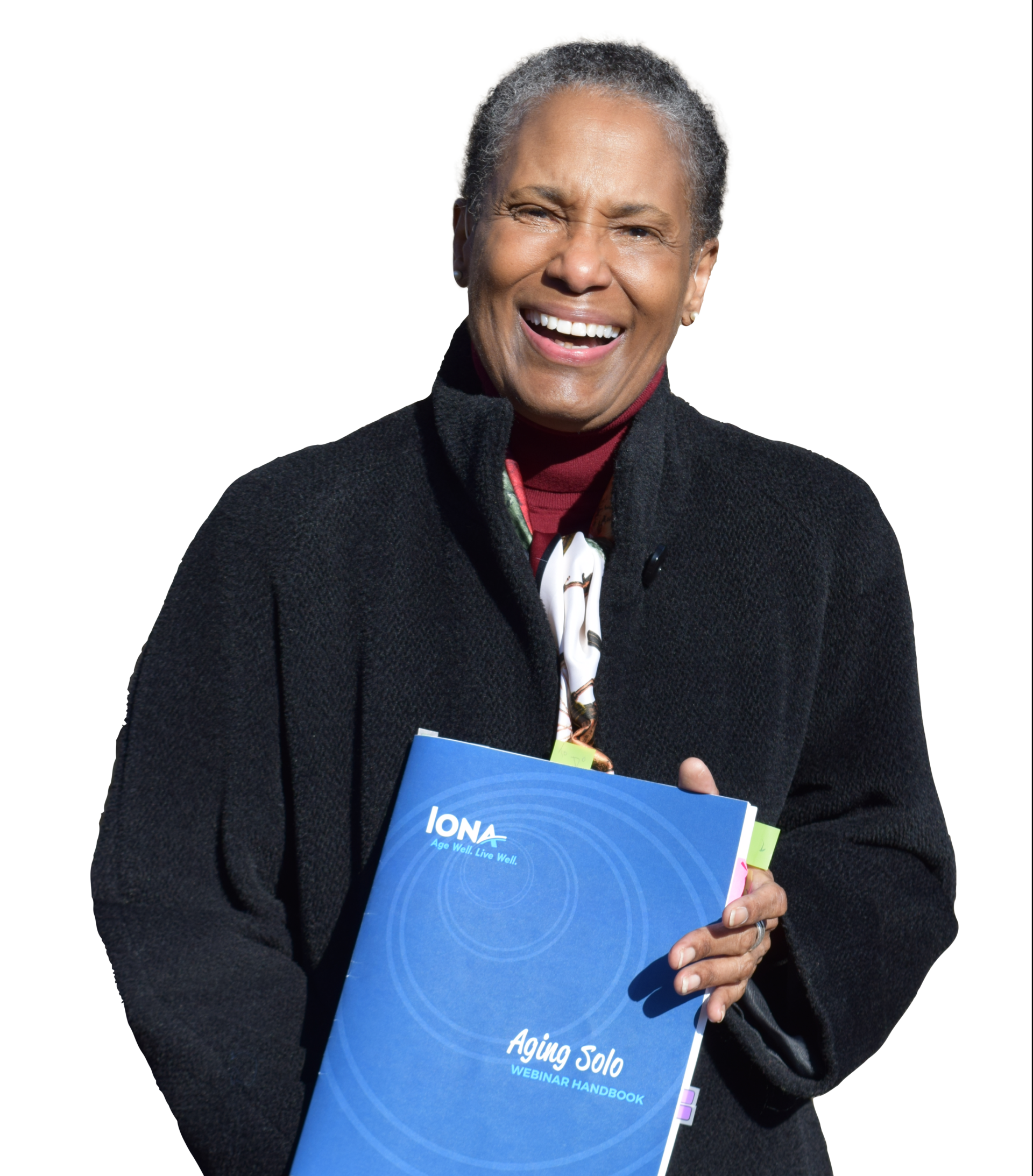
Several months into the pandemic, Maria received an email about Aging Solo – Iona’s six week online series that addresses the practical aspects of planning for aging.” I wanted to learn what I need to do to put myself in a position where in old age and death I don’t impose on anyone,” she says.
Fortunately, Aging Solo is an affordable program for older adults with limited income—and Maria was able to enroll immediately. As part of her course, Maria met weekly on Zoom with a group of older adults, guest experts, and facilitators who led discussions and shared resources.
“At first I was overwhelmed” says Maria. “But I started hammering through the booklet, and I called Iona’s Helpline. It helped me make some real concrete decisions.”
One of the biggest changes in Maria’s life has been downsizing her apartment. “Because of Aging Solo, I knew that now was the time to do it,” she says. “I’m glad I did. There was so much stuff I didn’t want, need, or even remember I had!”
Now, as a member of Aging Solo, Maria has been able to strengthen her social network. “I have been much more proactive in solidifying my friendships and family ties-which is a major step for
me,” she says. “I have gotten much closer to my sisters, aunts, cousins, and nieces, and it has made me feel so connected.”
“Every person aged 55 and older should take Aging Solo,” says Maria. “It’s a very important program.”
After being closed for more than a year due to the pandemic, Around Town DC at St. Alban’s returned in September 2021 to the delight of both longtime and new participants.
“There’s a real sense of gratitude,” says Site Manager Frances Bucien. Participants 60 years and older come for a variety of reasons: exercise, coffee and conversation, a daily meal, fresh produce from the twice-monthly farmer’s market, to see old friends make new ones. Mostly, they come to be part of a supportive community – all too important during a pandemic and a time of life when
many older adults feel isolated and alone.
This is confirmed by longtime participant Joy Allen, 68. She gestures to Harold Cupid, 82, who is sitting next to her at lunch. “I’ve known this gentleman since day one. When things shut down, I really missed my friends. I like being around people who are at my stage of life.” Harold loves the program so much that he takes three buses to reach St. Alban’s from his in Ward 5.
“Around Town DC has been my salvation” says LaVerne Holmes, 72. She lives alone, and three of her close friends died in 2020. “Getting used to the ‘new normal’ has been an adjustment,” she says.
But then a friend told LaVerne about Around Town DC, and she was quickly hooked. “From the beginning, I loved the variety of programs offered,” she says. Today, she is active in yoga three days a week, and she has enjoyed classes about African American art, decluttering, and cooking. “I didn’t know I could dance until I began Ruth’s Zumba classes. She always puts a smile on my face!” LaVerne says.
“The staff work hard to offer quality programs and select the most knowledgeable and caring educators,” she adds. “They’ve done an extraordinary job.”
After many months of construction and anticipation, Iona’s Washington Home Center opened its doors in fall 2020. This state-of-the-art facility – which serves individuals with dementia and physical and intellectual disabilities – is the only adult day health center located in Southeast DC.
Checonya Bittleb, 63, is one of the center’s first participants. He lives in Ward 8 with his sister, Janie Horn, 68, his primary caregiver. A former karate trainer, Checonya has dementia and struggles with mobility.
During the early weeks of the Covid-19 pandemic, Janie had grown increasingly concerned about her brother. Most days, he stayed at home with a hired caregiver watching the same TV shows over and over while Janie was at work. “I was so upset”, she says. “He was spending the time deteriorating.”
But things immediately changed for the better once Janie discovered Iona’s Washington Home Center. When Checonya first arrived, “he was bent over and unsteady on his feet,” she says. Iona staff worked with him to stand tall and move with ease unassisted. Their mantra, Janie says, is “You can do this!”
Janie, who drops her brother off before going to her full-time job as an administrative assistant, appreciates that the new center is only 10 minutes from their Congress Heights apartment. “When you are in certain DC neighborhoods, you don’t have access to the same resources as other people,” says Janie. “Hats off to Iona for bringing the same opportunities that exist elsewhere to residents east of the River.”
Today, Checonya enjoys going to the center three days a week, where staff engage him in exercise, art projects, and singing along to his favorite Motown songs. “This is so much for my brother than sitting at home,” says Janie. “He’s stimulated all day, and it’s good for him to have other people in his life- professional staff who work on his memory recall. If he wasn’t there, he would waste away.”
Janie also gets support from Iona on the days Checonya doesn’t go to the center. “The staff calls to ask how he’s doing and provide him with activities to do at home,” she says. “That helps me a lot. I’m really happy with his progress.”
As Checonya’s big sister and caregiver, “I don’t think about myself a lot,” Janie says. But the staff ask about Janie as well to remind her to take care of herself. Her response: She and her brother are doing great, thanks to Iona and its passionate staff.

Older adults run a higher risk of health problems and injuries related to colder temperatures and other winter hazards. In fact, as you age, changes in your body can make it more difficult to notice when you are cold. Additionally, some illnesses like diabetes, thyroid problems, or arthritis can make staying warm a challenge.
For these reasons, it is important that you understand the risks and take precautions during the colder months. This information is equally important to anyone caring for an older relative. Here’s what you need to know:
People with heart disease and other circulation problems are more likely to get frostbite. You may notice a discoloration in your skin (white, ashy, or grayish-yellow), or your skin may feel hard, waxy, or numb.
How to avoid: Bundle up! When going outside in cold temperatures, be sure to cover all parts of your body. Wear a hat, scarf or knit mask to cover your face, mittens, and water-resistant coat and shoes. On very cold days, try to limit your time outside, because frostbite can occur in just minutes.
What to do if frostbite occurs: Place your frostbitten body parts in warm (not hot) water. If your symptoms persist, call your doctor.
An important note: Shivering is not a reliable warning sign of frostbite because older adults tend to shiver less or not at all.
Hypothermia is especially dangerous to older adults because it can be difficult to tell when their body temperature is too low. Some warning signs of hypothermia include lots of shivering, drowsiness, exhaustion, confusion, slurred speech, and slowed breathing. Call 911 if you think you or someone else has hypothermia.
To avoid hypothermia, stay indoors when it’s very cold outside and if you must venture out, wear lots of layers and stay dry. When indoors, remember to dress warmly (wear socks and/or slippers), and keep a throw blanket over your legs.
How to avoid hypothermia: One way to avoid hypothermia is to keep your home heated indoors to a minimum of 65 degrees. Saving money is important, but not at the expense of your health and safety. (If you need help with high utility bills, call Iona’s Helpline at 202-895-9448.)
First and foremost, avoid walking on icy or snowy sidewalks to evade a slip. If you must walk outside (and your pathways are not dry or clear), wear boots with non-skid soles to help with traction. If you walk with a cane, you might consider replacing the rubber tip before it is worn smooth or even purchase an ice pick-like attachment to help with your balance. You can purchase this at a medical supply store.
Worried about having a fall while shoveling snow, or don’t have the energy to maintain the sidewalk in front of your home? In DC, you can apply for a Sidewalk Shoveling Exemption. You can also ask a neighbor to help you.
For even more winter safety tips, including information on accidents while driving and fire & carbon monoxide poisoning, download this American Geriatrics tip sheet.
If you’re looking for information and resources on influenza-a.k.a. the flu-check out Iona’s blog here.
The National Institute on Aging is also an excellent resource.
 Iona is partnering with the Georgetown Language Project to expand access to its community resources for older adults and family caregivers.
The Georgetown Language Project is a student group at Georgetown University in which undergraduate students provide free translation of materials for local nonprofits, schools, and organizations. The goal of the group is to promote language accessibility within the DC community through its translation efforts.
Fifty students with advanced language proficiency participate in the program. They speak a wide range of languages including Spanish, French, Mandarin, Arabic, and more. The group translates hundreds of pages of material each year, which are all reviewed by language experts for accuracy.
Natalia Lopez, 21, a rising senior and co-president of the Georgetown Language Project, says she understands the value of providing free translation services based on her own experience as the daughter of two immigrants from South America. “Translated materials from local organizations helped my parents learn English, enroll in school, and even start a business,” she says.
Alvin Lee, 21, also a rising senior and co-president of the group, agrees. “I grew up in an immigrant family and extremely diverse community in Los Angeles,” he says. “So I understood the challenges language barriers can cause, especially when it comes to understanding and filling out important documents.”
A passion for translation and making information accessible to all is a driving force for many students to join the Georgetown Language Project, according to Lee. “Our members’ dedication and passion for social impact have been key to the Georgetown Language Project’s success,” he says.
In spring 2021, the group began its translation of the first of several Iona fact sheets on helpful topics for older adults. “Low-Cost Housing Options” is now available in English, French, and Spanish. This fall, the group will continue translation of the remaining fact sheets, including a Mandarin translation.
For the students of the Georgetown Language Project, the effort to provide translations for community members is well worth it. “I am so proud to be part of such an amazing community at Georgetown. Our group is made up of such dedicated students who truly want to positively impact their community,” says Lopez.
“I’m extremely glad that our translation projects are able to make a positive impact, and I am excited about future projects and collaborations with Iona!” adds Lee.