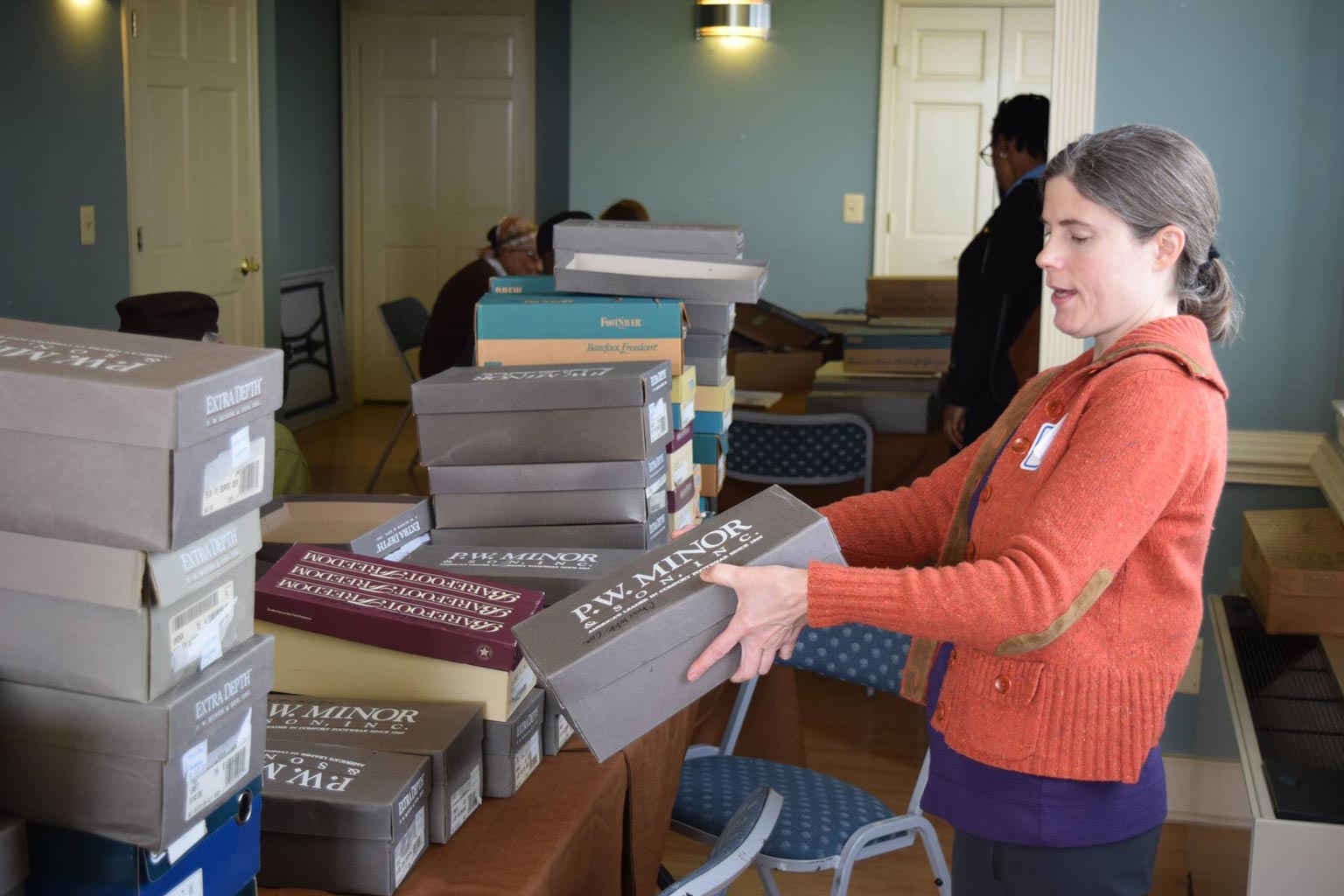
In early March, Iona was contacted by Karen Widmayer, daughter of Dr. S. H. Friedman, who owned Public Shoe Store in Arlington. After more than 70 years in business, Public Shoe Store was closing its doors. And, now, Karen was looking for a trusted nonprofit to take their bounty of orthopedic shoes. Iona, of course, jumped at the opportunity.
Thanks to this unusual gift, Iona’s social workers and care managers have been able to provide new shoes to any client in-need, totally free of charge. To help distribute the shoes, Iona hosted a special “pop-up” shoe market at Regency House, the only low-income public housing option for older adults in Ward 3. With 85 pairs of shoes in tow, we were able to find perfect fits for more than 50 residents. Says Joan Curry, who received a pair of loafers, “My goodness, these are comfortable. If I could do the happy dance, I would!”
All told, Iona received close to 300 pairs of shoes, valued at more than $45,000. In addition to our clients, Iona has shared this generous donation with other senior services agencies in the District. We will continue to share our bounty as supplies last.
Written by Rosie Aquila
Rosie Aquila is Iona’s Communications and Marketing Manager. A graduate of Kenyon College (where she worked as editor for the college’s newspaper), Rosie joined Iona’s team in 2014.
Special Guest Artists Valerie Watson, painter, and Norma Brooks, folk artist, share their inspiration and creative processes. Enjoy their artworks on display in the Gallery at Iona through October 4, 2016.
Q: What is your artistic process?
Norma: I like colors. I like richness, and I like transformation — taking found options and finding ways to make them into something completely different or embellish what I have. I love to pair colors and patterns that you might not necessarily think go together. And, often, my projects don’t turn out the way that I had envisioned them. I’ve learned to appreciate those errors and mistakes. They are now the best parts.
Valerie: Since high school, I’ve been working in watercolor. And now I am over 60 years old, and it is still my best friend. I am inspired by spontaneous moments that are visually exciting for me to watch. It is unrehearsed, just life happening. I usually snap a photo so that I can see all the nuances. The lights and the darks are mapped out for me, and the photo gives me the details that made me interested in the subject in the first place. Watercolor can be frightening, but at this stage, I feel that I have an understanding of the medium. It’s learning to control it and then you can really dance on the paper.
Q: Has your process changed as you’ve aged?
Norma: It has changed. I feel freer; I can exhale and it’s ok. I don’t have to play it safe, and I don’t have to stay within the line. The more I create, the more I want to color outside the lines. Try something riskier, and that will make it more artistic and make it more me.
Valerie: I’ve been very consistent when it comes to my subjects. But, I do find myself looking for the next challenge in a different way. As an artist, I want to go into new territories. I want to make myself do stuff that leaves me sweating. I don’t just look for a subject now, I think, “Wow, what if I did this?”
Q: What do you hope to evoke from visitors with your exhibition in the Gallery?
Norma: Just a smile. Or a breathless “wow.” It is a gift to share my art with others, and if I can bring happiness to them, then I am successful.
Valerie: I hope that visitors will get the experience of seeing the evolution in my work. I have a few older pieces that reflected my daily life. They are narrower in subject because I hadn’t explored yet. My newer work is much looser. I hope visitors see where I started, and where I am now.
Iona social worker Christine Kenny provides city-wide support to people with mild memory loss who live alone.
Imagine having your trust broken by someone close, maybe even a neighbor. Now consider if you had no family support and significant memory loss. Where would you turn?
For Mark, whose name has been changed to protect his identity, Iona Senior Services — and more specifically, social worker Christine Kenny — was the answer. Funded through the D.C. Office on Aging, Christine is able to provide support to vulnerable older adults across the city who have mild memory loss and live alone. She provides money management support, making sure that clients pay their bills on time, are managing their personal funds, and are not being exploited.
Mark, who has visual impairment that makes reading mail particularly challenging, also depends on Christine to regularly open and sort his bills. When a routine review of Mark’s bank statement showed multiple ATM uses on the same day, Christine knew something was wrong. “Mark’s mobility is impaired; he couldn’t possibly have gone to two ATMs in the same day,” says Christine.
Immediately, Christine jumped into action. After speaking with Mark, she uncovered that a neighbor, who Mark had shared his card and PIN information with for assistance in emergencies, was withdrawing additional money without Mark’s knowledge. All told, the neighbor may have made more than $200 worth of unauthorized withdrawals, which is nearly 30% of Mark’s tight monthly income.
A Safety Net for Mark
Fortunately, Mark had Iona as his safety net. Besides referring the case to the Adult Protective Services, Christine has also offered other options like personally accompanying Mark to the bank. “There are a lot of seniors who don’t have trusted family members or friends that can help them. And for people with memory loss, financial aptitude is often the first ability that becomes impaired,” Christine says. “As a social worker, I’m able to provide assistance or resources so they can remain in their home or community. Adding the money management program to Iona’s services has been so important.”
Written by Rosie Aquila
Rosie Aquila is Iona’s Communications and Marketing Manager. A graduate of Kenyon College (where she worked as editor for the college’s newspaper), Rosie joined Iona’s team in 2014.
Leland Kiang, who manages and frequently answers Iona’s free Helpline, has a lot of people leaning on him. 2,869 to be exact. That is the number of people who made 4,605 calls to the Helpline in the past year. Staffed by social workers every weekday from 9 a.m. to 5 p.m., the Information & Referral Helpline was set up to answer common — and uncommon — questions and to refer callers to services and programs in our area. Anyone can call the line. Iona gets inquiries from residents throughout the region as well as family members living across the country and overseas who have older relatives in the Washington area.
“My affinity for working with older adults stems from my grandmother, who helped raise me,” says Leland, who has a master’s in social work from Catholic University. He worked as an Iona case manager before taking over the Helpline in 2008. The job, says Leland, is part social worker, part resource librarian.
Most of the questions to the Helpline come from caregivers — spouses, adult children, close friends, and professionals — but some come from older adults interested in resources for themselves. Callers represent the spectrum of income levels. During the recession, there was an increase in inquiries related to financial support.
Today, many people are looking for affordable housing. Callers also want to know about free or low-cost transportation services, home care services, government benefits, and home-delivered meals. “Sometimes the call is from an adult daughter or son who has noticed that mom or dad isn’t functioning well,” says Leland. “They are overwhelmed and don’t know what to do.
“Our job is to sort out where the need is,” he says. “If the caller is anxious, I let her vent, which gives me time to figure out how I can help.” Questions run the gamut. Are they trying to find out if Medicare pays for long-term care? How to support a parent who is being discharged from the hospital? How to help a family member who is depressed or socially isolated? Leland frequently refers callers to Iona’s team of experts, which includes case managers, social workers, and a dietician, among others.
Beyond the Helpline, Leland produces the Bi-Weekly Resource Digest distributed to a mailing list of 1,000 area professionals. “The Bi-Weekly Digest is phenomenal, very valuable,” said Mary Ann Floto, United Way’s 211 Program Manager. “I’ve passed it on to information and referral colleagues in Maryland and D.C.”
Asked how this work has influenced thoughts about his own aging, 49-year-old Leland points out that he has the privilege of witnessing both the challenges and the rewards of aging. “I’ve seen a lot of courage and resiliency,” he says. “At Iona — and throughout the community — I’ve seen people collectively coming together to help others. If anything, it’s inspiring.”
To get answers yourself call (202) 895-9448 and ask for the Helpline or email info@iona.org.
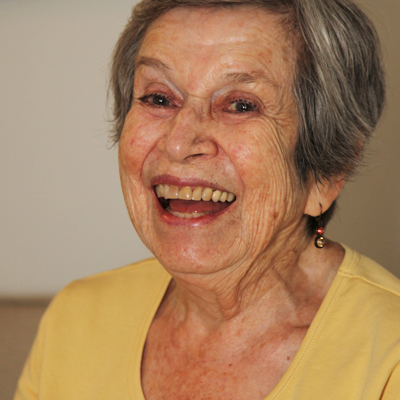
When Angela Mejia de Lopez retired as professor of ancient history from the Universidad Nacional de Colombia, she had big plans which included reading all the books she hadn’t had time to read when she was teaching. Macular degeneration changed all of that.
Now 86, Angela has lived for the past year in a DC apartment, three blocks from her son and his family — who check on her every day and host her for lunch every weekend. But family members became alarmed when Angela began having trouble with food shopping and cooking because of her impaired eyesight. Angela agrees it had become a problem. She was no longer able to distinguish between products at her neighborhood grocery store, and meal planning had become difficult as well. It was her idea to look into home-delivered meals.
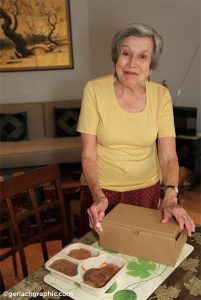
Angela’s daughter Adelaida Lopez — who lives in California — arranged through Iona to have meals delivered four times a week. (Through its grant from the DC Office on Aging, Iona delivered meals to 243 older adults in the past year.) “I live alone, but I’m glad to know I am not completely alone,” says Angela, who looks forward to the meals she receives. Adds her daughter: “It’s important for my mother to know that somebody cares about her besides her family.”
“The home-delivered meals program has not only allowed Angela to consume healthy and tasty meals, it has provided her daughter with a sense of relief that her mother is eating well and can continue to age well in her apartment,” says Jakia Muhammad, Iona’s home-delivered meals coordinator.
Iona’s home-delivered meals have been a safety net for Angela and her family. But notes Adelaida “this may be the tip of the iceberg in terms of what we need from Iona,” She recently arranged for her mother to meet with an Iona social work case manager.
Stella “Starr” Clarke, kept running into the sociable stranger in her Cleveland Park neighborhood. Each time, his message was the same: “Come check out the club.” After four invitations, she had to see this place for herself.
The “club” turned out to be Iona’s Active Wellness Program at St. Alban’s, held every weekday from 10 a.m. to 2 p.m. on the grounds of the National Cathedral. The program attracts older adults from the neighborhood and beyond who are drawn to the nutritious lunch and diverse activities — such as exercise class, a farmer’s market with free produce and field trips.
“I like the people and we have a lot to talk about, whether we are black, white, pink, or blue,” says Stella, 80, who is married and has children, grandchildren, and great-grandchildren but appreciates the opportunity to do her own thing.
She has been doing her own thing since she was three years old and fell in love with dance. A native of Guyana, South America, Stella honed her skills as an interpretive and Caribbean folk dancer and, at an early age, was crowned Carnival Queen. She founded a well-known dance school; her “Dancing Dolls” performed for presidents and other dignitaries. In Guyana she is considered a national treasure. She was recognized by the government in an official ceremony celebrating her as a national cultural icon.
When she moved to the U.S., Stella was invited to train with the prestigious Alvin Ailey Dance School. She has been teaching dance ever since, even recreating “The Dancing Dolls” with children of Caribbean heritage living in the Washington area.
Frequently asked her secret to staying “young,” Stella’s response is morning exercise — in the shower! — where she stretches, twists, and touches her toes. “The warm water loosens you up; that’s why I look and feel like a teenager,” she laughs.
At St. Alban’s, “we talk about everything from our families to our finances. It’s as if we’ve known each other for years,” says Stella, who has been participating in the program since 2013.
Courtney Tolbert, who manages the St. Alban’s program, “is one in a million,’” says Stella. “She’s constantly adding new programs. For instance, September is National Hispanic Heritage Month so we listened to Joan Baez and José Feliciano and went to the National Portrait Gallery to see an exhibition about Dolores Huerta (the farm workers’ movement leader).”
“We all have such incredible lives,” says Stella, noting that a recent event featured a discussion about a new book by Alec McRae, another St. Alban’s participant.
And, in fact, Stella herself (along with granddaughter Kahina Haynes, School Director of Dance Institute of Washington) performed at St. Albans. “I plan to dance until the day I die,” she says with a twinkle in her eye.
With an average monthly allotment of $119 for seniors living alone, SNAP is a particularly effective tool for addressing hunger. However, thousands of eligible older residents are not enrolled in SNAP, and thousands of seniors receive only the minimum benefit, which last year was cut by the federal government to $16 monthly. This minimum is woefully inadequate for many seniors who live on fixed incomes and must contend with the rising costs of DC living. Thanks to an advocacy campaign led by D.C. Hunger Solutions, the Fair Budget Coalition, and the DC Senior Advisory Coalition, the DC City Council increased the minimum SNAP benefit to $30 — allocating $1.3 million from the DC budget.
“This step will actually keep older adults in our community in better health,” says Elizabeth Fox, coordinator of the DC Senior Advisory Coalition which is hosted by Iona. “Fixed incomes, rising food prices, and the growth in DC’s aging population translate to the current reality of more hungry and malnourished seniors.”
Elizabeth is no stranger to this work. A leader on aging issues for 35 years, she was Iona’s executive director from 1982 to 1998 (presiding over the building of our home at 4125 Albemarle St. NW), worked for Experience Corps locally and nationally, and was instrumental in the inclusion of certain provisions of the 2006 Older Americans Act. In 2011, Elizabeth, now 72, came out of retirement to lead the S.A.C. She is often found with fellow advocates making their voices heard at the District’s Wilson Building. This advocacy led the City Council to increase the D.C. Office on Aging budget for home-delivered meals, eliminating long waiting lists that had existed for years. “Our success in reaching the City Council is in large part due to Elizabeth,” says Iona’s executive director, Sally White.
In turn, Elizabeth says, “the Coalition’s positive relationships with the DC government are a tribute to Iona in general and Sally’s leadership in particular. She is at the same time respectful and fearless.”
“Today, this stage of life is better recognized and understood,” says Elizabeth. “Thanks to Iona, Emmaus Services for the Aging, AARP, and many nonprofit advocates, organizations are now working together more effectively.
Still, for Elizabeth, who is currently organizing a second city-wide forum on affordable housing, “there is much more work to be done.”
They came together later in life and from different backgrounds. Larry Bell, the son of a popular disc jockey, had a hit record, “Hey Mr. Lonesome,” by age 17.
Later, he worked in a series of sales and music industry jobs around the country. Back in DC, he enjoys his work as a trainer in cross-cultural communication. Michelle Dompierre is from a small French-speaking enclave in Ontario, was inspired by the First Nation population that lived on a nearby reservation, and traveled the world working in international development.
An unlikely couple perhaps, Larry and Michelle met in the District in 1992. “That was the beginning of a whole new chapter,” Larry says. Michelle would cook while he read Siddhartha to her. After seven years of dating, they married. “We are different racially, culturally, and behaviorally but we connect on a spiritual level and around shared values,” she says.
Most recently they had begun thinking about the aging process. Their friends tend to be younger. They wanted to be with peers to get their perspective on aging and be better prepared for what lies ahead. So they signed up for Iona’s new Take Charge/Age Well Academy.
In Academy classes, they have candid conversations with other participants and Iona’s staff about everything from nutrition and second careers to the physical challenges of aging. (Michelle had knee-replacement surgery; Larry was in a life-altering traffic accident.) The Academy “demystified the aging process,” says Michelle, 71. “It reinforces that we are not alone, moves you to be more proactive, to be lighter, and enjoy aging.”
“If I learned one thing,” says Larry, 67, “it’s the more you plan, the more successful and happy you will be.” Michelle’s takeaways are: “Have an open attitude toward change. Be grateful. Be more deliberate in self-care. Embrace the possibilities.”
“We used to go hiking and dancing a lot,” she says. “Now it takes us longer to do things — cooking, entertaining, walking. I was getting impatient. But now we stroll. I am no longer the roadrunner. I am the turtle. But that’s okay. I am here.”
Theirs is a love story that began on Christmas Eve, 1989. Linda Heaney and Bob Blinn were married 21/2 years later — the second marriage for both. The years since have been filled with a love of entertaining and dinner parties in their home, children and grandchildren, fulfilling careers, travel, and good health. Until the Parkinson’s diagnosis, that is.
The first indication of trouble was during a trip to South America. In Argentina Bob lost his balance for no apparent reason. In Chile, they were walking down a hill, when he started tilting slightly to one side. Linda, whose mother had Parkinson’s, quietly suspected what it was.
After a 2010 diagnosis, Bob refused to let the disease define him. As recently as a year ago, he was mowing his lawn. “I know everyone’s Parkinson’s journey is different,” says Linda. “What is identical is it’s a progressive degenerative disease. Intellectually you think you are prepared for it. But it’s like when you have kids and you say you are going to do things a certain way. Then the kids arrive and it’s not what you thought.”
This past spring, Bob’s health declined — quickly. He fell and fractured his ribs. The couple held out hope that surgery to address fluid in his brain would help. It did not. “That’s why we’re here,” says Linda, her voice choked with emotion.
She met with the staff of Iona’s Wellness & Arts Center in June. Bob’s world was shrinking. He was experiencing memory loss, was withdrawn, and his thinking processes were dulled — common symptoms of Parkinson’s. He needed to be in a safe environment. At first, Bob resisted the idea of visiting Iona, even though Linda assured him it would improve the quality of his life. (And, it turns out, hers — but she wasn’t thinking of herself or her need for respite at the time). After the first day at the Wellness & Arts Center, he asked to go back.
Prior to Iona, Bob felt marginalized. “When you have Parkinson’s,” Linda says, “people write you off. At the Wellness & Arts Center, people are nice to him. The staff monitors his health. And he’s making new friends. We have much more to talk about at the dinner table now.”
As for Linda, who is 10 years younger than Bob, she thought she’d use the two days a week when he is at Iona to run errands, go to museums, have lunch with friends, and exercise. But, she says, “The first few times, I just came home and read. The grieving process has been long and slow. It’s very emotional to watch his decline. What I do is not impossible. But it’s hard and it’s constant. But thanks to Iona, I don’t have to worry about Bob so much anymore.”





 When Angela Mejia de Lopez retired as professor of ancient history from the Universidad Nacional de Colombia, she had big plans which included reading all the books she hadn’t had time to read when she was teaching. Macular degeneration changed all of that.