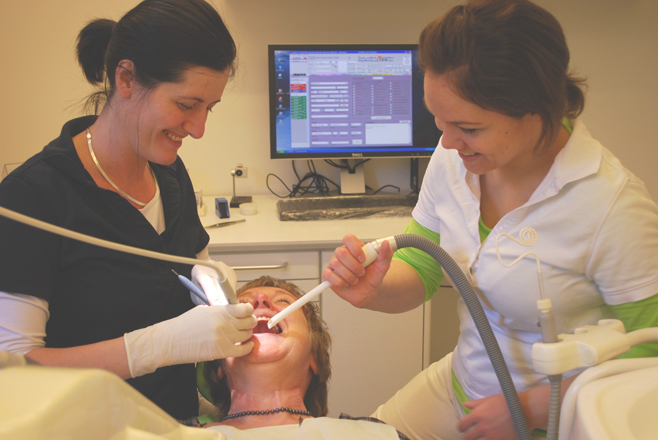
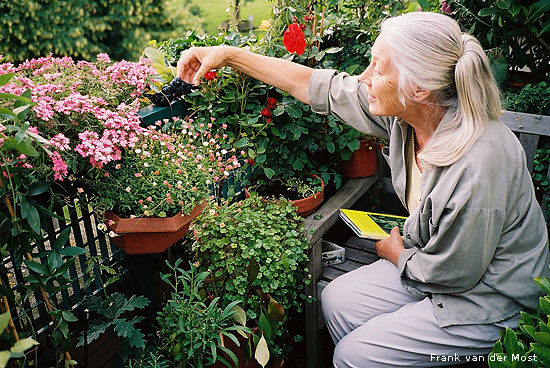
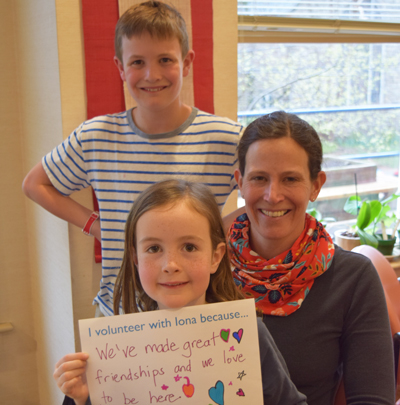
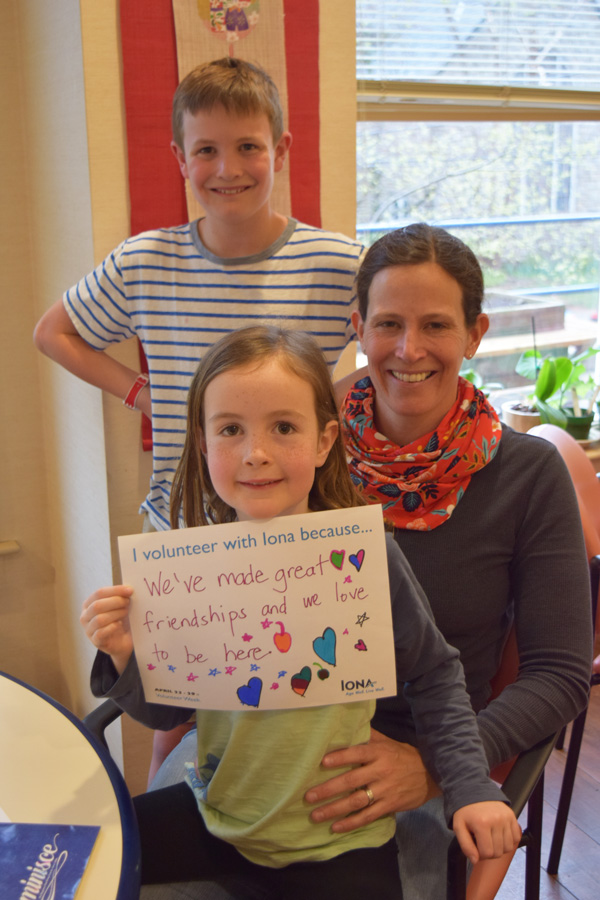
Tracy volunteers in the Wellness & Arts Center with her son, Max, and daughter, Nina.
We at Iona are thankful for all of the wonderful volunteers who make an impact on our organization each and every day. In the spirit of National Volunteer Week, we invited Iona volunteer Tracy Kroloff, who volunteers in the Wellness & Arts Center, to share how she has given back to the Iona community.
Q. When did you first start volunteering with Iona?
I started volunteering with Iona with my kids, Max and Nina, after Max came to visit with his first grade class at the National Presbyterian School. That was in the spring of 2013. I have volunteered with them since and have also started coming in on my own.
Q. How did you hear about us?
I used to live in the neighborhood, my kids go to school nearby, and we still live nearby.
Q. Why did you decide to give your time to Iona?
The people at Iona are wonderful — all of the staff and the participants and the families involved. I also think it is important to spend time with others to appreciate different perspectives and situations. That aspect has been very helpful for my children.
Q. What have your experiences been like volunteering with Iona? Do you have any favorite stories or memories to share?
When we visit, we often sit and chat, or color, or put a puzzle together. I have started reading stories as well. In the summer, my kids and I lead an exercise group in the morning often followed by dancing to the song YMCA. Sometimes the kids get to visit with one of the participant’s dogs, which they very much love. It is always enjoyable. I wasn’t there when my son Max recently visited with his fifth grade student council peers. I heard that the participants cheered on his arrival. That is my favorite story.
Q. Why is volunteering important to you/your family?
As I mentioned, I think it is extremely valuable to take the time to step outside of one’s own experiences and to gain some perspective of the experiences of others. We also always feel so happy and loved and full of love when we leave Iona. It is an incredibly valuable time for us.
Q. Why should others volunteer for Iona?
For all those reasons I just mentioned!
If you are interested in volunteering at Iona, read more here and then contact our volunteer coordinator at volunteer@iona.org.
Are you an Iona volunteer? We’d love to hear from you! Share your story in the comments.
Everyone has a story — a family, a life’s work, interests and avocations, a personal history. These stories, and the smiles that often come with them, are one of the things that keep me coming back to Iona Senior Services, where I’ve volunteered weekly since the fall of 2016.
Part of my role as a volunteer in Iona’s Wellness & Arts Center adult day health program is to greet the participants and talk with them as they settle into their day at Iona. As we visit, they sometimes talk about who they are and the interesting paths their lives have taken.
One man shared that he’ll turn 90 years old this month. He’s told me about his past work managing large construction projects nationwide, his love of Irish music, and a visit to Belfast with his son. He has also reminisced about growing up on Long Island and surprised me by listing— in quick succession — all of the rail stops on his long-ago commute to Manhattan!
One woman told me happily about meeting her husband when she was a young person working in San Francisco, and an often-silent elderly gentleman told me quietly one morning a little bit about his childhood and his career with the NAACP Legal Defense Fund.
Another participant is an encyclopedia of facts about Motown and other music. He can’t see, but he can tell you which musician released just about any song he hears, and he can tell you all about popular Washington area radio DJs over the years.
Not all participants in Iona’s Wellness & Arts Center are able or choose to talk about themselves and their lives, but I’m sure they all have rich and diverse life stories they could tell.
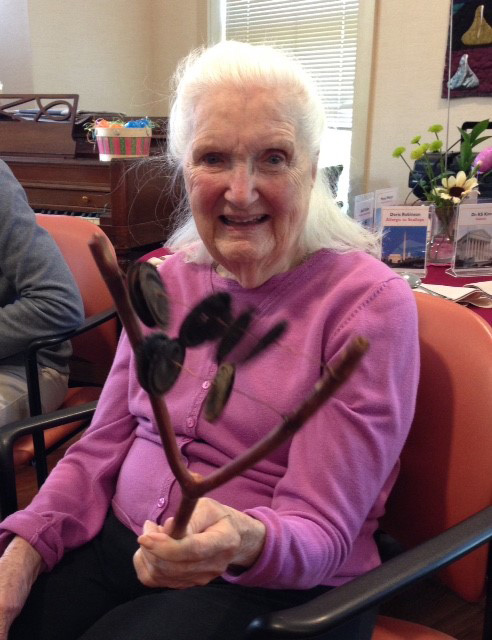
While volunteering at Iona, I’ve had the good fortune to observe a program led by Phillips Collection art gallery staff who regularly visit the Wellness & Arts Center. During the program, they show slides of paintings by famous artists, using the images to engage program participants in lively — and sometimes surprising — conversation about what they see in the art and the feelings the art evokes. Recently, they enhanced the experience by bringing along a few soothing sound makers, including one made simply of a Y-shaped wooden stick, a wire, and some old bottle caps. Here’s a photo of one participant, whose eyes and smile lit up in an amazing way when she took the instrument in hand!
Having the opportunity to talk with volunteers, staff, and other seniors — in addition to accessing many services — is a vital part of participants’ experience in the Wellness & Arts Center.
Making that kind of connection with others, even if briefly and in small ways, is one of the gifts we can both give and receive while volunteering at Iona.
My volunteer experience at Iona has helped me think about how we interact with older adults, especially those with cognitive or physical impairments.
Based on this experience, here are some tips that could help other volunteers make the most of conversations with elders.
10 Tips for Volunteers Connecting with Older Adults
Greet the older person and introduce yourself as a volunteer.
Sit or kneel so you’re at eye level if someone is seated.
Look at the person and make eye contact unless doing so seems uncomfortable for the older person.
Listen carefully.
Speak clearly and loudly enough for the person to hear you.
Be patient.
Show compassion and respect.
Avoid making assumptions about the person and what he or she wants.
Make requests using “I,” “we,” “let’s,” or “it” instead of “you.” For example, say “Let’s sit at the table” instead of “You need to sit at the table.”
Smile!
It’s National Volunteer Week! Get involved with Iona by contacting our volunteer coordinator at volunteer@iona.org. Already a volunteer? We’d love to hear from you! Share your story in the comments.
By Susan Farrer
Susan Farrer is an artist, writer, and former deputy project director with the National Institute on Aging’s Information Center.
The Junior League of Washington helps to organize toiletry and other product drives for our older neighbors.
Over the next 30 years, the United States is expected to experience considerable growth among its older adult population. In 2050, the population aged 65 and over is projected to be 83.7 million, almost double its estimated population of 43.1 million in 2012, according to the U.S. Census Bureau.
It is more important now than ever to learn about the organizations within your community that support older adults, especially as the population continues to age. You’ll never know when you might need help or care for your grandparents, parents, family, and friends.
One of the many reasons I have spent more than 3 years volunteering with Iona Senior Services is that its services are so vital to our aging neighbors in the Washington, DC community.
My volunteer experiences with Iona have been extremely rewarding and fulfilling, as I am able to help seniors who would otherwise not be able to prepare meals for themselves or be able to afford private in- home services.
I first learned about Iona through the Junior League of Washington (JLW), which recently celebrated a 25 year partnership working with Iona. I am so grateful for this collaboration!
Through this partnership, I’ve been chairing the relationship between Iona and JLW. I am responsible for organizing Saturday morning meal deliveries, participating in Iona’s Friendly Visitor and Grocery Shopping Programs, and organizing volunteers for the Meet the Artists receptions and toiletry drives.
My favorite part about volunteering is the Saturday morning meal delivery. This is when I really get to see the impact I’m making in the community and how I’m helping to change lives. There have been many amazing moments for me on my delivery trails.
Clients often ask me about the weather, invite me in to chat and a share a cup of tea, or thank me for helping their friends. However, not all of the older adults in the meal delivery program are as cheerful. For many, my Saturday morning visit might be the only interaction they have the whole day. Many also have a hard time moving and taking care of themselves. Others are lonely or ill.
Meeting these Iona clients and hearing their stories, as well as seeing firsthand the many challenges older adults face in the District, has been such a valuable experience for me.
I have found a new perspective, and connected with a community I wouldn’t otherwise engage with.
Iona is one of the best senior services organizations in the Washington, DC area. Their mission and work directly impact over 3,000 seniors and caregivers in the area. As the older population continues to age, it is my goal to continue volunteering with Iona to help seniors have access to food and better help them age in place.
Want to give back to your older neighbors? Contact our volunteer coordinator at volunteer@iona.org to learn how you can join our community of care. Learn more about volunteering opportunities by visiting our volunteer page here.
By Kristen Lively
Kristen has been an Iona volunteer for three years through the Junior League of Washington. As a volunteer, she helps to coordinate Saturday meal delivery, toiletry drives, and other events.
If my Human Services and Social Justice major is any indication, I have long had a love for working directly with others and serving the community.
Throughout my time at George Washington University (GW), I have volunteered every semester, both because I love it and because I’m required to fulfill service learning requirements for my major. After volunteering for two semesters with children of different age groups at the School Without Walls at Francis-Stevens, I started to realize that working with children wasn’t exactly my forte.
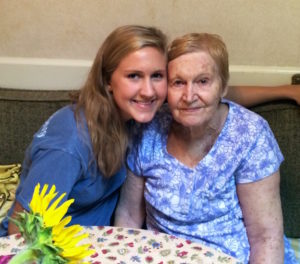
Ali Perry (left) volunteered with Hospice in honor of her grandmother. This experience would eventually lead her to Iona.
During my second semester working at the school, my grandmother’s breast cancer diagnosis began to accelerate at a frightening pace. We lost her in December: she passed peacefully in her own home, comforted by my family and the in-home hospice care professionals who had helped her so much throughout her battle with cancer.
Forging connections through Hospice
Seeing the incredible impact that my grandmother’s nurses and doctor had on her life, especially towards the end, inspired me to volunteer with hospice patients the following semester.
I started volunteering at VITAS Healthcare, a hospice healthcare center located in Northeast DC. From the very start, working with hospice patients was very emotionally exhausting for me.
I thought it would comfort me to work with these patients and know that I could possibly make an important impact on them, just like hospice care did for my grandmother. But, it was incredibly hard for me to look past all of the loss and pain. I became very close to the wife of one of the patients I visited with regularly, and became a source of support to her as she watched her husband with Alzheimer’s slowly fade away.
Lessons on Aging
It wasn’t as much through working with the hospice patients themselves, as it was providing support to their spouses, that made me realize my passion for working with older adults.
I found such genuine and candid connections with the older women I became close to during my weekly visits, learning a great deal about them and the world they have seen evolve so much within their lifetimes.
One of the women I visited with often described aging as “a world of opportunities,” an idea that has stuck with me, especially since it came from someone who had so much taken away from her by her husband’s cruel disease.
Continuing on with my service learning at GW, I knew I wanted to work with older adults, though I didn’t think I could continue to work in the hospice capacity for a handful of reasons.
One of my professors at GW first introduced me to Iona, urging me to do some research on the organization as it provided innovative care to older adults in DC, as well as helped them adjust to both challenges and opportunities of aging.
Finding my way to Iona
From my first day as a volunteer at Iona’s Active Wellness program at St. Alban’s, I was instantly drawn in by the eclectic group of participants. I made countless valuable connections with older adults at St. Alban’s, and often times stayed late just to have a chance to talk to them longer. There is so much to be learned by talking with older adults, especially at my age, because we both have such different perspectives of the world and have so many contrasting experiences.
I left each day at St. Alban’s feeling like I had learned something new, made an impact on the lives of others, and shown appreciation to a generation that is so near and dear to my heart. I volunteered at St. Alban’s through December, and even after finishing my last semester of required service hours, I wasn’t ready to say goodbye to Iona. So I decided to seek an internship at Iona’s main office, where I now work as a Communications and Marketing intern.
Despite the many hurdles it can and often does present, aging provides so many different opportunities to continue to learn and grow as an individual. This is the core of Iona’s mission, an organization that strives to provide older adults with resources and support to face some of life’s most difficult challenges, as well as appreciate and take advantage of opportunities.
As a hospice volunteer, I heard that aging opens a world of possibilities. Two years later, Iona has shown me how true that statement really is.
Becoming a part of Iona’s family as a volunteer and intern has broadened my community and introduced me to incredible and talented older adults, staff members, and other volunteers.
As this week is National Volunteer Week, why not celebrate by giving back to your community? If you are interested in volunteering at Iona, I encourage you to read more here and then contact our volunteer coordinator at volunteer@iona.org.
Are you an Iona volunteer? We’d love to hear from you! Share your story in the comments.
By Ali Perry
Ali Perry is a Communications and Marketing Intern at Iona, and a former volunteer at our Active Wellness Program at St. Alban’s. She is a senior at The George Washington University studying Human Services and Social Justice, and intends to pursue a career in Nonprofit Management.
When it comes to planning for your future, it seems like there’s never enough time to make it a priority — until you’re facing a health crisis.
Unfortunately, we hear far too often from family caregivers that they wish they had prepared earlier, started the difficult conversations sooner, or discussed their loved one’s wishes before it was too late.
Imagine for yourself, too, this unthinkable situation: you’re taken unconscious to a hospital, needing life-saving medical care, but are unable to tell your physician what treatment you want. What would happen? And how can you prepare now?
Completing a healthcare advance directive is a good place to start.
Healthcare advance directives are legal forms where you can share your future healthcare and end-of-life care preferences with medical professionals and loved ones. These forms may include living wills and/or powers-of-attorney (sometimes called proxies).
They typically contain information on your specific medical preferences, including aging-in-place or legacy preferences, and your assigned trusted individual for any healthcare decision-making, if you are no longer physically or cognitively able to make such decisions.
Starting the conversation
Another important aspect of healthcare advance directives is actually having the conversation with your loved ones. Arguably, for some, sharing your thoughts with family or friends can be even more difficult than considering the medical- and end-of-life care you may want in the future!
Fortunately, there are many resources available that can help guide these discussions and ease your anxieties.
Ready to take the next step? Here’s where you can find forms.
Free (state-specific) forms are available from the National Hospice and Palliative Care Organization here. Low-cost forms (valid in multiple states) are available in various languages from Aging with Dignity here.
Do I need an attorney?
While health care advance directives may be completed with or without an attorney’s assistance, if you have concerns that are not addressed in these online templates, you might consider consulting with an attorney to draft something customized. An attorney can also help answer any specific legal terms or issues.
Looking for other resources to get you started?
There are a number of resources to help make, discuss, and document future healthcare wishes and decisions. Some include:
Aging With Dignity (Five Wishes)
The Five Wishes document is a document that helps people express their medical and legal wishes, but also spiritual and personal. Five Wishes can also help guide family conversations and provide valuable information to family, friends, and your doctor about what good care means to you. The advance directive meets the legal requirements in most states and is available in 20 languages for a fee.
DeathWise
Deathwise is a nonprofit organization that helps people talk about, make decisions, and plan for the end of their lives. Their website includes resources to help you organize financial records, make healthcare decisions, and plan memorial services, among other important topics.
Finally, if you’re looking for a good motivator to start your advance healthcare planning, why not today – the official beginning of National Healthcare Decisions Day (NHDD), a weeklong event to educate and empower the public about the importance of advance care planning.
This week, NHDD has a dedicated schedule to guide and empower you in your healthcare decision making. Take a look here for more information on NHDD and their resources.
Do you already have an advance directive care plan? Let us know in the comments how you started planning (and if you have other resources to share).
By Rosie Aquila
Rosie Aquila is Iona’s Communications and Marketing Manager. In her role, Rosie works to share diverse stories from Iona’s team, clients, partners, donors, volunteers, and other community members. A graduate of Kenyon College, Rosie joined Iona’s team in 2014.
When I decided to make dentistry my career many years ago, I looked forward to having my own business that could utilize skills I would learn and develop over time.
What I didn’t appreciate then was that I was embarking on a long-term journey with my patients’ lives. I would get to know individuals and families over decades, watching them grow from youth to middle age, and from middle to old age. It was a privilege to be a part of their team of health care providers, and to get to know them through their transitions.
As my patients aged, some of them began to lose the ability to adequately take care of their oral hygiene needs.
For some, their lack of manual dexterity inhibited effective tooth brushing and flossing. They were sometimes on multiple medications that gave them dry mouths and this lack of saliva, besides being uncomfortable, caused a rapid increase in cavities.
The change in the bacterial population in their mouths due to these changes made them susceptible to infections, loose teeth, tooth loss, and a host of other problems. In general, with some extra measures, these expected changes with aging can be limited and controlled.
But what I was not prepared for was the dramatic downturn in their oral health that too often occurred when my patients entered long term care facilities (LTCF). Patients would come to my office for their appointments, accompanied by their adult children or other caregivers, and I would be disheartened to see many loose teeth, multiple deep cavities, fungal infections, and dental appliances that clearly had not been cleaned or even removed for weeks. Why was this happening?
The answer, I have found, is that the oral care of older adults and other residents in LTCF is often inadequate.
The reasons are many:
Many older adults lose or have a reduced ability to self-care.
There is no real standard of care for oral care in LTCF.
Each resident requires a personalized program for their individual oral care. Most LTCF, however, do not have certified nursing assistants (CNAs) adequately trained to provide this care.
Family members are not educated in the oral care needs of their relatives. Because of this lack of education or awareness, they can’t recognize problems or effectively monitor the care that is given.
In truth, oral care has long been an underappreciated component of older adults’ general health.
The challenges of decreasing mental and physical abilities, along with a lack of understanding and education, create a situation for neglect.
The results can include:
An increase in the likelihood of aspiration pneumonia.
An increase in the incidence of diabetes.
Mouth pain.
Weight loss due to an inability to properly chew food, and the accompanying digestive problems.
A decrease in socializing due to appearance, mouth odors, etc.
As has been abundantly reported, the population of older adults is continuing to increase as a percentage of our nation’s population. In addition, we are living longer. This is good news, especially if our attitudes on maintaining our capabilities evolve with these realities.
Thankfully, there is an emerging recognition of this in the dental profession. The American Dental Association, dental schools, nursing schools, governmental agencies, and others are developing standards of care and are conducting oral care programs in LTCF. These efforts are just getting off the ground, and public awareness is an important component of success.
Since my retirement last year, I have been a member of the District of Columbia Dental Society Foundation. We are developing training programs for the LTCF in DC. Our goal is to educate these facilities in the best practice standards of oral care for their residents and work with them to develop programs that will work for them. We also want to provide families and caregivers the information and tools to partner with their LTCF in caring for their loved ones.
Visit Iona’s blog again for a future post on oral care advice for family members and caregivers.
By Sal Selvaggio, DDS
Sal Selvaggio received his Doctor of Dental Surgery (DDS) degree from Georgetown University and completed a General Practice Residency at Providence Hospital in DC. He had a private practice in general dentistry for 36 years. He has been a volunteer dentist at Catholic Charities’ Spanish Catholic Center for 32 years and currently chairs a committee for the District of Columbia Dental Society Foundation exploring ways to improve the oral health of our aging population.
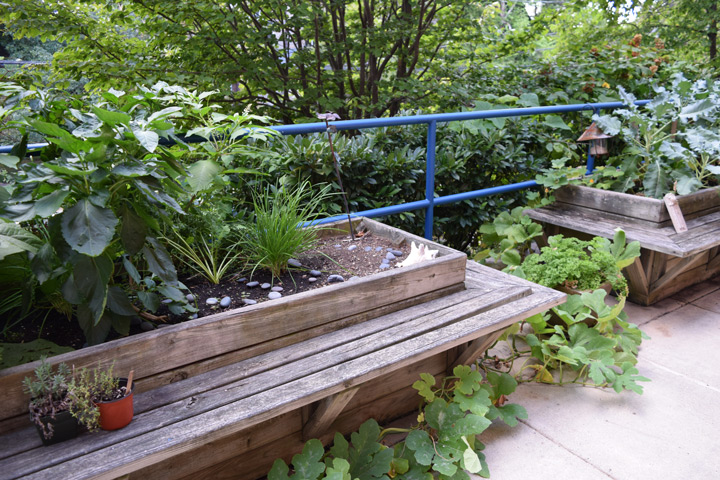
The Wellness & Arts Center’s “Wellness Gardens” use compost from Iona’s own food scraps and paper clippings.
Last fall, Iona’s Food Access Coordinator Ashlea Steiner restored the raised beds in the Wellness & Arts Center and launched our very own “Wellness Gardens.” Though gardening has always been a part of our enriching adult day program, it was difficult to stay on track with the upkeep for maintaining our raised beds. But, with Ashlea’s help, today the Wellness Gardens feature nutrient-rich soil (we’re even composting at Iona!), tomato cages, a special storage bench, and seat cushions for our older participants.
Best of all? We enjoyed a bountiful harvest of cucumbers, beans, pumpkins, strawberries, tomatoes, basil, carrots, chives, eggplant, bell peppers, lettuce, broccolini, kohlrabi, parsley, mint, and beets.
Participants helped plant the seedlings that grew in our sunny windowsills throughout Iona from January – May, and enjoyed special food demonstrations, nutrition education, and tastings of the fresh produce during their harvest. And, we’re happy to report that the garden will continue to blossom this year. In fact, we even have 50 gallons of dark, moist, and nutritious compost made from Iona’s own food scraps, paper shredding, and yard waste to fertilize our beautiful gardens.
When You Garden, You Grow!
Did you know that April is National Garden Month? It’s a time for communities, organizations, and individuals to come together and celebrate gardening and all of its benefits — from health and nutrition to a greener and more liveable space.
And what better way to celebrate National Garden Month than by starting your very own compost. We did it at Iona, and we know you can do it too.
Composting is a great and simple way for you to improve the growth and vitality of your garden, increase nutrients in your soil, and benefit the environment. What’s more, composting is an easy, responsible way to dispose of your food waste, and it’s completely free.
How can composting benefit me and my garden?
Enriches and conditions soil
Allows for recycling kitchen and yard waste
Introduces beneficial nutrients to the soil
Is a natural alternative to chemical fertilizers
Is good for the environment
Reduces landfill waste
Composting introduces vital nutrients to soil that help increase plant growth and the health of the surrounding environment, by cutting down on landfill waste.
What steps can I take to begin composting?
At Iona, we started our composting by filling coffee cans with food scraps. There are many ways that you can get started with composting. Some simple steps include:
Start compost pile on bare earth, or in a trash barrel (helps with critters!)
Lay twigs and straw first
Add compost materials in layers
Add manure to compost
Keep compost moist
Cover compost with wood or plastic sheeting
Turn compost pile every few weeks
What can I compost?
While most food waste can be composted, certain items such as meat, bones, or fish waste can attract pests. Additionally, some fruits and other vegetables can hold traces of disease and pesticides, which can be risky when using compost soil to grow food. Still, there are many foods, organic materials, household items (like newspapers), and even weeds that can make for good compost.
Nurture your garden, and nurture your soul this April: get out there and start composting today!
Have you started composting in your home or office? Let us know your tips for starting this environmental-friendly process in the comments below.
By Ali Perry
Ali Perry is a Communications and Marketing Intern at Iona, and a former volunteer at our Active Wellness Program at St. Alban’s. She is a senior at The George Washington University studying Human Services and Social Justice, and intends to pursue a career in Nonprofit Management.
Matilda Davis worked for the DC government for 18 years. When she retired, she didn’t receive as much money as she thought she would get, so she planned to pick up some work on the side. But then she had a stroke, which left her unable to stand to cook or go to the grocery store.
Today, she gets home-delivered meals through Iona Senior Services that give her peace of mind. In her words: “I don’t have to think, ‘What if I can’t get someone to go to the store for me?’ because I have the food here.”
As a national debate rages over funding for Meals on Wheels – the popular national food delivery program – I am reminded of the many people like Matilda Davis who I have met since I began working at Iona more than 30 years ago.
Angela Mejia de Lopez has trouble cooking because of her impaired eyesight. Iona’s home-delivered meals have been a safety-net for her.
People like Mrs. de Lopez, who at 88 has trouble cooking because of her impaired eyesight. Or Mr. Gaymon, who received home-delivered meals from Iona after two heart attacks and knee replacement surgery.
Many of our clients are fiercely independent.
They are people who have worked for many years, often for the government, raised their children here, entertained friends, and enjoyed all our community has to offer. The last thing they thought they’d have to do is to ask for a hot meal.
Home-delivered meals have been an integral part of our service to the community for 27 years. Through the support of the DC Office on Aging, Iona offers nutritious and well-balanced hot and cold meals to older adults 60 and over.
Last year, 220 older adults received 45,506 meals from Iona. Many recipients live alone and most make an income that places them close to if not below the poverty level. It’s not unusual for Iona’s social workers to meet with seniors who, after the rent and bills are paid, have less than $100 left to buy food – for the entire month. In fact, more than 15,000 seniors living in the District – approximately 15 percent of the senior population – are living in poverty. Thousands more struggle to cover housing costs, medical care, and still pay for food on a fixed income, according to D.C. Hunger Solutions.
Home-delivered meals is a proven way to address hunger insecurity.
They “improve diet quality and increase nutrient intakes among participants,” according to a 2014 scientific study. And home-delivered meals are proven to be cost-effective, since keeping older adults in their homes is less expensive than nursing home care.
The need will only grow as the Baby Boomers age. According to Feeding America, “In 2040, there will be 79.7 million older adults, more than twice as many as in 2000. These changing demographics will have profound impacts on the demand for social services, especially the need for adequate and culturally-appropriate nutrition services.”
Closer to home, multiple public and private agencies cite an increased demand for senior food assistance in the face of flat or declining resources of lower and middle class residents, coupled with rising food prices. Food security is an ongoing challenge for the 14.5 percent of the District’s senior population living below the federal poverty line and for many more in the next higher income tiers. Nearly 10 percent of all District seniors, regardless of their income level, were worried about food running out sometime in the preceding year, according to the 2010 U.S. Census report.
Like many isolated older adults I’ve met over the years, Ms. Davis needs home-delivered meals to survive.
There are many ways we can support our older neighbors. Providing those in need with a reliable source of nutritious food is a good place to start. It’s the least we can do.
By Sally S. White
Sally S. White is executive director of Iona Senior Services and co-chair of the D.C. Senior Advisory Coalition.



 From my first day as a volunteer at
 Unfortunately, we hear far too often from family caregivers that they wish they had prepared earlier, started the difficult conversations sooner, or discussed their loved one’s wishes before it was too late.