Meet Leon Paparella: Parkinson’s Support Group Facilitator

My last blog post about Parkinson’s Disease Awareness Month gave you information and resources about Parkinson’s disease. The Parkinson’s Foundation’s theme for this year’s Parkinson’s Awareness Month is “Start a Conversation.” Earlier this month, I had the privilege of starting a conversation with Leon Paparella, M.S.W., CGP, who leads Iona’s weekly Parkinson’s disease support group.

Leon’s Experience

To speak to Leon is to hear him draw from decades of experience in group psychotherapy as well as in Parkinson’s disease advocacy. Leon has worked in mental health since 1969. When he received his Parkinson’s diagnosis in 1987, his history and skills in group psychotherapy made him uniquely able to support and advocate for others with the diagnosis.

Besides his support group at Iona, Leon runs several other support groups in the DMV, teaches at the Walter Reed Hospital and the Washington School of Psychiatry, runs a private practice, and writes articles and blog posts. One such article, “Group Psychotherapy and Parkinson’s Disease: When Members and Therapist Share the Diagnosis,” was published in the International Journal of Group Psychotherapy in 2004.

Parkinson’s Support Groups

Several of Leon’s Parkinson’s groups, including Iona’s, are offered in partnership with the Parkinson’s Foundation of the National Capital Area, where Leon has served as Support Group Specialist since 2001. Leon emphasizes that while many other organizations focused on Parkinson’s disease use their funding for continuing research on the disease, the Parkinson’s Foundation of the National Capital Area uses its funding exclusively for ongoing services. This ensures that DC area residents with Parkinson’s have access to free services, such as exercise classes, support groups including those Leon runs, lectures and symposia, and more.

Currently, Leon runs five support groups for people with Parkinson’s disease and for care partners. Meetings are typically held at churches or at community centers or agencies such as Iona. Some of Leon’s groups have been going for almost two decades, though the members vary over time. Leon’s group meetings do not have set topics or goals. He “leads by following”, listening to the thoughts and comments members bring to the group and reflecting them back for discussion.

Challenges and Triumphs

This is not easy work. Leon says the biggest fear among group members is the risk of developing cognitive and executive function issues. Not everyone with Parkinson’s develops these, but they become more common with age. For Leon, as his own Parkinson’s disease progresses, the worry of “Can I do this?” persists, but he says he is lucky to have colleagues who listen to and support him.

And the work itself is immensely gratifying. The best part of the job, for Leon, is the satisfaction he receives by doing this extremely important and worthwhile work. He is known and valued in both the group therapy and Parkinson’s disease communities, due to his unique position as a group psychotherapist with Parkinson’s. Leon is able to bridge the gap between the professional communities focused on chronic medical conditions and psychotherapy and mental health, bringing “mind” and “body” together.

Iona is very lucky to have Leon’s expertise and support. For more information on Parkinson’s disease and Parkinson’s Awareness Month, take a look at our previous blog post, or contact Iona directly at (202) 895-9448.

By Indy Weinstein.

Indy Weinstein is an intern at Iona. They graduated from St. Mary’s College of Maryland last year with a BA in History, and are excited to learn about nonprofit management and aging. 


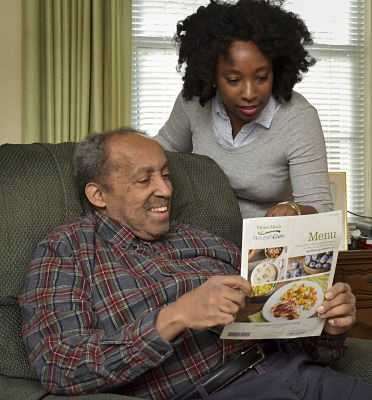
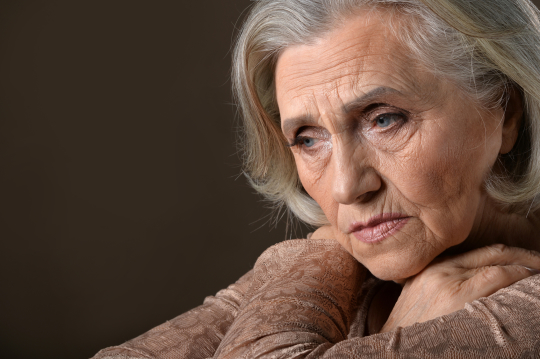
Photo courtesy of former support group participant John Schappi’s blog “Aging and Parkinson’s and Me.” John was diagnosed with Parkinson’s disease in 2009, at age 90. He wrote, “My diagnosis with Parkinson’s Disease in September 2009 at age 80 gave my life a new focus and challenge. Finding ways to meet this challenge helped make 2010 the best year of my life. I hope this blog will be a place where I can connect with others who also are dealing with aging and its afflictions and attractions so that we can share our ‘experience, strength and hope.'” John passed away on February 21, 2018.
Marina Quijano: I do this work with all my heart

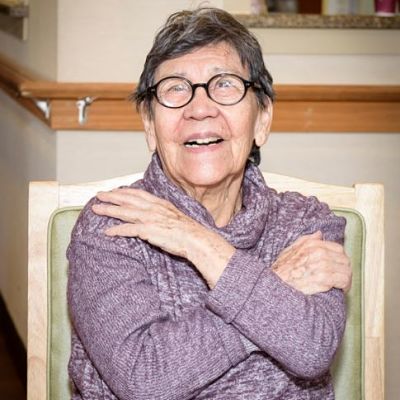
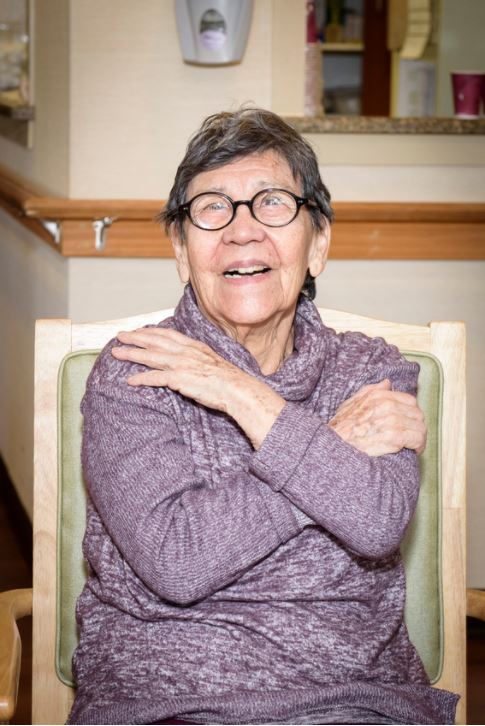
Marina Quijano is independent and headstrong. She is also humble and generous.
Marina left her native Colombia in 1949 in the midst of that country’s bloody civil war to join her parents in Washington, DC.

“In Colombia, she was never expected to work,” says her brother Peter, a New York-based attorney. She was expected to get married and raise a family.

But Marina had an independent streak. Instead of a more traditional role, she landed a job in the District with a local real estate company. She threw herself into her career and rose to a management position. She never married or had children. Her colleagues became a second family. In 2011, she retired at age 84.

Now 90, Marina still goes to “work.” But instead of going to an office, she goes to Iona’s Wellness & Arts Center, an adult day program for older adults with dementia, Parkinson’s Disease, and other chronic conditions.

“She’s worked for 60 years,” says Peter. “It’s what she knows how to do. Iona provides something no one else can: a safe and supportive place where Marina has a sense of self-worth. That’s something all of us want—no matter how old we are.” In addition, Peter says, it gives him peace of mind to know she is in a safe, supportive environment. At Iona, Marina dresses the same way she did when she went to the office, always with a purse to complete the outfit.

“I’ve seen a real change in my sister since she started at Iona,” says Peter. “Once again, she has a purpose. I noticed it almost immediately after she…I was about to say ‘started working there.’”

“Marina likes to feel needed,” adds Sharon O’Connor, director of the Wellness & Arts Center. “She is happiest when she is doing something helpful. So we put her to ‘work.’”

Marina helps “lead” exercise classes and clears the tables after lunch. In addition, since Marina was trained in Colombia as a classical singer, the staff frequently invites her to share a song. She recently performed the national anthem at Iona’s Celebration of Achievement, an annual Wellness & Arts Center program that recognizes participants’ accomplishments.

“We talk about a strength-based program,” says Sharon. “What that means is we figure out what makes people tick, what brings them joy. We figured out right away what brings Marina joy: helping people.”

“Every time I step foot in this place it’s like stepping foot in heaven. I do this work with all my heart,” says Marina.

Gregory Shadley: Iona is the friend that’s always there

Gregory Shadley had an eclectic career—first in the medical field, then at Tower Records, where he combined work with his passion for music, and finally as the sacristan at Georgetown University, responsible for the altar, vessels, and vestments used by the priests.

It’s at Georgetown where he started having health issues. It’s a long, scary list that includes diabetes, a pulmonary embolism, and, more recently, multiple strokes. He’s 62.

Gregory’s been fortunate to have had stable housing for 12 years. But, his basement apartment can only be accessed by eight steps. In order to get his groceries down the steps, Gregory has to move the bags slowly, one at a time, so he doesn’t lose his balance. In the past year, he’s had five falls that resulted in head trauma.

Clearly, living in an inaccessible basement apartment is not ideal. Gregory receives government disability benefits. But after paying rent and basic necessities, there is little left over. “When I was younger, I never imagined I’d go on disability. I never imagined I’d retire early because of my health. I was completely blindsided.”

However, when he counts his blessings, he starts with Iona.

Feeling overwhelmed by his health, housing, and financial challenges, Gregory reached out to Iona. Right away, Iona assigned a case manager to help Gregory navigate the complex world of local and federal benefits—many of which he didn’t know he could get.

With Iona’s assistance, Gregory applied for food stamps, a reduced Metro fare card, a rental rebate, a home health aide, a DC identification card, and a free “Safelink” phone. (When he had previously fallen, there was no
way to call for help because he couldn’t afford a phone.)

In addition, his case manager told him about the subsidized apartments for seniors at St. Mary’s Court in Foggy Bottom and helped him fill out an application.

The waiting list is long, but he’s willing to wait for an accessible apartment. Gregory feels it’s the best option. It will bring his rent down considerably and he won’t have to navigate any steps to get to his apartment.

“Without Iona, I wouldn’t have known about St. Mary’s Court—or how to apply,” he says. “Iona is the friend that’s always there.”

William Reid: I should have learned to cook


Back in 1976, when William Reid and his mother bought a three-bedroom house in the District’s leafy Chevy Chase neighborhood, he imagined living there with his future wife and children—maybe even a son who would carry on the family name. But that was not to be.

Instead, 41 years later, William lives alone. After a long career as a regional economist at the U.S. Department of Commerce, he took early retirement because of health challenges. His mom, who for many years cooked his favorite dishes—like pork and beans, sautéed liver, and homemade cakes and pies—passed away 20 years ago.

His debilitating psoriatic arthritis (the same thing professional golfer Phil Mickelson has) makes shopping and cooking difficult, if not impossible. He’s had both knees and both hips replaced and lived with club feet since birth.

Having given up driving a year ago, William’s world is shrinking. On a good day, the 74-year-old moves from his living room to the adjacent porch to use his computer, which serves as a lifeline to the outside world. He rarely leaves the house.

“I should have learned to cook,” he admits. “But I was an only child and my mother spoiled me.” Immediately after her death, William resorted to eating breakfast at McDonalds, going to the local food court, and ordering take-out Chinese food or pizza. He taught himself to use the microwave to heat up frozen meals. As a result, he gained weight, developed diabetes, and blood clots. That was a low point.

The high point was learning he was eligible to receive home-delivered meals through Iona. In partnership with the DC Office on Aging, Iona arranges for the delivery of 10 nutritious meals to his door every other Friday. (William supplements that with food delivered by a local grocery store.)

Older adults are particularly vulnerable to the effects of poor nutrition, hunger, and food insecurity. Last year, 220 older adults received 47,292 meals through Iona. Like William, many of the recipients live alone.

“The meals are healthy, there’s good variety and, most importantly, they taste good,” William says. His favorites include the apple-walnut oatmeal breakfast and the home-style meatloaf dinner. In addition, every Saturday an Iona volunteer delivers a hot meal ready to eat and a cold meal for later in the weekend. “Sometimes parents bring their children to the door: he says. “It’s wonderful to see a cheerful face on a Saturday morning! I don’t think they have ever missed a Saturday.”

Zelda Kapner: Iona has your back


Zelda Kapner, 85, never found her soul mate, but she did find Iona. As a regular participant in Iona’s Active Wellness Program at St. Alban’s, she has made friends; gets a daily dose of exercise, current events or culture; and enjoys a midday meal.

She’s not alone. Each weekday, 35 or more men and women gather for conversation, an activity, and a meal. Her lunch table is a mix of new and returning participants. There’s Sarah, who’s been coming for five months. Recently “retired,” she works two days a week for a former ambassador. Alec is a retired psychotherapist. And Sherry, who has been coming for nine years, is an artist. “I belong to a gym,” she says, “but—in contrast to Iona’s program—I find it lonely going there because I don’t know anyone. Iona is an entirely different experience.”

Zelda agrees. A native of New York, she came to the District in 1973 to work at a national women’s organization. She found a rent-controlled apartment in Foggy Bottom, where she’s been ever since. “I know a good thing when I see it,” Zelda says.

She could just as easily be referring to Iona.

When Zelda retired at age 67, she recalls the words of a dear friend: “Make sure you have something to do every day.”

At Iona’s Active Wellness Program, “you meet the most interesting people who have the most interesting lives,” says Zelda. “Iona broadens your universe.” Beyond the participants are the many high school students who volunteer their time, young people who “give you faith in the future,” says Zelda.

While Iona enlivens Zelda’s social life, “it also has my back,” she says. Zelda has instructed her niece—who is executor of her will—that the first call she should make in the event of a crisis is to Iona. “I had a friend living in a group house where the landlady was taking advantage of her,” recalls Zelda. “I referred her to an Iona social worker who helped her find new housing. Iona saved her life.”

Of her own experience, Zelda says: “If I wake up and think, ‘another boring breakfast,’ all I have to do is head to Iona, which makes me smile.” Zelda and other participants credit program manager Courtney Tolbert, who, in Zelda’s words, is not only a creative and effective leader “but has a big heart.”

Parkinson’s Disease Awareness Month 2018: Resources for You

April is Parkinson’s Disease Awareness Month. Whatever your personal relationship with Parkinson’s is, this April is a good time to brush up on your knowledge of the disease.

Parkinson’s disease (PD) is a neurodegenerative disorder, affecting dopamine-producing neurons in the brain, affecting at least one million people in the United States alone. It most commonly affects people over 60, but can be diagnosed as young as 18. There is no absolute test for detecting PD, and its causes are mostly unknown. Common symptoms include:

• Resting tremors
• Slowness of movement (bradykinesia)
• Rigid limbs
• Difficulty with standing, walking, balance, and coordination
• Cognitive impairment, difficulty with multitasking or concentrating)
• Mood disorders
• Difficulty with speech and swallowing
• …and other diverse symptoms, not all of which are visible or present all the time.

There is no one treatment for PD, so treatment focuses on each person’s symptoms and experience. Various medications are available to manage or minimize symptoms, although none exist yet that can reverse symptoms entirely. Individuals with PD can also try surgical therapies such as deep brain stimulation if medication proves ineffective. On the other hand, some individuals see improvement through lifestyle changes such as getting more rest and exercising.

Iona offers a Parkinson’s Support Group, meeting at Iona every Friday from 11 AM – 12 PM, available to individuals with Parkinson’s (not caregivers). The group is free, and pre-registration is required. Call (202) 895-9448 for more information.

Additionally, thanks to a grant from the Parkinson’s Foundation Moving Day DC, Iona is able to offer “Stay Moving with Parkinson’s Disease,” a free community exercise class for people with Parkinson’s Disease and their caregivers. Learn more and register for a pre-screening with a physical therapist by calling (202) 895-9448.

For more extensive resources about Parkinson’s disease symptoms, research, and support, you can visit the Michael J. Fox Foundation for Parkinson’s Research. Also available is the Parkinson’s Foundation’s digital library, with a wealth of information about all aspects of PD. Another local resource is the Parkinson Foundation of the National Capital Area, with whom we partner to host our Parkinson’s Support Group.

National Healthcare Decisions Week 2018: It’s always too early, until it’s too late

Many families tell us that they wish they’d prepared earlier, started the difficult conversations sooner, or discussed their loved one’s wishes before it was too late.

After all, it’s easy to push planning a healthcare advance directive to the back burner when you have more pressing issues now. It always seems too early to plan—until it’s too late.

That’s why all of us at Iona firmly believe in the importance of preparing an advance directive and designating a healthcare decision-maker should you no longer be able to make decisions on your own. Likewise, it’s just as important to start talking with your family members about their wishes in case you ever need to make decisions on their behalf.

We can make sure that our own wishes and those of our loved ones are expressed and respected—but only if we start the conversation now.

Fortunately, there are many resources available that can help get you started and guide conversation.

1. The Conversation Project provides a Conversation Starter Kit, as well as information on how to choose a health care proxy, how to be a health care proxy, and how to talk to your doctor.

2. The Scan Foundation has a document on 10 Conversations to Plan for Aging with Dignity and Independence.

3. The National Hospice and Palliative Care Organization offers free (state-specific) forms.

4. Aging With Dignity (Five Wishes) document helps people express their medical and legal wishes, but also spiritual and personal. Five Wishes can also help guide family conversations and provide valuable information to family, friends, and your doctor about what good care means to you. The advance directive meets the legal requirements in most states and is available in 20 languages for a fee.

5. DeathWise is a nonprofit organization that helps people talk about, make decisions, and plan for the end of their lives. Their website includes resources to help you organize financial records, make healthcare decisions, and plan memorial services, among other important topics.

6. PREPARE is an interactive online interface that helps you make medical decisions for yourself and talk with your doctors. You can also view the site with friends or family members, and a printable pamphlet with tips by PREPARE is also available.

7. National Healthcare Decisions Day’s website has a number of guides and resources for you to empower you in your healthcare decision making. What better time to get started than National Healthcare Decisions Week (April 16-22).

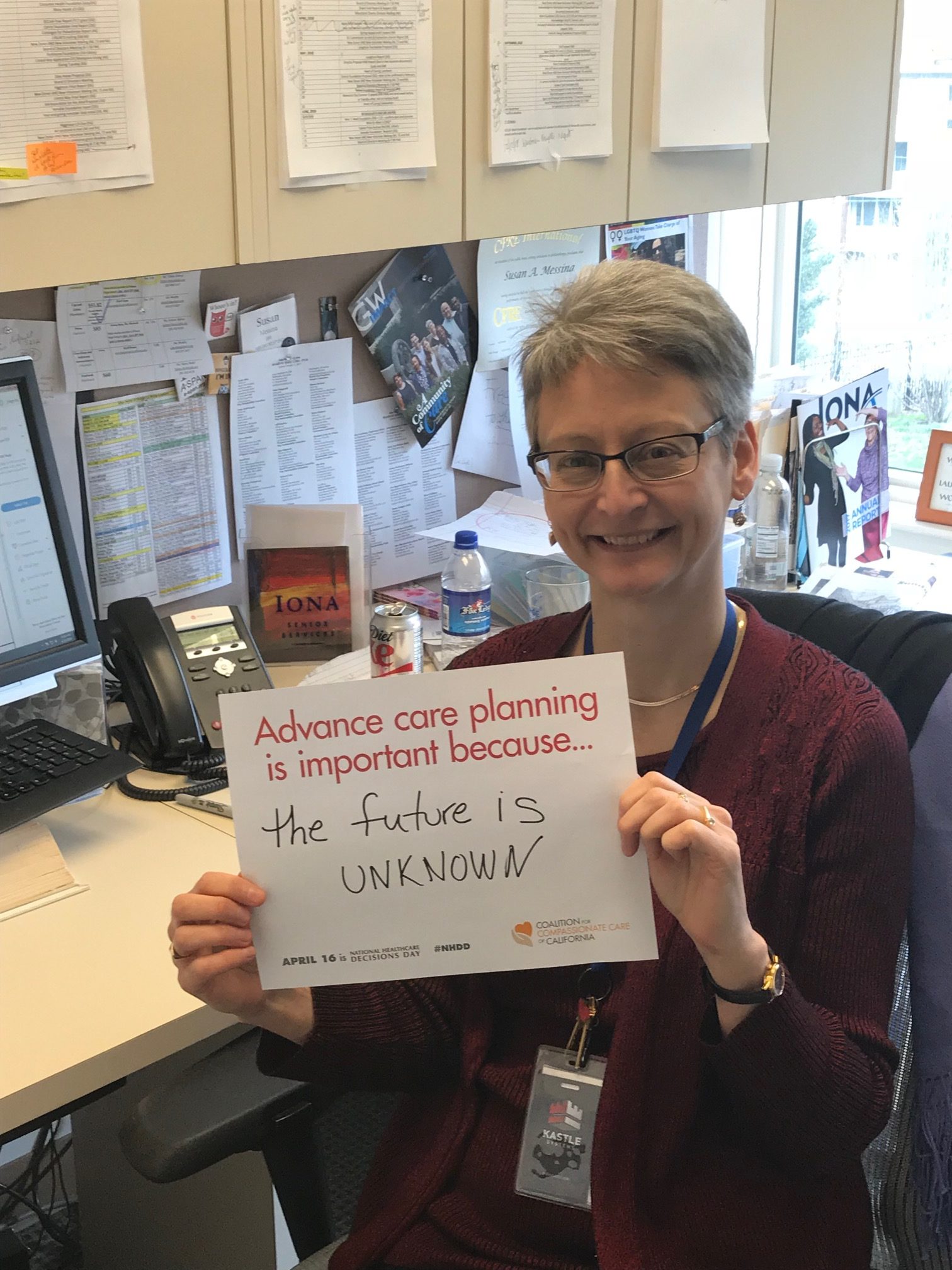
Additionally, if you’re looking for inspiration on what to discuss, Director of Development & Communications Susan Messina shares her own thoughts. We hope that her ideas will inspire you to start your own conversation with loved ones.

After much observation of others’ situations and thought about my own wishes, I provide these six pieces of guidance:

1. If it is only possible to keep me at home with help from professional caregivers like home health aides or certified nursing assistants, I hereby grant my family members my blessing to hire those people. Regardless of whether I say, “I don’t want strangers in my house” or “I only trust you.” My family caregiver(s) get to be the ones to decide when they need help with giving me care, not me.

2. Please check out any adult day health programs I might join. I’m a super social person. So, being part of a new community will probably be good for me, even if I am skeptical at the time. Get a guest pass for me and let me give it a whirl!

3. If my safety or the health/well-being of my family is in jeopardy because caring for me has become too demanding, I want to be moved to an appropriate long-term care setting.

4. Similarly, I hereby grant my family members my blessing to stop me from driving if they no longer think it’s safe. Other people’s safety is more important than my independence.

5. I want my family and doctor(s) to talk to me about palliative care and also hospice. I would rather have those options on the table earlier rather than later. And if I bring them up, please do not shush me with, “It’s too soon to give up “or “I don’t want to talk about that.”

6. If I have severe dementia, I hereby grant my wife the freedom to pursue another romantic relationship. She will not be “cheating”; she will be meeting human needs for companionship and intimacy. I just ask that she (or even they) continue to take care of and/or visit me!

Do you have questions or comments about starting a conversation or planning for your healthcare? Let us know in the comments.

Iona Volunteers through the Decades: Meet Veronica Ferris

This week is National Volunteer Week, when we honor the work that volunteers do year-round to support organizations and communities across the country. In gratitude and celebration of our incredible volunteers, we’re highlighting some of our dedicated volunteers. 

Meet Veronica Ferris

Age Category:

20s/30s

Year you started volunteering with Iona:

2017

Why did you start volunteering with Iona?

I have always had a passion for helping older adults, especially those with memory loss and Alzheimer’s. I firmly believe that we need to treat our seniors with respect and dignity, and I think that Iona’s slogan “Age Well. Live Well” perfectly captures that. I have been familiar with Iona’s work for almost a decade now, and am delighted to be a part of it!

What volunteer roles have you had with Iona?

As a volunteer at Iona, I have represented Iona at community partner fairs, and helped recruit new volunteers. I also help coordinate the Friendly Visitor/Grocery Shopper program, and match volunteers of all ages with older adults, who often develop lasting friendships. I have volunteered with the seniors in the Wellness & Arts Center and the Active Wellness Program at St. Albans. I have also helped out with special events such as art shows and holiday lunches.

What have you learned through your experience volunteering with Iona?

I hope to learn more about the needs of seniors in the Washington, DC area, and how organizations like Iona are meeting those needs and advocating for seniors in policy. I am also thrilled to be learning about multiple aspects of volunteer coordinating, which is extremely important.

What would you say to someone thinking about becoming an iona volunteer?

Iona is an organization with an amazing spirit of service to senior citizens. Being a volunteer at Iona means joining a community of wonderful, friendly, and selfless people. Volunteering at Iona has been an incredibly inspiring and rewarding experience!

If you’re interested in volunteering at Iona, please contact our volunteer coordinator at volunteer@iona.org. We’d love for you to join our community of care!

How to plan care for your later years when you’re aging solo

Here at Iona, we’ve encountered many people who lack the traditional support system that so many older adults rely on as they age. We call it aging solo—and it’s not as uncommon as you might think. In fact, the New York Times recently reported that there’s a growing number of older Americans who are living alone, unmarried, and childless. Instead, they’re aging solo.

In the article, “Single? No Kids? Don’t Fret: How to Plan Care in Your Later Years,” the New York Times outlined a number of ways that you can build your own support network and make plans now (when you’re still independent and functional) in case a crisis occurs in the future.

These plans could include making a move to an accessible and age-friendly community, signing up for home-delivered products or services, or hiring experts in elder care.

If you read the story (or, read it here now), you may have noticed Iona’s very own Iona Care Management services were referenced as a valuable tool for individuals who don’t have someone to oversee their care.

Iona Care Management is comprised of a team of experienced, licensed social workers and nurse care managers who have a deep knowledge of local resources and issues related to aging. Care Managers can be on call for health crises and coordinate care if needed. For those who are aging solo, having a care manager on call provides great peace of mind.

Though the article only touched on Iona Care Management, it is not Iona’s only service that helps you if you’re aging solo. We have programs that support adults of all income levels and needs.

Our goal is to help you go from aging solo to aging in community. What that means is that we’ll support your aging solo by not only helping you to navigate changes in your health or functional ability, but also help you tap into or build meaningful relationships.

Some of the ways we do this include:

Education: Iona’s Take Charge/ Age Well Academy offers presentations and workshops on critical topics like legal planning, deciding among housing options (aging in place or making a move), how to pay for care, and how to build a social support network. We even have a series specifically on Aging Solo and how to age well while aging alone.

Community: Many of our programs encourage social connection. Iona’s free Active Wellness Program at St. Alban’s welcomes men and women from diverse backgrounds all over the District for discussions, films, field trips, fitness, and lunch. We also provide social events for our Take Charge/Age Well Academy alumni. Or, you might get involved by volunteering with us.

Direct support: If you’re aging solo, but don’t currently need help, a good option for you may be Iona’s Care Management Services. A care manager can serve as your expert advisor, giving you individualized guidance as you plan for the future. As previously mentioned, this fee-based service can also ensure a case manager is available to assist you in the event of a health crisis down the line. Additionally, we offer free subsidized case management services to individuals that meet eligibility requirements.

If you’re feeling anxious or unsure about your social support as you age, you’re not alone. Iona can help. To learn more about our services and speak with a social worker, we encourage you to contact our Helpline. Iona’s Helpline is open Monday – Friday from 9:00 AM – 5:00 PM. Call (202) 895-9448 or email info@iona.org.

Tell a lie day: four myths about Iona debunked

Despite our 40+ years serving the Washington, DC area, many longtime DC residents still have questions about our work.

In honor of “Tell a Lie Day” (which is on April 4, 2018), we’re dispelling the most common myths about Iona and our services.

1. MYTH: People live at Iona.

THE TRUTH: It’s true that when Iona was founded in 1975, it was known as Iona House, but we have never been a residential community. Our organization was called Iona House because we were located in a small clapboard house on Butterworth Place NW.

As our services expanded – as well as our space (Iona moved to the current Isabelle Breckinridge Center in 1997) – we dropped “House” from our organization’s name to better reflect our widespread community presence.

No one lives at the Isabella Breckinridge Center at 4125 Albemarle Street NW, but many people visit our building to participate in our adult day health program, attend a support group meeting or exercise class, or meet with a social worker.

2. MYTH: Iona only serves Ward 3 residents.

THE TRUTH: Many of Iona’s services are available to older adults and caregivers wherever they live. A few services funded by the DC Office on Aging, like home-delivered meals or case management, are restricted to residents of Ward 3 and parts of Wards 2 and 4.

Our Active Wellness Program at St. Alban’s is open to DC residents from all over the city, and many of our services, including the Wellness & Arts Center, workshops and support groups, care management, and counseling are open to anyone in the region. If an Iona Care Manager is travelling to a person’s home, we serve primarily Northwest DC and close-in Montgomery County.

3. MYTH: Iona only helps low-income older adults

THE TRUTH: Iona certainly does help older adults with limited financial resources; for example, an estimated 80% of the individuals served through our DC Office on Aging subsidized case management services cannot contribute anything towards the cost of their care.

Through individual contributions, grant funding, philanthropic partners, and the DC Office on Aging funding, we are able to help those who cannot afford to pay for our services.

But aging and caregiving affects everyone, regardless of economic status. Our care management charges fees and provides services comparable to private practice. Medicare and other insurance pays for counseling. And the Wellness & Arts Center has a variety of funding options, including Veterans Insurance and private pay.

4. MYTH: The best way to refer someone to Iona is to give them the name of an Iona staff member.

THE TRUTH: One of Iona’s most important services is our Helpline, staffed by expert social workers whenever Iona is open. These team members are experts at talking with callers about their needs and connecting them to the right services at Iona or in the community.

If you have an aging- or caregiving-related question, or you know someone with a question, the best thing you can do is tell them to contact our Helpline. Call (202) 895-9448, and ask for our Helpline, or email info@iona.org.

Were you surprised by any of our truths? What other questions do you have about Iona? Let us know in the comments!


Feedback for Iona