

Terry’s Journey as a Caregiver

Terry Baker
Terry Baker, 72, enjoyed a long career with the Federal Emergency Management Agency helping local governments prepare for natural disasters.

But nothing prepared her for becoming a caregiver to her two parents, who moved from New Jersey to Washington, DC in 2000. After her father had a hip replacement and her mother experienced a serious fall, Terry became concerned about how they would continue to manage living independently while she and her husband worked full-time.

“I’m a planner,” she says. “I needed to know where to turn—and I knew to turn to Iona.”

An Iona Care Manager visited Terry’s parents at their apartment, conducted a full assessment, and provided Terry with recommendations and resources for caring for her parents. “It was so helpful to know more about Iona and all the things they could provide,” Terry says.

One day, in 2009, Terry saw a flyer in the mailroom of her apartment advertising a new caregiver support group at Iona. Until that moment, Terry had never thought of herself as a caregiver. “All I knew is that I was really stressed, tired, and feeling a little resentful,” she remembers.

That support group ended up being a refuge for Terry for seven years until her parents passed away. “It was a place where I could vent, share my feelings, and find out that I wasn’t alone,” she says. “It was my go-to place for emotional and practical support.”

Since then, Terry has supported Iona as a volunteer and monthly donor. As a member of Iona’s Safety Net Society, she understands the importance of her investment in Iona’s work.

“Iona staff are lifesavers. I think about all the people who don’t have family or financial resources, people who get meals and groceries delivered, all the elders in isolation. I don’t know what people like that would do without Iona. It’s utterly essential,” she says.

Today, Terry takes comfort knowing that she can always turn to Iona. “Life throws you in different directions,” she says. “There may be a time when I need Iona, and I want it to be there for me and my friends.”
Taking Care of Other People’s Parents

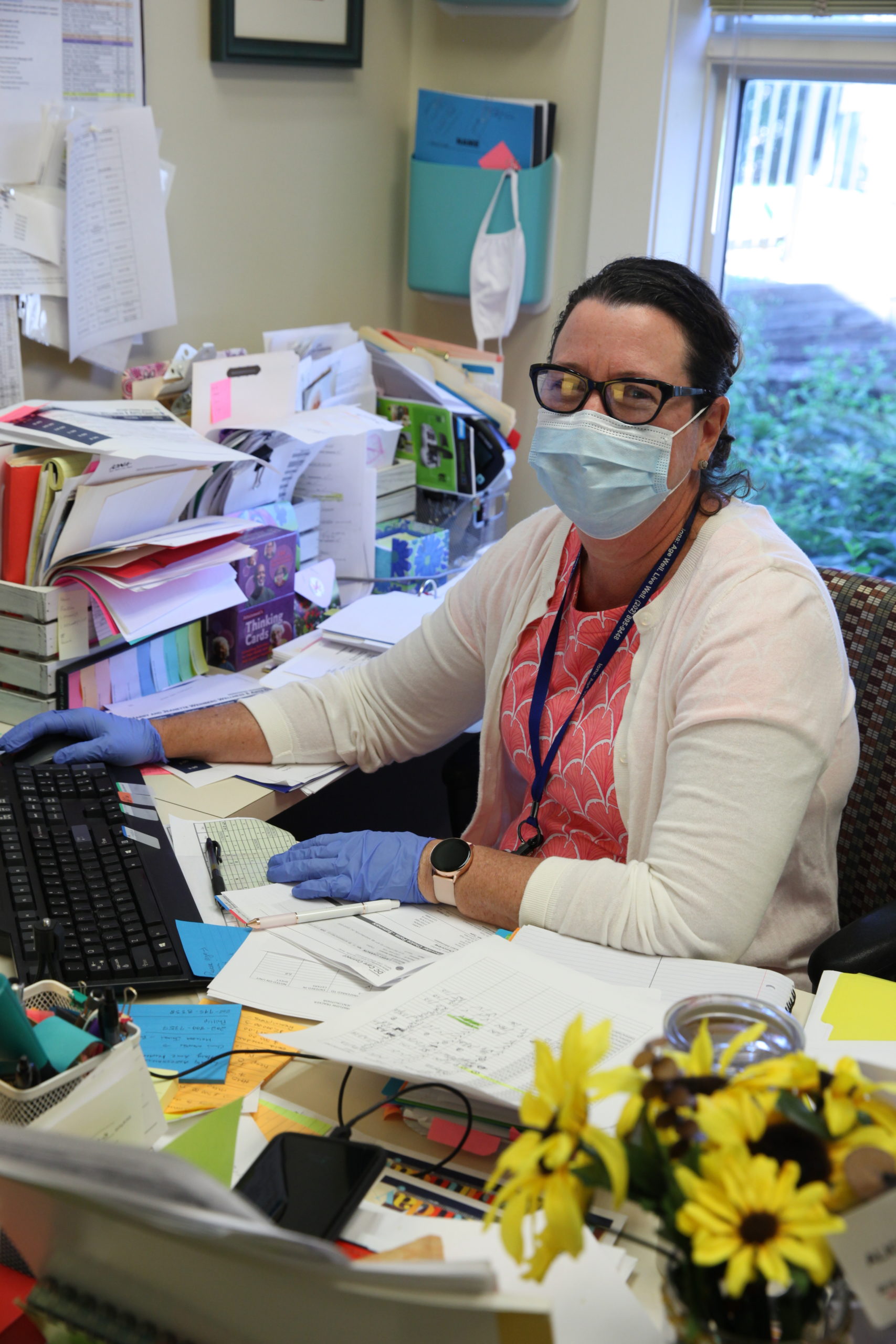
Alicia McCarthy is a social worker at Iona’s Wellness & Arts Center. In this interview, she discusses her daily responsibilities and how she entered the social work field.

What do you do at Iona?

I’m the designated social worker for the adult day health program at Iona’s Wellness & Arts Center. During normal times, the day program serves 40 participants with cognitive impairments and developmental disabilities.

What does the center look like these days during the pandemic?

The center has pivoted to a hybrid model. We have virtual programs twice a day during the week—a 10:30-11:30 exercise program in the morning and in the afternoon we have stimulating discussion groups. Visitors come in from places like the Spy Museum and the Montgomery Historical Society. We also can have up to 10 participants physically at the center daily right now.

How did you start working with older adults?

I grew up with older parents, and I was totally surrounded by older adults growing up. Apparently when I was a kid, someone asked me what I wanted to do when I grew up, and I said, “What do you mean? I’m going to take care of my parents.” So I always tell people, I’m not taking care of my parents now, but I’m taking care of other people’s parents.

What are your responsibilities as a social worker?

Much of my focus is bringing people into the Wellness & Arts Center. Once they decide to join, we have to do an assessment. Out of each assessment there comes an individualized plan of care. That plan is then developed and closely monitored. We meet regularly with the family and we are always reviewing that plan, with the goal of providing the best services that we can to that individual. We’re also engaging with family members and trying to help them out.

You recently started two support groups for family caregivers whose loved ones attend the center. Tell us about that.

We started two groups last April for caregivers who were at home with participants who would normally be at the center but who couldn’t come in because of the shutdown. We used Zoom and it was really well received. One support group has almost become like sisters.

For me, it’s just a way to help them understand that they need to focus on themselves, whether that’s having another family member pick up their loved one while they take a walk or a bath and get some alone time. In a strange way, the Zoom platform has given people more intimacy—you get that opportunity to vent or share tips and information.

By Lauren Stephenson

Resources and Self-Care Tips for Family Caregivers

It’s been nearly one year since sheltering in place became a daily reality for individuals in the Washington, DC area.

People caring for an older family member—especially if those individuals have Alzheimer’s or other dementia-related illness— face unique challenges in keeping their loved one safe and engaged at home. How do you encourage hand-washing when your family member is sensitive to water? What wellness activities can you do with your relative in your home?

In honor of National Caregivers Day (February 19th), here are some  recommendations and resources to help family caregivers as the public health crisis continues.

GENERAL RESOURCES RELATED TO COVID-19

    1. The Administration for Community Living has a resource page that outlines what older adults and people with disabilities need to know related to the coronavirus. The page shares information on making a household plan, everyday actions to prevent illness, and many links to federal and state guidance related to scams, Medicare, and CDC tools. Visit it here.
    2. Another great collection of resources comes from The John A. Hartford Foundation. They’ve curated important news and articles to keep you informed, as well as resources from AARP, the CDC, National Foundation for Infectious Disease, and others. Visit it here.
    3. Looking for information about the vaccine? Visit Iona’s Vaccine Updates page or the District of Columbia’s appointment registration and information page

HELPLINES

    1. Iona’s Helpline continues to operate our normal hours during this crisis, M-F from 9am-5pm ET. If you have any aging- or caregiving-related questions, please call 202-895-9448 or email info@iona.org and connect with a social worker.
    2. Neighbors across the District have launched different DC Mutual Aid efforts to support each other.
      Ward Hotlines:
      Ward 1: (202) 681-9183
      Ward 2: (202) 688-5812
      Ward 3: (202) 556-1315
      Ward 4: (202) 681-3098
      Ward 5: (202) 643-7030
      Ward 6: (202) 683-9962
      Wards 7 & 8: (202) 630-0336
    3. The Caregiver Action Network (CAN) has tips for how you can plan now and manage the rapidly changing situation to keep yourself and your loved ones as safe as possible. Read their tips here. CAN also has a caregiver Help Desk, which can provide information to help caregivers navigate complex challenges. It’s available by phone at (855) 227-3640 , M-F from 7am to 6pm CT.
    4. The Alzheimer’s Foundation of America has a National Toll-Free Helpline at (866) 232-8484. It’s staffed by licensed social workers who are specifically trained in dementia care, and is available via Skype (Alzheimers_Foundation), live chat, and e-mail. It’s open M-F from 9am-9pm ET, and 9am-3 pm ET on Saturday and Sunday.

TIPS FOR CAREGIVING THROUGH COVID-19

  1. The Alzheimer’s Foundation of America has information and practical tips on how to prevent the spread of illness. For example, to practice the CDC’s hand-washing recommendation, they suggest that you use a soothing tone and model it step-by-step. Some people with dementia are no longer able to sequence (i.e., they can’t anticipate what step is coming next.). Modeling step-by-step could look like saying: “First, let’s wet our hands under the water.” When that’s done, “Then we will use the soap dispenser to squeeze out some soap into your hands.” Then, “Rub your hands together with the soap. Lather the backs of your hands…. Lather between your fingers…. Lather under your nails.” Another great suggestion is to use a fragranced soap such as lavender to improve the sensory experience for your person. For more practical tips, visit their site here. 
  2. The Family Caregiving Alliance offers a number of tip sheets for caregiving during COVID-19, including what to do when someone gets sick, caregiving guidance, how to practice self care, and more.

ACTIVITIES

    1. Iona’s Around Town DC program has partnered with the Department of Aging and Community Living to provide a list of online activities you can enjoy from your home. We’ve also moved a number of our regular programming to a virtual space using the tool Zoom, and are even launching new discussion groups and virtual workshops. Click here for our expanding list of online activities and information on new virtual events. 
    2. Some good activities to have on your tool belt to pass the time include: playing word puzzles and games, looking through picture albums, listening to favorite music albums, watching special movies, and offering your person small tasks to engage in such as folding towels or putting socks together.
    3. National Certification Council for Activity Professionals has created a PDF of 101 activities you can do in your home. Access it here.
    4. Alzheimer’s Foundation of America has a Youtube series of quick and easy activities that caregivers can do with someone living with Alzheimer’s disease. Activities include simple craft projects, chair yoga, and more. Watch the Virtual Community Classes here. 
    5. The Alzheimer’s Foundation of America is providing families affected by Alzheimer’s disease with information about simple therapeutic activities they can do to keep their loved one engaged and active while at home. Ideas include flower arranging (for tactile stimulation), virtual tours, storytelling, fitness classes, and more. Read the full list here. 

Art and Dance Classes

    1. Dance for PD is committed to supporting the global community and encouraging people living with Parkinson’s to keep dancing during a time when live classes may not be available. To this end, they’re making this full digital class archive available free of charge. Access it here.
    2. Kennedy Center Education Artist-in-Residence Mo Williams has launched a new Lunch Doodles program. Learners worldwide can draw, doodle, and explore new ways of writing by visiting Mo’s studio virtually at the link.
    3. Museum Arts Culture Access Consortium (MAC) has created this webpage to link you to as many at-home learning resources and activities being offered by NYC cultural institutions and beyond as possible. The list includes resources for families, individuals, teachers, and people with disabilities. They link to many institutions’ current offerings (including live streams from the MET opera) as well as podcasts and online classes.
    4. Advancing Digital Transformation in Museums has put together a guide to virtual museum resources, e-learning, and online collections. Every resource is free to access and enjoy! See the full list here. 

MEDITATION AND SELF-CARE 

During stressful times, practicing self-care becomes even more important. As anyone who has ever been responsible for the care of another can attest, it’s easy to ignore your own needs when somebody else’s seems so much more present or overwhelming. But when you forget to take care of yourself first, your effectiveness as a caregiver only diminishes.

Especially as well all practice physical distancing, it’s important that we continue to stay connected, maintain care support, and nurture personal health and wellness. We hope the resources below help. 

  1. Iona has a blog post with tips on practicing self-care in uncertain times. Read it here. 
  2. Read our Self-Care Checklist for Caregivers.
  3. The Red Cross offers helpful tips for caregivers during the pandemic, and they also offer a free online course on how caregivers can support themselves and others during these difficult times.
  4. The Center for Mindful Living is offering intimate meditation groups and a variety of other social and support opportunities on their website.  See a list of their virtual events here. Questions: info@living-mindfully.org.
  5. Participate in virtual lunchtime meditation on Sundays, Tuesdays, and Thursdays. 
  6.  Engage@HOME is a YouTube Channel offered by Montgomery County MD’s Caregiver Support program. New episodes are uploaded daily to support wellness and provide trusted updates.  Engage@HOME features: topical interviews, stories about quality resources, and opportunities to connect with others – all while maintaining resilience. Engage@HOME is free to view with no special software. Click here to visit the Youtube page. 
  7. Insight Meditation Community of Washington DC has a number of virtual meditations and classes. Visit their calendar here. 
  8. There are also a number of applications for smartphones that help users meditate or practice mindfulness. See if you can take just a few minutes when you wake up or before bed to ground yourself and practice deep breathing with these tools. 
  9. A large part of anxiety can come from a loss of control. And in those times, our mental health can suffer. It’s important to remember that you are not helpless, even in light of the current news events. Here are some ways you can take care of your mental health in the face of uncertainty.  

Remember, we’re all in this together! If you have questions or need support, please contact Iona’s Helpline at 202-895-9448 or info@iona.org. We’re here to listen and help.

Memory Café: Día de los Muertos

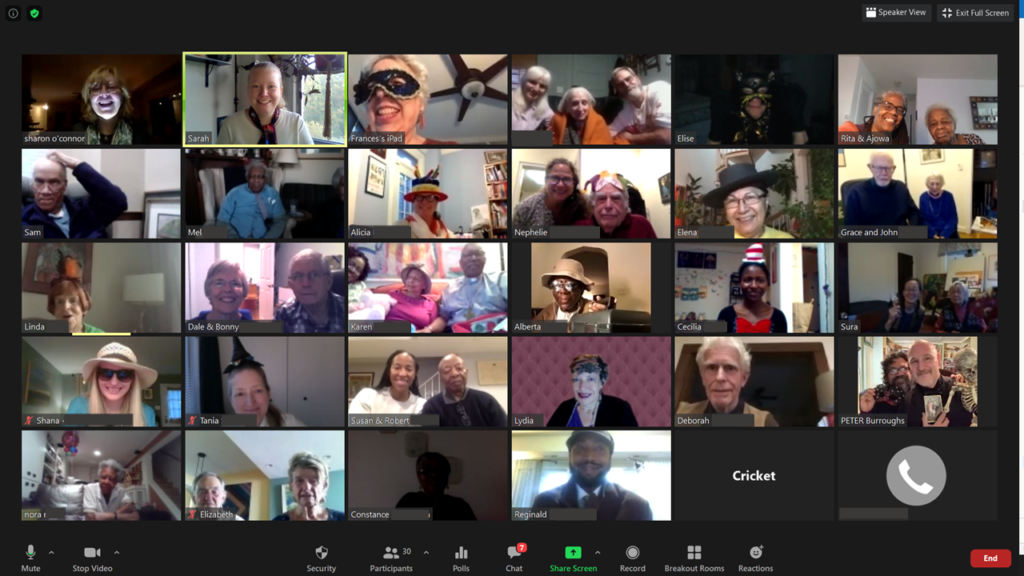
Screenshot of Halloween Memory Cafe participants

On October 31, Iona hosted its second-ever virtual Memory Café, this time celebrating Halloween and Día de los Muertos (Day of the Dead).  The event was led by tenor Peter Joshua Burroughs, a professional singer and performer. Clients and their family caregivers showed off costumes, sang songs in multiple languages, danced, and learned about Day of the Dead traditions. 

 Here’s what one participant said about the event: 

 “I wanted to thank you all so much for the Memory Café. Things seem so long ago, it came back to me in pieces… what is a Memory Café?  And first I remembered a buffet, and people and families at tables, and then… some kind of entertainment. (In the big room, once, another singer about 3 feet from me sang with all the power of an opera singer, I could almost feel the sound waves.) And there were other things for us to do, like Jesse and Seth playing for us to dance. 

But even though I’d gotten to dance then, this was the first time when I really felt what it was like to be on the other side of the line, not a part of the providers, but one of the receivers. And how much I needed it, how good it felt to be dancing, singing, all by myself in my box-filled basement room, monitor with no mic or camera, but still part of all of you, and the energy and good feeling that was coming across the room. Even though I couldn’t talk or be seen, you still managed to include me in what you were saying and writing-just as I bet everybody else felt included.   

So I really got to experience the power of Iona. And to be so glad it’s there. Which is to say, glad you’re there. And that you’ve found ways to keep doing what you do. How valuable it is. 

The love of a daughter and caregiver

In this essay for National Family Caregivers Month, Safieh Hekmat describes a day in the life of being a family caregiver for her parents during the public health crisis. 

Like many people, life after COVID-19 has become much harder for myself and my parents. Both of my parents are 99 years old and have been living with me for more than 10 yearsI’ve been their primary caregiver since 2013, when I left my full-time job at the International Monetary Fund 

These days, my parents get up much later, and they want to sleep a lot more. I’ve also noticed they seem to be more anxious and need to have me around all the timeOften my parents call out my name throughout the day or in the middle of the night just to make sure I’m still around. If I ever leave the apartment, my parents always want to know where I went and when I will return home 

Before the pandemic, my parents were very social and would pass the day sitting in the lobby of our building watching people and talking to neighbors. My sister helps take care of my parents part time and would visit us frequently. Unfortunately, to keep my parents safe from the coronavirusvisits from friends and neighbors have decreased. The most emotional downside to this for me has been seeing my parents so isolated with only myself and the day helpers to keep them company.  

To compensate for the monotony the pandemic has brought to my parents’ lives, make sure to give them lots of attention and have them talk to relatives by phone on a daily basisI also buy them their favorite foods, play music for them, and dance to keep them entertained. We go outside to get some sun and fresh air, and my dad loves it when I take him outside and pass by Dr. Anthony Fauci’s house. I make sure my mom exercises dailyFinally, prepare meals for them delivered by Iona and include other foods that they enjoy.  

Although my friends and relatives praise me for taking care of my parentsthey also do not shy away from criticizing me for not taking more time for myself or living a different life–one of my own. At times, they feel pity for me, and that’s something I don’t want people to feel. For me, it has been pure joy to spend time with my parentsI was separated from them as a teenager due to political unrest in Iran, and I didn’t see them for three years. As a single person, I have traveled extensively and had a good life, and now I view my parents as my kids, whom I cherish. 

People often come to me for advice about how to care for older adults. Here are five things that I suggest people keep in mind: 

  • Don’t forget to hug and kiss your parents. They need to be held and feel loved.  
  • It’s very important for family caregivers to eat healthy.  
  • You also have to exercise! Go on walks. 
  • Cherish older people, as they are filled with wisdom and great stories. Try to pay them attention by engaging them in conversation and asking them questions and giving feedback. Even if they seem unalert, they are not always that way.  
  • If older people do seem forgetfuldon’t assume they have dementia—treat them with respect and like an adult. Talk to them about current events, even if you feel they’re not interested. And absolutely NO baby talk! 

By Safieh Hekmat 

11 purposeful activities to do at home for people with Alzheimer’s

The COVID-19 outbreak has been a difficult time for all of us. But for those with Alzheimer’s or other dementia-related illness, change is especially confusing.

We’ve seen this with participants in our adult day health program. Many have Alzheimer’s and can’t understand why they aren’t coming to Iona each day like they used to. Instead, some are withdrawing into their private world and falling into depression. A few even refused to leave their beds when the stay-at-home orders first began.

That’s why to help support our families during this crisis, Iona’s adult day health program staff now offer daily activities for current participants and their families to do together over the phone and online. It’s a reason to get up and a way to stay connected.

But this challenge goes well beyond our adult day health center roster. We know that many care partners in our wider community are burning out or running out of creative ideas for how to keep their person engaged and active while at home. Additionally, in the words of Teepa Snow, a leading educator on dementia, “Meaningful days matter to all people. This need does not change for someone who is living with dementia.”

As we’re all experiencing change to our routines and a loss of control, it’s easy to feel like our days are less meaningful. So we asked Wellness & Arts Center Program Coordinator Cecilia Sono to share some of her favorite activities that focus on what people can do, not what they cannot do. In doing so, everyone can have positive new experiences.

11 activities that can help your family member feel valued, productive, and purposeful

  1. Nature appreciation: Take a family walk. If there’s a nice place to stop, you can write a story, a poem, or simply write down observations. On a bad weather day, see if you can take a drive and find a place to park with a nice view.
  2. Helping around the house: No matter the activity you do with your loved one, giving your person a sense of purpose can make a big difference in the success of the activity. This can be as simple as stating, “I’ve made a little mistake and need some help. Will you help me?”Ask your loved one to help with folding laundry or towels, drying dishes, matching socks, etc. These small tasks have many benefits including improved self-esteem and sense of purpose.
  3. Blast from the past: Take an hour or so to pull out old photo albums or family videos. Watch and reminisce together. You might also want to listen or even dance to old favorite songs.
  4. Explore your block: Take a scenic walk around your immediate neighborhood. Take the time to appreciate the place you call home. You may discover interesting things that you never knew existed. Some neighborhoods in DC even have interesting back alleys to explore.
  5. Organizing fun: Pick a room in your house that needs some TLC and involve your person with tasks like organizing CDs, emptying drawers, etc. Take a couple of hours to organize this space.
  6. Plan a family video chat with family and friends: “Zoom” and “Skype” are two popular platforms. For other technology advice, read our blog post here. If you’re new to Zoom, Iona’s Around Town DC program offers regular Zoom 101 Workshops. Visit our Around Town DC website to learn more and see the upcoming schedule of classes.
  7. Spa treatment day: This activity is so versatile. It can be done inside or outside, paired with lemonade or tea, coffee, or hot chocolate—iced or hot—depending on the season. You might choose to play soothing music or even light candles (battery-operated candles work too). And don’t stereotype; all genders can enjoy and benefit from relaxing spa treatment. To get started, all you need is an emery board, polish (can be clear or colored), and some lotion. Provide your loved one with a gentle hand massage using some lotion and file. If desired, you might paint their nails. Other variations of this idea include purchasing or making a DIY face mask or trying a foot bath and pedicure.
  8. Flower arranging: Together or independently, ask your loved one to help create beautiful centerpieces. All you need is an assortment of artificial flowers and a colander with large enough holes that the stems will fit inside. There is a sense of immediate gratification. As you add the flowers, the plain colander transforms into a work of art! You can also arrange flowers with vases, jars, and real flowers.
  9. Scrapbooking fun: Find mementos around your house that are special to you and start scrapbooking. This will be a fun way to preserve all your favorite memories.
  10. Collage making: Cut up magazines or newspapers and make collages. You can choose to respond to a theme or feeling.
  11. Go on a virtual tour: The Google Arts and Culture project has content from more than 2,000 organizations to bring their collections and galleries online.  You can view virtual tours of many of the museums, galleries and sites, and also explore details of their collections as well as cultural and historical contexts through their online “exhibits.”Many Washington, DC museums are offering virtual tours too. Here’s a list of some to check out. 

We hope these ideas will provide a little fun and routine into your daily schedule. One final tip—because routine can be especially important for people with Alzheimer’s, if possible, we encourage you to make a weekly calendar with designated times for these activities (for example, a daily activity at 2:00 PM). You may find that your person even starts to get ready and prepare for the activity before it begins!

If you have other aging or caregiving-related questions, please contact our Helpline at 202-895-9448 or info@iona.org. We’re here to support you.

Avoid Caregiver Burnout during COVID-19

While we are all doing our part to stay home, caregivers of aging loved ones are experiencing a dramatic increase in their caregiving duties as well as having to deal with new and unprecedented challenges in their routines. In these turbulent times, many family caregivers are transitioning to providing full time care for their loved ones while juggling their own. In the face of so much uncertainty, caregivers may feel exhausted, hopeless, and isolated. Caregivers experiencing an excessive amount of any of these symptoms or emotions may be at risk for caregiver burnout.

At Iona, we want to support our caregivers as much as possible while we all navigate our new normal. We’ve compiled some tips for caregiving and self-care, as well as identified some additional resources that may be helpful to caregivers in the midst of this pandemic.

Self-care is essential for caregivers, especially during this time.

Caregivers should not minimize or neglect their own health and emotional needs.

Here are some ideas for caregiver self-care:
  1. Paint or draw something. Studies show that just 45 minutes of art making can reduce stress causing hormones.
  2. Watch something funny. Laughing releases endorphins, soothes muscle tension, relieves pain, and improves your mood.
  3. Take an online yoga or workout class. If you’re looking for a new class, check out AroundTownDC.org for various fitness class options, including virtual and online sessions.
  4. Try guided mediation. Here are the top 2020 meditation apps from Women’s Health.
  5. Take a warm bath.

Caregivers may observe that their loved ones are seemingly experiencing additional distress and restlessness. For those individuals with dementia, having a daily routine is crucial to their sense of stability, since all the new safety precautions may have completely thrown off their daily schedule.

Here are some ways that caregivers can help calm their loved ones, and reduce their anxiety:
  1. Verbally acknowledge the changes in your daily routine.
  2. Create a new daily schedule and stick to the new routine as best you can.
  3. Try to turn off the news— the panic and constant reminder of a crisis going on outside will not help calm you or your loved one’s distress.
  4. When you speak with your family member, try to not only talk about the isolation. Make a list of other life updates to reference for conversation.
Here are some ideas for implementing a new daily routine:
  1. Set times for meals and try to enjoy healthy meals together.
  2. Have your loved one participate in small housekeeping tasks, like folding dishtowels or even winding a ball of yarn.
  3. Try to get some exercise into your day— even stretching while watching TV is better than nothing.
  4. Incorporate music into your daily activities. Music can be incredibly soothing for your person in times of added distress.

Remember, if you’re a caregiver for an aging adult and you are experiencing excessive exhaustion and feelings of hopelessness, you are not alone.

In addition to reaching out to family or friends, here are other resources to help support caregivers in this time:
  1. Contact Iona’s Helpline for advice and resources on caregiving or aging at 202-895-9448 (Press ‘1’ to connect to our Helpline) or email info@iona.org.
  2. AARP offers various resources such as articles and tips relative to family caregiving. Learn more at www.aarp.org/caregiving.
  3. The Institute on Aging Friendship Line at 1-800-971-0016 is a 24-hour toll free accredited crisis line for people 60 and older.
  4. 211 is a resource hotline for referrals to human, health and social service organizations. Call 211 from your phone.
  5. The Caregiver Action Network is also a great resource for helpful information. Check them out at caregiveraction.org/covid-19 or call their front desk at 855-227-3640.

By Patsy Lieberman

Patsy Lieberman is a graduate student at the University of Maryland School of Social Work. She recently completed an eight month internship in Iona’s Wellness and Arts Center where she learned about providing person-centered care for aging adults and their caregivers.

Technology to Stay Connected through COVID-19

With COVID-19 continuing to advance, and the order from national and local governments to stay home, many of us are not getting the same level of interaction with peers and loved ones. You may find yourself becoming bored or feeling lonely. Fortunately, there are a number of online and mobile resources that can help keep you connected and engaged virtually.

Here’s a list of online platforms that you can use to stay in touch with friends and loved ones. The table below includes information on available mediums and devices, compatible operating systems, associated costs (if any), and where you can find it to download. 

APPLICATION NAME

KEY FEATURES

AVAILABLE PLATFORM/DEVICE

COST

WHERE TO FIND IT

What’s App
Text message, video, and audio technology.
• Video and audio calls—can contact people in other countries
• Document sharing
• Record voice messages/notes
• End-to-end encryption for safety and privacy
• Mobile (iOS & Android) FREE Desktop (for Windows or Mac)
Apple Store (for iOS)
Google Play Store (for Android)
Zoom
Enterprise video conferencing with real-time messaging and content sharing. Please note: There have been some privacy concerns with Zoom that the company is working to resolve. For advice on how to best secure your call, try these best practices.  
• HD video and audio
• Unlimited 1 to 1 meetings
• 40 mins limit on group meetings
• Unlimited number of meetings
• Online support
• Recording and transcripts
• Group Collaboration Tools & Features
• End-to-end encryption
• Web
• Mobile (iOS & Android)
Basic Version: FREE Online
Apple Store (for iOS)
Google Play Store (for Android)
Messenger
A simple way to text, video chat, and plan things all in one place.
• Video and audio calls
• Chat
• Video conferencing features
• Location sharing
• Money sharing features
• Voice message options
• Web
• Mobile (iOS & Android)
FREE Apple Store (for iOS)
Google Play Store (for Android)
Google Duo
Simple, high quality video calls for smartphones, tablets, computers, and Smart Displays like the Google Nest Hub Max.
• Video and audio calls
• Has Knock Knock feature (live video preview of person calling you)
• Calls stay private with end-to-end encryption
• Web
• Desktop
• Mobile (iOS & Android)
FREE Web
Mobile (for Android & iOS)
Skype
Video-conference tool
• Video and audio calls
• HD video conferencing
• Get a Skype number to disguise personal number
• Call recording and Live subtitles
• Screen sharing
• Desktop
• Mobile
• Web
• Xbox
FREE to send messages and have audio and video calls with groups of up to 50 people. Desktop (for Windows or Mac)
Apple Store (for iOS)
Google Play Store (for Android)
Web
Facetime
Make video and audio calls from your iPhone, iPad, or iPod touch.
• Video and audio calls
• Use FaceTime Audio with Call Waiting
• Create your own or Memojis or use theirs
• Use FaceTime Live Photos
• Mobile (iOS & iPadOS) FREE Apple Store (for iOS & iPadOS)
Marco Polo
Texting, social media, and video chats.
• Video and audio calls
• Unlimited, and ad-free
• Group or 1:1 conversations
• Unlimited video storage
• Mobile (iOS& Android) FREE Apple Store (for iOS)
Google Play Store (for Android)

For more information on these tools, and others, read this fact sheet from the National Council on Aging.

10 Mental Health and Wellness Quarantine Tips

It’s a new world out there—one that has many of us working from home for the first time, staying in as much as possible, and balancing many responsibilities at once. It’s normal to feel stressed, anxious, or overwhelmed. Remember, we’re all in this together.

Eileen M. Feliciano, Psychologist, PsyD, MSEd, shared some excellent tips for maintaining your mental health through the coronavirus crisis. In honor of Stress Awareness Month, we wanted to pass along some of our favorites.

You can read her full list here. 

Here are 10 tips that resonated with us that we hope will help.

  1. Dress for the social life you want, not the social life you have.

    Get showered and dressed in comfortable clothes, wash your face, brush your teeth. Take the time to do a bath or a facial. Put on some bright colors. It is amazing how our dress can impact our mood.

  2. Find some time to move each day, again daily for at least thirty minutes.

    If you do not feel comfortable going outside, there are many YouTube videos that offer free movement classes, and if all else fails, turn on the music and have a dance party!

  3. Reach out to others, you guessed it, at least once daily for thirty minutes.

    Try to do FaceTime, Skype, phone calls, texting—connect with other people to seek and provide support. Do not forget to do this for your children as well. Set up virtual playdates with friends daily via FaceTime, Facebook Messenger Kids, Zoom, etc—your kids miss their friends, too!

  4. Stay hydrated and eat well.

    This one may seem obvious, but stress and eating often do not mix well, and we find ourselves over-indulging, forgetting to eat, and avoiding food. Drink plenty of water, eat some good and nutritious foods, and challenge yourself to learn how to cook something new!

  5. Give everyone the benefit of the doubt, and a wide berth.

    A lot of cooped up time can bring out the worst in everyone. Each person will have moments when they will not be at their best. It is important to move with grace through blowups, to not show up to every argument you are invited to, and to not hold grudges and continue disagreements. Everyone is doing the best they can to make it through this.

  6. Everyone find their own retreat space.

    Space is at a premium, particularly with city living. It is important that people think through their own separate space for work and for relaxation. For children, help them identify a place where they can go to retreat when stressed. You can make this place cozy by using blankets, pillows, cushions, scarves, beanbags, tents, and “forts”. It is good to know that even when we are on top of each other, we have our own special place to go to be alone.

  7. Expect behavioral issues in children, and respond gently.

    We are all struggling with disruption in routine, none more than children, who rely on routines constructed by others to make them feel safe and to know what comes next. Expect increased anxiety, worries and fears, nightmares, difficulty separating or sleeping, testing limits, and meltdowns. Do not introduce major behavioral plans or consequences at this time—hold stable and focus on emotional connection.

  8. Notice the good in the world, the helpers.

    There is a lot of scary, negative, and overwhelming information to take in regarding this pandemic. There are also a ton of stories of people sacrificing, donating, and supporting one another in miraculous ways. It is important to counter-balance the heavy information with the hopeful information.

  9. Find something you can control, and control the heck out of it.

    In moments of big uncertainty and overwhelm, control your little corner of the world. Organize your bookshelf, purge your closet, put together that furniture, group your toys. It helps to anchor and ground us when the bigger things are chaotic.

  10. Reach out for help—your team is there for you.

    If you have a therapist or psychiatrist, they are available to you, even at a distance. Keep up your medications and your therapy sessions the best you can. If you are having difficulty coping, seek out help for the first time. There are mental health people on the ready to help you through this crisis. Your children’s teachers and related service providers will do anything within their power to help, especially for those parents tasked with the difficult task of being a whole treatment team to their child with special challenges. Seek support groups of fellow home-schoolers, parents, and neighbors to feel connected. There is help and support out there, any time of the day—although we are physically distant, we can always connect virtually.

    We will add that Iona is here for you too! If you’re caring for an older loved one at home right now…worried about a family member afar…or are an older person yourself looking for resources and support, please reach out. Contact 202-895-9448 and press 1 for our Helpline, or email info@iona.org.

And thanks again to Eileen M. Feliciano for creating this list. To read her full list of advice, click here.

COVID-19 Safety Tips for Helping Others

Coronavirus (COVID-19) is affecting individuals at alarming rates across the United States and globe. While practicing social distance and staying at home are both critical actions to slowing the rate of transmission, there may be instances when that’s not possible for you. You may have someone in your life—a friend, a relative, a neighbor—who is especially high risk because they are immunocompromised or an older adult, and you may need to support them.

If you’re considering volunteering or assisting someone in your life during this crisis, it’s important that you still follow safety precautions to lessen the risk of spreading the virus. While you may be “low risk,” it’s important to understand that there is still a risk. You may be an unwitting carrier or become sick yourself. Anyone can be infected with the virus.

How is COVID-19 Spread?

COVID-19 is a new virus, and therefore we learn more about it every day. According to the CDC, the virus is believed to be transmitted:

  • By having close contact with a person who has the virus (within ~6 feet) through respiratory droplets produced when an infected person coughs or sneezes
  • By touching a surface or object that has the virus on it, and then touching your own mouth, nose, or eyes.

Other points to know:

  • It’s believed that the Coronavirus can live for up to three days on various surfaces (as low as 1-24 hrs. for cardboard and fabric, longest for non-porous surfaces like metal).
  • People are thought to be most contagious when they are most symptomatic (the sickest). They may also be contagious 1-14 days before any symptoms show, and may be contagious with no visible sign of symptoms.
  • Infected persons can continue to be contagious during recovery, believed to be between 8 and 37 days.
  • Thorough hand washing (with soap and water, or alcohol based sanitizer) should be done frequently, and always done after touching the face, using public transportation, or touching the same items as others.

Safety Practices:

  • Closely monitor your health. If you begin to show symptoms, such as fever or coughing, follow CDC guidance and stop your volunteer work right away.
  • Avoid crowded spaces like public transportation and maintain 6 feet distance with others.

General sanitation guidelines for when helping others during the COVID-19 outbreak:

  • Take your temperature before making any food delivery or other volunteer outing. If you have an elevated temperature or any symptoms, do not volunteer.
  • If you have ANY symptoms of ANY kind, or any known contact with people who are symptomatic, stay home and help with tasks that can be done online.
  • Clean all surfaces (use a CDC-approved disinfectant) before doing anything with food, even if the food is packaged and sealed.
  • Wear plastic gloves while handling food. Use a fresh pair for each and every delivery.
  • Use hand sanitizer if no running water is available (during deliveries) every time you put on a fresh pair of gloves while delivering food.
  • Cover your nose and mouth at all times while interacting with food (because masks are hard to come by, you can use a bandana or other DIY method).

If you’re assisting with food packaging or delivery, please note the following tips:

  • Pick up supplies at off-peak times and avoid public transportation.
  • Thoroughly wipe food and food prep areas with CDC-approved disinfectant and a disposable towel.
  • Cover your nose and mouth before entering food and food prep areas (a bandana is suggested).
  • After covering your mouth and nose, wash hands with soap and water immediately for 20 seconds before entering food and food prep areas.
  • Wear fresh, sterile gloves when in food and food prep areas.
  • While wearing your gloves, do not touch anything that was touched by people who have not washed their hands (i.e. doors, light switches, fridge/freezer doors, etc.). If you do, wash hands again, and put on a fresh pair of gloves.
  • When making deliveries, try not to touch anything except the bags. Place the bag on the doorstep, knock, and then return to your car. Do not stay on the doorstep and talk with the person; only talk from a distance of at least 6 feet. Avoid entering the person’s home.
  • Remember that your phone is a hotspot for germs. If you touch your phone with your gloves, throw gloves away, wash/sanitize your hands, and put on a fresh pair before touching food bags.

If you’re looking for ways to support your neighbors —whether financially, donating your time, or dropping off supplies, the following list of organizations/efforts may be looking for assistance.

At Iona, we’re navigating uncharted waters and face significant funding gaps. If you’re able to, we would be grateful for any financial assistance.

Your contribution will go towards supporting older adults and families during this crisis—providing food to homebound seniors, offering virtual wellness and fitness programs that address isolation, continuing support groups and psychotherapy online, answering calls on our Helpline, coordinating care for vulnerable older adults, making wellness check-in calls, and performing other essential services.

Donate to Iona

Other organization efforts:

  • Bread for the City – Accepting monetary donations for groceries, diapers, and medical supplies to give clients during open hours. Please consider making a donation to support their efforts here.
  • Capital Area Food Bank – They are experiencing a shortage of volunteers, and are in critical need of help sorting and packing food in their warehouse and assisting at their offsite food distributions.  To learn more and sign up, visit volunteer.capitalareafoodbank.org.
  • DC Mutual Aid – Neighbors Helping Neighbors efforts to organize by pods. Opens spreadsheet of efforts (click through all tabs)
  •  DMV Neighbors Helping Each Other Through COVID-19 – A Facebook group connecting neighbors to assist each other during COVID.
  • Dining at a Distance – Support restaurants while practicing social distancing. Here is a list of local restaurants and business who are operating delivery and carry-out, as well as ways to support local business during temporary closures.
  • Feeding America Meal Connect – Restaurants can sign up and donate their surplus food (tax deductible) to food banks in the area. Restaurants can schedule a pick up time for food banks to pick the food up.
  • Food & Friends– Free meal and grocery delivery available to people living with life-challenging illnesses. Clients must be referred by a healthcare provider. They are in urgent need of extra volunteers throughout the coming weeks. There are two volunteer opportunities, food preparation and packaging and meal and grocery delivery. More information found here.
  • Food it Forward – Help keep DC restaurant jobs, and help feed DC families in need by buying a meal package. Martha’s Table has teamed up with Clyde’s Restaurant Group, amongst others, to deliver meals to those in need — while helping keep restaurant workers employed.
  • Martha’s Table –  Volunteers may be needed to help prepare and bag food.
  • Miriam’s Kitchen– In need of financial donations to help neighbors experiencing homelessness receive access to a sink or have a home to stay when they are sick.
  • So Others Might Eat (SOME) – SOME is in need of items to support their clients who may be ill.
  • The Table Church – The Table DC is organizing volunteers to help at-risk members of the DMV community who should not leave their homes during this crisis.
  • We Are Family – Volunteer to deliver groceries to seniors

Related Resources and Sources:

  1. Centers for Disease Control and Prevention (CDC)
  2. Food Handling During Outbreak
  3. QueerCare Resources for Support Care In and In Response to the COVID-19 Gobal Pandemic
  4. Safety Practices for COVID-19/Coronavirus Mutual Aid Projects

Feedback for Iona