With movement, there’s improvement

Senior movement seated exerciseLiving life to the fullest involves movement. In fact, my own motto is “your body is meant to move.” No matter how small the movement – start where you can, and improve from there.

At Iona Senior Services, where I teach “Strength, Balance, and Posture,” I see this philosophy firsthand. Just recently, for example, a class participant shared with me that they’re “feeling stronger and more mobile” because of this regular exercise and movement.

Being able to move with more ease allows you the opportunity to stay independent in your activities of daily living, enjoy leisure time, along with bringing a new sense of confidence in your abilities.

In our exercise group classes, we start with the fundamentals of movement and posture, and then move to learning how your body moves and feels with exercise.

Additionally, staying active as you age is very important for the proper functioning of ALL your bodily functions — including your mental health.

If you’re looking for ways to add more movement into your routine, there are many simple exercises you can do at home.

Below are some of my favorite exercises/movements that you can do daily in your own home. One of the reasons why I love them is because they all correlate to your activities of daily living and, when done properly and frequently, can help you stay as independent as possible.

Of course, I recommend before beginning any exercise routine to check with your physician to make sure that you are medically cleared to begin.

Once cleared, you can try out one, two, or all three and it’s OK if you can only do one repetition! Just practice and build up from there.

Remember to BREATHE!

  1. Sit to stand, and stand to sit.

    Sit in a stable chair. Practice coming to stand with knees slightly apart and feet pointing forward and at hip width. Use a higher seat if you are unable to do this without strain, or use your arms to push off the arm rests of the chair until you don’t need to. Try three to five repetitions to start. This movement is good for strengthening legs and hips.

  2. Push outs.

    Place hands a little bit wider apart than shoulder width and about chest height on a wall in front of you. Step your feet back so that your heels are off the floor with straight legs. Starting with your arms straight, bend your elbows to lower your body towards the wall. Start with small movements and go deeper as you feel strong enough to control the movement. Try five to ten to start. This movement is good for full body strength and control.

  3. Ankle circles.

    Sit in a stable chair. Lift one foot off the floor and begin to make large circles with your foot without moving your entire leg. Do ten circles, and then reverse to the other direction for another ten. Then switch legs. This movement is for ankle mobility, balance, and fall prevention.

Another way to add exercise to your routine is to attend one of the group exercise classes that are offered through Iona Senior Services.

What are your fitness goals? Let us know in the comments!

By Dave Reynolds, Personal Fitness Specialist

For the past 40 years, Dave Reynolds has been providing the best in fitness services to all ages and abilities in the metro DC area through Dave Reynolds and Associates, LLC, Personal Fitness Specialists. Dave is a Medical Exercise Specialist and Postural Alignment Specialist. He is also certified by American College of Sports Medicine as an Exercise Physiologist. He teamed up with Cindy Kardeman, a Licensed Physical Therapist, and together they created innovative group exercise programs that have been marketed and delivered to older adults in independent, assisted living communities and senior community centers, like Iona Senior Services, for more than 30 years.

In addition to group classes, Dave or one of his associates is also available for one-on-one sessions if you would like individual attention for your fitness needs. Want to learn more, or see where we provide classes? Please visit our website http://www.drafitness.com/ . On our website, you can also view clips of our available easy-to-follow videos that can help with exercise at home.

Mental Health in May and Every Month

Mental Health Month
May is Mental Health Month, which has been commemorated in the U.S. since 1949 with awareness-building activities that today include ad campaigns, blog posts (like this one), and even lighting up the Empire State Building in green to kick off the month.

Iona is committed to fostering good mental health of older adults and their family members in May and throughout the year. Our team of psychotherapists, all of whom are licensed clinical social workers, helps people cope effectively with depression, anxiety, stress, anger, interpersonal conflicts, loneliness, grief, and other issues. We also have support groups for people who are living with dementia, low vision, and Parkinson’s, and who are caring for a family member or did in the past.

We all face satisfying and challenging times during our lives. Though you may not have much control over these vicissitudes, what you do have more control over is how you deal with them. The better you can cope with challenges, the better your mental health.

And sometimes you may need some help with that.

If you’re concerned about your mental health, one thing that can help is talking about it with someone you trust, like a family member or friend, your doctor, faith leader, or a psychotherapist, as well as with a support group. Medications, if needed, can complement the effect of talk therapy, and your doctor or a psychiatrist can help you consider the options.

There are also things you can do on your own that can help, such as:

  • Exercising, eating right, and getting enough rest
  • Staying socially active
  • Doing hobbies and activities that tap your creative side and engage your mind
  • Doing things that make you feel useful and helpful to yourself and others
  • Limiting alcohol consumption and taking medications as prescribed
  • Balancing negative thoughts with positive ones, as hard as that can be sometimes
  • Keeping a list of things for which you’re grateful, like this nursing home that implemented regular gratitude journaling 
  • Engaging in spiritual practices that are meaningful to you
  • Treating yourself, like getting a massage, having a nice meal, or listening to your favorite music

This list is by no means exhaustive, and if you have strategies you’ve found helpful we’d love to hear from you. Let us know how you cope with challenges in the comments.

By Bill Amt, LICSW

Bill Amt, LICSW, is a licensed clinical social worker and is the Mental Health Program Manager at Iona Senior Services. As a psychotherapist he works with older adults and caregivers who are coping with the emotional challenges of aging, and he also leads support groups for caregivers and people diagnosed with early-stage dementia. He has a Master of Social Work degree from The Catholic University of America.


The long term care benefit for our veterans

As a veteran myself, it is a huge honor to acknowledge and help educate our brave men and women of our armed forces.

Many fought on behalf of their fellow Americans, many shed their blood for this great nation, and some gave their lives protecting men, women, and children of foreign countries. Now they are growing old and many need our help and compassion, shown with a caring hand and heart, and, yes, money.

There are many wonderful benefits that can help, but with age generally comes the need for long term care, and the monetary cost alone can often be totally overwhelming for a family and their loved ones.

Thankfully, the Veterans Administration offers an Improved Pension Benefit more commonly called VA Aid & Attendance. This benefit has been around for over 60 years, but is overlooked by the majority of veterans and their families.

It specifically pays for medical expenses, of the veteran and/or their surviving spouse, for assistance with the common activities of daily living or ADLs. This is not a disability benefit and so it is provided even if a veteran was not injured during service.  

In 2017 the Aid & Attendance benefits will pay up to:

  • $2,127 per month for a Married Veteran who needs care
  • $1,794 per month for a Veteran (single or widowed)
  • $1,153 per month for the Veteran’s Surviving Spouse

Now, let us not forget that according to the 2016 Genworth Cost of Care Survey, the average monthly cost of an assisted living facility was $3,628. So for many families this one benefit can determine the quality of care and even the place of residence of their loved one.

To get started one must meet some very basic qualifications:

  1. The Veteran must be at least 65 years old with some exceptions, and
  2. The Veteran must have served 90 consecutive days of active duty, and
  3. The Veteran must have served at least one day during a designated wartime period of WWI, WWII, Korean, Vietnam, or Gulf War (specific dates apply), and
  4. The Veteran must have received an Honorable, General, or Other than Honorable Discharge, but not a Dishonorable Discharge.
  5. A Surviving Spouse must have been married to the Veteran at his or her time of death, must have been married at least a year unless they had a child, and must not have remarried since the Veteran’s death.

If you and/or your loved one have met these requirements then eligibility must be proven by filing the proper VA21-534 or VA21-536 forms, along with providing additional supporting documentation. Some of the documents needed are a DD-214, Physicians Medical Report, Medical Issues Report, List of all Assets, Income Sources & Expenses, just to name a few.

However, in classic government fashion, these are only guidelines to go by when applying for this benefit, so seeking out a professional who can assist with the application process is highly recommended, even by the VA themselves.

You are now well on your way to at least being able to preliminarily determine if you or your loved one might be able to qualify for this benefit and get some help paying for long term care.  If you answered yes to all the initial qualifying questions, then you should seek out the assistance of a Certified Senior Advisor, an Aging Life Care Professional, an Elder Law Attorney, or an Accredited Veterans Attorney or Agent.

Remember that education is a lifelong pursuit, and though you are leaps and bounds ahead of most, you still have room to improve when it comes to learning and planning for you or your loved ones long term care needs.

Continue on your educational journey by attending seminars at Iona Senior Services, visiting your local library or Area Agency on Aging in your community, or come back here for more articles related to financial planning for long term care needs.

By Rick Gow, CSA

Rick Gow is a Certified Senior Advisor & Wealth Management Advisor with Lara, May & Associates, LLC. Member FINRA/SIPC.

Create the DC that You Want: Making a 311 Call

You might not be aware of it, but in addition to our crucial direct service work, Iona also engages in advocacy work designed to improve services for older adults in Washington, DC.

We host three advocacy groups, the DC Coalition on Long Term Care, the Senior Advisory Coalition, and Ward 3’s Citizens Advocacy Group. All harness the power of citizen advocates to make an impact on policy by educating community members, monitoring DC agencies, and testifying on your behalf before the City Council.

Uneven sidewalk
But you can also “advocate” for yourself — and make changes that will impact your daily life.

  • You have the ability to replace a broken or uneven sidewalk.
  • You have the ability to increase pedestrian and driver safety, and curb crime by replacing a burned out streetlight.
  • You have the ability to have tree limbs that block your driving visibility pruned.

In this article, I will show you the how: How to walk through different requests to engage your DC government to provide the repairs and services that you need.    

There are three simple steps:

1. Make the REQUEST:

Two ways:  Computer or Phone

  • Go to 311.dc.gov
  • Log in as a guest or set up an account    
  • Scroll down the request list and enter the request you want
  • Dial 311:
    • If you are more comfortable on the phone than the computer
    • If you want to put in the request without your name  

2. Provide the DETAILS:

  • Service location (know exact address and intersection, i.e., Wisconsin @ Albemarle Street)
  • Service information (will ask 3-4 questions about the request)
  • Can attach a photo   
  • Can add additional information

3. Keep on TRACK:

  • Keep your assigned request number
  • Note the estimated completion date and put on calendar
  • Can find out progress of request by computer or by phone
  • Contact your Council member’s constituent services with request number when not completed by assigned date

So, what do these steps look like in action?

Last summer my sneaker tread caught on my lobby’s carpet — and down I went.

Fortunately my fall resulted in a broken shoulder that did not require surgery, but now I walk slower and am more aware of my walking surface.

I have put in several sidewalk repair requests — some even beyond my immediate neighborhood. Last fall, for instance, I requested and got the entire sidewalk on Porter and Quebec Street NW replaced for my faith-based organization, Adas Israel Synagogue.  

And, in fact, folks were so impressed with the sidewalk repair I am now Co-chair of the building committee for the Adas Israel congregation! But of course anyone could have done this, if they knew about the 311 service.

Here’s what you need to know:  

How do I fix a broken or uneven sidewalk?

For a sidewalk repair request, you’ll need the following information:

  1. Service location
  2. Service information
  3. Type of sidewalk material (concrete = grey, brick = red, asphalt = black)
  • Is a sidewalk segment raised and now a tripping hazard?
  • Is a sidewalk segment sunken or depressed?
  • Does the sidewalk stop a wheelchair or a stroller from rolling?
  • If the sidewalk segment is raised, is it a result of tree roots?

Maximum Resolution Time: 270 Business Days

My advice is to convert the days to an approximate date on your calendar so that you can track any progress. If your request isn’t completed within that window — or your request was closed for some reason that you don’t understand or was not clear — it’s time to check in with your Council member’s constituent services staff with your request number for follow-up.

Learn more with the CAG

There are several other kinds of requests you can make on behalf of yourself and your community. For more examples and information, I encourage you to attend Ward 3 Citizens Advocacy Group’s next educational session, “911 or 311: Making the Right Call.”  

The session will cover the differences between an emergency 911 request and non-emergency 311 requests, and you’ll have the opportunity to ask Director of Office of Unified Communications Karima Holmes your questions. Call (202) 895-9442 for more information. 

Have you made a 311 service request? What advice do you have? Let us know in the comments!

By Barbara B. Cline

Barbara B. Cline, CPA, is a former auditor and non-profit executive. She is a SERVEDC Commissioner, where she works on the emergency planning task force. She lives with her husband, who has some physical challenges, in an apartment in NW, DC.  Barbara is a fair housing and disability rights advocate and writes articles on housing issues — including rent-control, an often unknown and misunderstood type of affordable DC housing, for both Iona and the Forest Hills Connection. 

Ask a dentist: advice for caregivers on older adult oral health

In my last blog post, I wrote about long term care facilities and the all too often decline in the dental health of their residents due to incomplete, non- individualized oral care (you can read it here).

This decline can contribute to a variety of other conditions, such as aspiration pneumonia, heart disease, diabetes, and oral cancer.  

So, what are the barriers for better care? And what about older adults at home who are being cared for by children or others?

The first obstacle to overcome is faulty and inadequate information.

Perhaps the most pervasive common misbelief is that “older people lose their teeth because they’re old.” Actually, there is no reason to lose teeth because of advancing age. We lose teeth because of disease processes. These processes can for the most part be controlled. What changes is our ability to self-care due to physiological alterations that call for adaptations in that care.


I have seen rampant tooth decay in older adults incapable of self-care in an astonishingly short period of time. Often they and their caregivers are unaware of the situation until a severe infection brings them into the office for emergency treatment. These are scenarios no one should face.

Here are some general guidelines for an older adult’s oral care:

  • Everyone needs a dental examination by a dentist at least once a year to check for, among other conditions, cavities, periodontal disease, and oral cancer.
  • Dentures and partial dentures need to be removed each evening after the last meal, cleaned, and stored in water (not bleach or mouthwash. Polident-type products are OK) overnight.
  • Those not able to effectively self-clean their teeth need to be aided or have their teeth cleaned for them.
  • Be alert to changes in behavior while eating, puffy areas of the face, or indications of pain on chewing.

When I was taking a communication class in college, as an exercise, I was asked to explain in words to a fellow student how to tie a shoe lace. The result was a knot. With that in mind, here are links to some helpful YouTube videos that can demonstrate visually how to help older adults with their oral health better than a written description.

I also recommend contacting the District of Columbia Dental Society Foundation for helpful information at info@dcdental.orgThey can provide links to find dentists familiar with providing care for older adults and other resources.

Finally, once you have become familiar with what should be done for older individuals you care for, you need to make sure it is being done.

Monitor how your family members are able to handle the important functions of daily living, which includes oral self-care. If you have a family member in a long term care facility, monitor their care, and make it known to the caregivers the importance of individualized help for daily oral care.

By Sal Selvaggio, DDS

Sal Selvaggio received his Doctor of Dental Surgery (DDS) degree from Georgetown University and completed a General Practice Residency at Providence Hospital in DC. He had a private practice in general dentistry for 36 years. He has been a volunteer dentist at Catholic Charities’ Spanish Catholic Center for 32 years and currently chairs a committee for the District of Columbia Dental Society Foundation exploring ways to improve the oral health of our aging population.


A Day in the Life of Iona’s Nurse Care Manager

9:00 AM

Iona’s nurse care manager Carol Kaplun’s day begins in typical Washingtonian way with emails and voicemails. That is where the similarity ends.

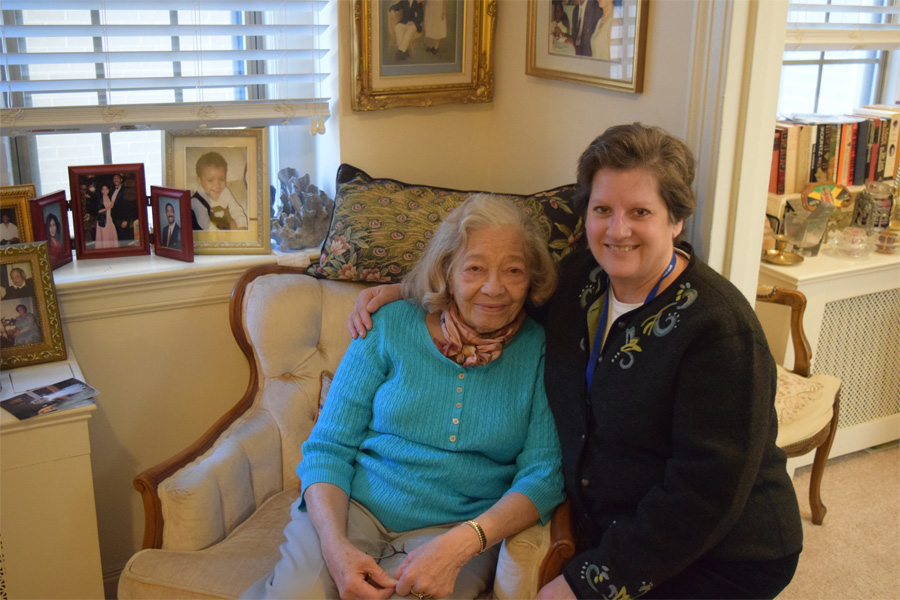
Nurse care manager Carol Kaplun (right) and client Lydia Robertson. You can read how Carol supports Lydia and her family here.

“There is often one email that was written in the middle of the night from an out-of-town caregiver who is distressed. It might be about someone who has fallen and is in the emergency room, or will be released from the hospital or rehab before they expected,” says Carol.

As a nurse care manager with Iona Care Management, Carol is equipped to help people who are facing seemingly insurmountable challenges as they interface with a complex and often fragmented medical system.

Carol gathers as much information as she can from the message and settles in to return the calls. One call is placed to a long-distance caregiver who is worried about the health of her father, who lives in the district. Her mother is in the dementia care unit of a local assisted living facility. Her father goes to visit every day, but lately on the phone he has sounded increasingly  foggy about the details of his day. Can Carol go visit?

Carol nods when she hears her say “I can’t believe that I already need Iona. I used to volunteer there when I was in high school.” Carol takes down all the pertinent information and places a call to the father who will be at home after he goes to visit his wife at lunch time.

10:00 AM

Carol finishes her calls and emails and grabs a folder of information that she has gathered for her next clients, a husband and wife who called because they were feeling overwhelmed by the volume of information about long-term care and the choices that they will have to make as they grow older.

When they called to set up the appointment, they made it very clear that they love their home and want to remain in it for as long as they can even though the wife has arthritis and their children live very far away. They want help from an objective and knowledgeable professional who can help them navigate some of the issues that they might face with a chronic illness and options they have for growing older in their own home.

“Sometimes we help people identify the problem. With this couple, they had identified the problem pretty well. What they needed help with was identifying the resources and an understanding of ways they could accomplish their goals within their financial resources,” she says.

The couple left an hour later with their decisions and some strategies they could employ to make those decisions in a timely manner. “That’s the very best scenario. They are taking the time to develop a coordinated plan before a crisis.”

11:30 AM

Carol grabs her bag to drive to an area rehabilitation unit to meet with a discharge planner. A daughter had to return home to another city after attending to her mother and so called Carol to be at the discharge meeting and report back. The return of her mother to her home is pretty straightforward, and Carol calls to walk the daughter through the home health care and medical equipment needed for this transition.

Iona’s loan closet can supply a walker which Carol will deliver once the mother is at home, but arrangements need to be made for a delivery of other equipment to the house. The call should take only a few minutes, but the daughter feels aching guilt about needing to be away during this transition.

Carol listens attentively and validates her concerns, offering advice on how to seek support in her hometown and to identify strategies that will allow her to care from a distance. Carol assures her that she has seen people recover from this type of injury and that she is only a phone call away if more followup is needed at a later time.

2:00 PM

After her visit to the rehab unit, Carol heads to the meeting with the gentleman who is home from visiting his wife at the assisted living community. The “fogginess” that the daughter hears on the phone from her father seems to Carol to be evidence of mounting caregiver stress related to his wife’s decline in the assisted living community. In addition, the father reports, “This house is getting beyond me. I can’t care for her and do the maintenance that I need to do.” Would it help if Carol arranged a time for him to come to the office and get on the phone with his family and talk through the next steps and all the resources that are available with Carol present? The relief on the father’s face is immediate.

They arrange a time to meet. Carol refers him to the local aging-in-place village for volunteer help around the house.

Sometimes the hardest thing to do is to ask for assistance, especially when there is a sense that you don’t want to burden your children. Sometimes there are differing opinions about what the next step should be.”

– Carol Kaplun, Iona nurse care manager

Iona care managers can help families negotiate difficult decisions about long term care or other needs.

3:30 PM

Carol’s final visit of the day is with a woman who was referred by her building manager to Iona a couple of months ago. When Carol visited her for the first time she had to call 911 because it was obvious that the woman’s blood sugar was dangerously low. “She was increasingly unresponsive as my first visit progressed,” Carol remembers. “No wonder her neighbors were concerned.”

Since the woman lived alone and there was no immediate family, Carol served as an advocate for her in the hospital emergency room and later assisted the discharge planner at the hospital with an assessment of what she would need to return home safely. Carol arranged for resources like an emergency response button, home delivered meals and transportation to and from doctor’s appointments. The woman is doing well on her own and is about to celebrate a 92nd birthday. It is a good way to end the day.

5:00 PM

Finally, Carol heads back to the office with the copious notes she took today that will need to be typed in a report to caregivers. She knows that tomorrow when she logs onto her email, there will be another family to help, another way to give back to a generation that she respects and admires, and another way to be an important resource in the network of care for seniors in the community.

May 6 – May 12, 2017 is National Nurses Week. Here at Iona, we are thankful for the nurses and nurse care managers who help older adults in our community remain healthy and safe, and provide expertise, oversight, care coordination, and support for family caregivers. Thank a nurse in the comments below! 

Celebrate Older Americans Month: How do YOU age out loud?

Every May, our nation celebrates Older Americans Month (OAM) to honor the many contributions of older adults. This year’s theme, “Age Out Loud,” shines a light on how older Americans are thriving, engaging in their communities, working longer, and trying new things.

What does ‘Age Out Loud’ mean, you might ask? According to the OAM website, its about giving aging a new voice to better reflect what older adults have to say about aging today.

It’s an opportunity to celebrate what aging really looks like, as “older Americans are working longer, trying new things, and engaging in their communities. They’re taking charge, striving for wellness, focusing on independence, and advocating for themselves and others.

Age out loud transitions in aging support group
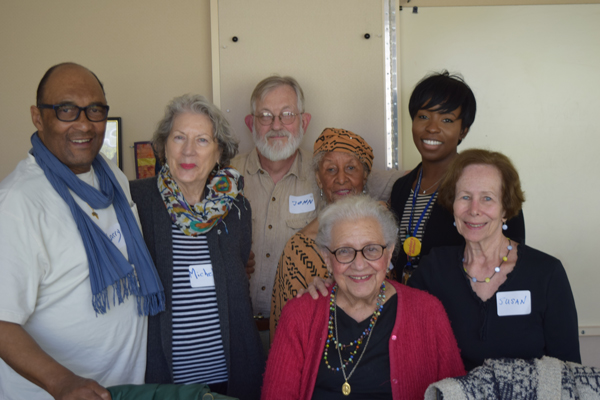
Participants in the Transitions in Aging Support Group at Iona ‘Age Out Loud’ by building community, sharing experiences, volunteering, and continuing to explore and grow.

Here at Iona, we’re proud to celebrate Older Americans Month and highlight the many contributions of older adults in our community. Like Stella Clarke, better known as Starr, who ages out loud through dance. Or Gil Lavine, who found new passions after an unexpected retirement.

And, in fact, our participants age out loud every day: some are taking charge of their health and wellness, others are volunteering, fostering new passions, or creating connections. Courtney Tolbert, program manager of Iona’s Active Wellness Program at St. Alban’s, has a front row seat to aging out loud. 

Iona’s participants are ‘Aging Out Loud’ when they come to Iona, because in doing so, they’re taking an interest in their own lives and creating friendships and relationships,” she says. “They have put aside their fear of loss, and instead embraced the ability to still acquire, even though it’s different than what they were used to.

“That’s living out loud – to not overly value what you’ve lost, and have it in mind that you can still gain so much and have a certain ‘je ne sais quoi’ for life. And when you think about it, that’s really what Iona is all about: recognizing and embracing all of the opportunities of aging despite the many challenges.”

To celebrate Older Americans Month, we asked participants and other friends of Iona what aging out loud means to them. Here’s what they had to say:

I’m a retired surgeon, so it’s really important for me to continue to do activities that are useful to other human beings. Volunteering helps me while also helping the participants. They benefit by increased nutrition and health, and we both benefit from engaging socially.

I think it’s really good for all older adults to continue to provide useful services to other people, health permitting, even into old age. Keeping active is good for your brain, good for your heart, good for your whole life. Helping others keep healthy keeps me healthy – volunteering is an opportunity to get out there and engage in a meaningful way.

It’s so important to continue to do good and contribute to other people’s lives, no matter what age you are. A lot of older people don’t think they can continue to do good if they’re retired, but they can help themselves by getting out of the house and helping others. That’s how I age out loud.”

– Tom, Active Wellness Volunteer


To age out loud, I eat right, stay active, and take care of myself as best I can. Iona helps me do all of those things. I live alone, so Iona is a really good way to get around other people because I don’t think I would otherwise. I’ve made a lot of friends and they are what keeps me coming back everyday. Also, the daily lunches are a big plus – I’m not much of a cook and never have been, so it’s a good way to get a healthy meal.”

– Lisa, Active Wellness Participant


Iona allows me to ‘Age Out Loud’ by volunteering: meeting new people, socializing, and giving back to the community, which means a lot to me. Most of the participants are the same age as me, but it improves my day to day life to interact with my peers and help them at the same time.”

– Drew, Active Wellness Volunteer


I’m 66, and I have felt that at every gateway – turning 40, turning 50, turning 60 – I have felt younger than I anticipated feeling at that point in time. I am still quite active, I do a lot of traveling, and I continue to do some consulting, though I have been retired for a number of years.

I am finding that one of the nice things about getting to my stage of life is that it is very, very liberating. I think, if anything, it’s made me more willing to reach out and take risks. I think I am beyond a lot of the hangups and fears that I had as a younger person, and I feel that I have the ability to mentor and reach out to the extent that people are interested in what I have to share. ”

– John, Transitions in Aging Support Group Participant


 Just a small story I’d like to share, which I always laugh when I think about it. About ten years ago, if somebody would get up on the Metro to give me a seat, I would be absolutely upset for three weeks afterward that they would think I needed that. But now, if nobody gets up to give me a seat, I get furious!

To me that’s a metaphor about aging – we don’t want to be thought of as old, but on the other hand, some of us would like to sit down when we get to a certain place in life.

The thing that I find to enjoy about this age is that I want to be out there doing things, and I’m not so worried about playing to perfection anymore. I think I’m a lot more courageous about what I risk doing or saying, like the story I just shared.”

– Susan, Transitions in Aging Support Group Participant and Volunteer Co-Facilitator


“I have always been active all my life, so I find as I’m getting older that a lot of my independence is dissipating. I love music, I love plays, and when I have a chance I get out to attend these things. I have an open mind, and I’ve been fortunate enough to do a lot of traveling.

I find coming to Iona to be very engaging, and I look forward to being here because of who I encounter and the conversation going back and forth. I like getting out, I like talking with people, and this is just another avenue for me to be able to do so.”

– Lillian, Transitions in Aging Support Group Participant


Whether it’s by giving back to the community or simply being a part of it, it goes without saying that older adults are ‘Aging Out Loud’ everyday. 

How do you Age Out Loud? Let us know in the comments!

By Ali Perry

Ali Perry is a Communications and Marketing Intern at Iona, and a former volunteer at our Active Wellness Program at St. Alban’s. She is a senior at The George Washington University studying Human Services and Social Justice, and intends to pursue a career in Nonprofit Management. 

Feedback for Iona