The Consumer Health Foundation is a non-profit organization that provides funding to programs with the goal of improving the health and wellbeing of low-income communities and communities of color in the Washington, DC region. One area that the CHF focuses on is advancing the direct care workforce, whose members often struggle with low wages and poor job stability. The Consumer Health Foundation understands that direct care workers provide invaluable personal care assistance to disabled and elderly people, and that by ensuring a strong workforce, consumers in need will receive adequate care.
With the theme of “Quality Jobs, Quality Care” in mind, the DC Coalition on Long Term Care conducted interviews with three stakeholders in the direct care workforce, which were then published on the Consumer Health Foundation’s blog. We are proud of the DC Coalition on Long Term Care’s contributions, and thankful to the Consumer Health Foundation for providing this opportunity.
We invite you to view the blog posts, which are listed below:
In this interview, the LTC interviews Daniel Wilson, the Director of Federal Affairs at Paraprofessional Healthcare Institute. Mr. Wilson advocates for better job quality in the direct care workforce, and tells us he supports the idea of a direct care cooperative as a way to motivate workers and enhance their skills. Read it here.
In this Q&A, Marla Lahat discusses the challenges of providing direct care workers with adequate wages in a system that is not generous with reimbursements. Ms. Lahat is the Executive Director of Home Care Partners, one of DC’s longest running Home Health agencies. Read it here.
In this interview with Karen Skinner, the Executive Director of the DC Board of Nursing, the LTC discusses why direct care workers are a frequently overlooked group in the healthcare field, despite their growing presence and the essential services they provide. Ms. Skinner suggests that if a national Home Health Aide association existed, there would be more lobbying efforts on behalf of this workforce. Read it here.
By Rebecca McDermott
Rebecca McDermott is an intern for the DC Coalition on Long Term Care and the DC Senior Advisory Coalition. She is currently a junior at American University, pursuing a Bachelor of Arts in Public Health. Her interests in the public health field include policy, advocacy, and program planning, and she is passionate about health equity and supporting vulnerable populations.
Many older adults consider planning for their long term care to be akin to planning for their final days. Wouldn’t any one of us push back on such a task or deny that it will ever be needed? The problem is we are emotional human beings that often ignore facts and statistics, even to their own detriment.
Let’s consider the act of planning for our children’s college by starting a savings account, yet we know not all children go to college. We have homeowners insurance, and yet most of us don’t know anyone who actually had their house burn down. When was the last time you actually used an umbrella, but you probably own at least a couple, just to be prepared. Planning is something we do naturally, but not when it comes to our later years.
We know Baby Boomers are turning 65 at a rate of 8,000 – 10,000 per day, US Census.
We know at least 70% of individuals over age 65 will need some long-term care services, per the U.S. Dept. of Health and Human Services.
We know Medicare does not pay for long-term care.
We know in 2015 the U.S. General Accounting Office estimated the median savings for households age 65-74 to be just $148,000.
We know that the average annual cost of a skilled nursing home stay is $91,250, per a recent 2016 study by Genworth.
Last but not least, in 2015 the GAO found 52% of all U.S. households age 55 and older have NO retirement.
While you may be the lucky one who is right when you say “It will never happen to me,” the odds are definitely not in your favor that you won’t need some long term care assistance. Just stop and think about how many family and friends you have who are much older than anyone thought they would be. So the real question you need to consider is what to do next. Putting your head in the sand is not a planning process recommended by anyone I know. You may be chuckling at that image, but all too many seniors are doing just that.
Like any puzzle there are many pieces to review and put together to construct the final picture. The process to evaluate and establish a long term care plan may seem daunting, but you are not alone. Start taking steps in the right direction by attending any one of the educational series offered by Iona Senior Services, visiting your local library or Area Agency on Aging in your community, or simply come back here for some fun and informative articles.
by Rick Gow, CSA Certified Senior Advisor & Wealth Management Advisor with Lara, May & Associates, LLC. Member FINRA/SIPC
Rick Gow is a seasoned Wealth Management Advisor, a member of the Society of Certified Senior Advisors®, facilitator of the Meaningful Future Process™ and nationally recognized speaker on many senior related long term care financial planning topics. He primarily works with seniors, their caregivers and family members, related to all aspects of financial planning for long term care needs. He helps develop all-encompassing long term care plans, tax efficient wealth transfer structures and retirement strategies. Most plans start with his Long Term Care Financial Assessment that addresses various components: from income generation, Medicaid & Veteran’s Administration compliant insurance products to real estate transfer strategies and principal protection, just to name a few.
Special Guest Artists (husband and wife duo!) James Landry, painter, photographer, and musician, and Nicole Burton, author, share their inspiration and creative processes. Enjoy their artworks on display in the Lois and Richard England Gallery at Iona through January 9, 2017.
Q. When did you first start creating art/writing?
James: I always wanted to “do” things: take pictures, make music, make paintings. For me, these activities all seemed like the same thing. I’m a photographer, painter, musician (keyboards), blogger, poet, performer, husband, and father.
Nicole: I started writing as a child and have kept a journal my whole life. I was relinquished as a baby and grew up in an adopted home. Writing stories, I could be truthful and explore the mysteries and possibilities around me.
Q. Since then, how has your artwork/writing evolved?
James: After obtaining a B.A. from the University of Bridgeport, CT, I moved to San Francisco. There I got a Nikon, my first “real” camera, and learned to process film and make B&W prints. In 1972 I moved back to Washington, D.C. and eventually started a band, Acrylix. We toured the East Coast, from New York to Miami. In 1985, the band reorganized as Shocko Bottom, named after a neighborhood in Richmond, VA. In 1988, I married Nicole Burton, a playwright and actress. We have always supported each other as artists. Nicole: I wrote stories and poems and acted in theater throughout my teens. A friend suggested I try playwriting because my poems often had dialogue. As soon as I tried the form, I was hooked. She and I started a Brechtian theater company in DC called Everyday Theater. I studied English and playwriting at the University of the District of Columbia where I received my B.A. in 1989. I worked for years as a writer-editor for the federal government, always writing and producing plays on the side. I enjoy all kinds of writing but plays have my heart. They’re challenging!
Q. Where do you draw your inspiration?
James: From everything. The world around me. People. Buildings. The light, shadows. In San Francisco and DC, the light and the diverse buildings fascinate me so I created a series called “Urban Landscapes.” When our son was young, there were small toys everywhere in the house. The “Boy Toys” photographic series was born, closeups of the tiny faces and figures of the toys. When I began making large acrylic paintings, I painted abstracts from the urban landscape photos and eventually, pixelated close-ups of portraits of people, toys, and icons, which became the series, “Pixelated Portraits.”
Nicole: I’ve been blessed with a fascinating life: multiple, blended families; reunion; immigration to the U.S.; travel; motherhood; activism; and a public service career so I never want for material. My favorite theatrical genre is drama that’s dark yet redeeming. I love the intersection of the personal and political. Everything’s political. Everything’s personal. I’m never bored. Like James, I find material all around me.
Q. What is your artistic/writing process?
James: I use the materials at hand in my studio in the basement. I paint with acrylics, never could wait for oil to dry. When I was painting large canvases, I’d plan out the painting meticulously. I’d enlarge and “pixelate” the image, print it out, and create a grid on canvas before I painted. As soon as I finished a painting, I began another one.
Nicole: I set aside a few mornings a week for uninterrupted time. I can really focus when I let myself. I usually wait until a subject taps me repeatedly on the shoulder before I commit to writing a play about it because we’re going to be living together for years. Many of my plays have been historical and involve research. I generally outline and write character histories before I begin but at some point, it’s time to put away all notes and research and write.
Q. Has your process changed as you’ve aged?
James: I’m painting smaller and quicker pieces now, usually works on paper with acrylic paint, spray paint, or pastels. Whatever we get at the arts supply store! Plus shells, rocks, driftwood, leftover building supplies.
Nicole: Yes and no. Writing a play always feels like jumping off a cliff but now I know I’ll survive. There’s still so much I don’t know about playwriting but the constant learning makes it fun. Every play has something to teach me. I’ve rejiggered my definition of success. I try to make my own success through self production and by starting my own publishing company, Apippa Publishing Company, to publish our books.
Q. Are you involved in each other’s projects. Describe that relationship.
James and Nicole: Yes! All of the above. I published James’ color photography book, Memory Music, and we’ve performed several multimedia shows jointly. We work together and help each other. James has always been a truthful, no-nonsense early reader of my work.
Q. What does “creative aging” mean to you? Has having the arts in your life informed other aspects of it?
James: It means you keep on working. Artists cannot stop. The only time you stop is when you’re dead.
Nicole: Art is a never ending inspiration and teacher. The older I get, the more I enjoy the process of writing.
Q. What do you hope to evoke from visitors with your exhibition in the Gallery?
James: That they come in happy and go out happy. Uplifting. Though art, this is not hard to do.
Nicole: What he said.
James: Where’s the money?!
Nicole: (laughs).
Want to hear more from our artists? Check out our upcoming events here (scroll down to see our next arts events).
Each year, from October 15 through December 7, Medicare beneficiaries may make changes to their healthcare and prescription coverage for the following year. Specifically beneficiaries may change their healthcare coverage between Original Medicare and Medicare Advantage, and/or change their prescription plan.
Beneficiaries may alter their coverage for the coming year by phone, through a counselor, or online.
By phone: 1-800-MEDICARE
By counselor: Federally funded State Health Insurance Assistance Programs (SHIPs) provide free assistance to Medicare beneficiaries with open enrollment. Local SHIPs are listed below. To find a SHIP nationwide, visit the website of the SHIP National Technical Assistance Center.
(DC) – Health Insurance Counseling Project: 202-739-0668
(MD, Montgomery) – State Health Insurance Assistance Program: 301-255-4250
(MD, Prince George’s) – State Health Insurance Assistance Program: 301-265-8471
Online: Beneficiaries also can make changes online via Medicare’s Plan Finder. Tips on using Medicare’s Plan Finder can be found in this 12 ½ minute video by federal CMS, and/or this slide show by the state of Illinois.
Where to Find Guidance
Several nonprofits and government agencies offer free online guides for selecting among plan choices. Several are listed below.
Like most private health insurance policies, Medicare’s coverage is not free. Beneficiaries pay premiums, deductibles, and co-pays. These costs can be challenging for elders on tight or restricted incomes. Luckily, the federal government offers financial assistance to low-income beneficiaries in the form of Medicare Savings Programs, which help with costs associated with Medicare Parts A and B; and Extra Help, which helps with costs related to Medicare Part D.
Glossary
Extra Help – This subsidy, for low-income beneficiaries, helps cover some of the costs of Medicare Part D.
Original Medicare – One of two ways in which a beneficiary may choose to receive coverage (the other is Medicare Advantage), Original Medicare operates like many traditional health insurance policies, in that beneficiaries may choose their own medical providers (so long as the provider accepts Medicare). Original Medicare consists of Medicare Parts A and B.
Medicare Advantage – See Medicare Part C.
Medicare Part A – Part of Original Medicare, this subsection of Medicare covers inpatient (e.g. hospital) care.
Medicare Part B – Part of Original Medicare, this subsection of Medicare covers outpatient (e.g. medical appointments) care.
Medicare Part C – Also called, Medicare Advantage, this program offers managed care coverage equivalent to care under Medicare Parts A & B (of Original Medicare); and may offer additional coverage for care (e.g. dental, and eyeglasses) not covered under Original Medicare.
Medicare Part D – Covers the cost of prescriptions.
Medicare Savings Programs – These subsidies, for low-income beneficiaries, helps cover costs associated with Medicare Parts A and B.
Medigap – These secondary insurance policies, sold on the private market, cover costs that Medicare doesn’t cover, including premiums, co-pays, and deductibles.
By Leland Kiang
Leland Kiang, LICSW is manager of Iona’s Information & Referral Help Line, whose staff answers questions about senior services throughout the DC metro area. Leland also has written articles for BIFOCAL, Unite Virginia, and the National Resource Center on LGBT Aging.
Rose Clifford, Iona’s licensed dietitian nutritionist, is a senior hunger advocate – a warrior in the tireless fight against senior food insecurity and malnutrition.
I’m often asked what I do in my role as Iona’s licensed dietitian nutritionist. Many think I spend my days telling people to eat this, but not that. “Not quite,” I say. Though I am Iona’s Nutrition Program Manager, I primarily work as a senior hunger advocate – a warrior in the tireless fight against senior food insecurity and malnutrition.
While no one should go hungry or lack access to sufficient healthy food, all older adults are particularly vulnerable to the effects of food insecurity, hunger, and sub-optimal nutrition. The National Foundation to End Senior Hunger’s June 1, 2016 release of the State of Senior Hunger in America 2014 Annual Report found that 1 in 5, or 20% of DC seniors overall face the threat of hunger. DC is ranked #7 in terms of the worst states/communities in the United States for the threat of senior hunger. Imagine that.
I know what you’re thinking: “But, what about Ward 3? There can’t possibly be hungry seniors even in our tidy, mostly well-off Ward 3 neighborhoods?!?!”My response? This is a problem that affects all of DC. In fact, my team and I spend our days tirelessly fighting on the front lines of senior hunger right here in Ward 3.
An Iona Client
Take for example, a current client who is a 77 year old male. In June of this year, he was referred to me by his social worker because he had lost 63 pounds in 6 months. He looked haggard, weak, and underweight. He’d had all kinds of sophisticated, invasive, and costly medical tests and procedures to rule out everything from an undiagnosed malignancy to gastrointestinal disease. All of the testing was inconclusive and provided no cause for his unintentional weight loss.
Imagine his anxiety level and distress, just trying to survive each day in this weakened state. I wish this was an unusual situation or referral, but in Iona’s work, it’s common.
Did anyone think to investigate his nutritional situation or ask this man if he had enough food to eat before thousands of dollars were spent on medical tests? Such a simple, basic human need and right – to have sufficient good-quality food to eat in order to maintain health and a good quality of functioning and life.
Yet, here is an older adult who recently had only $7.00 left of his monthly income to last him the 10 days before he would get another social security check deposit in his bank account. In fact, he was so low on funds that he literally did not have enough money to buy food after the middle of the month.
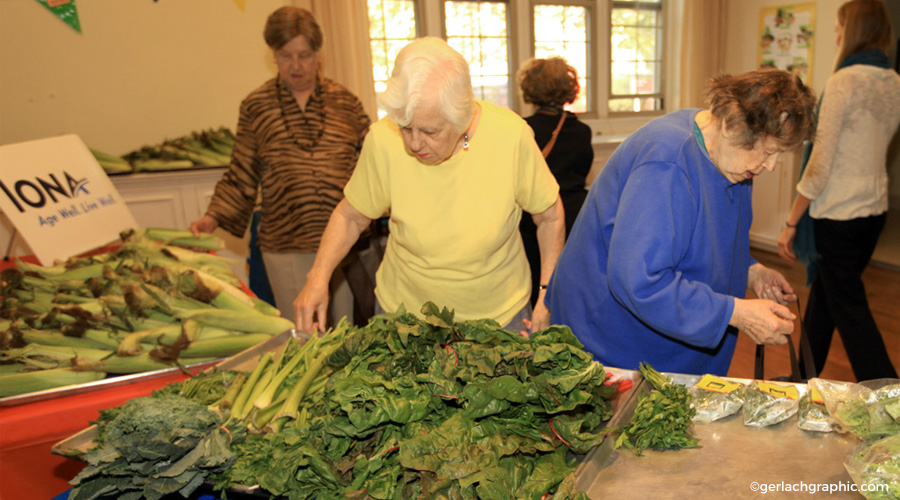
And while Iona does offer a free lunch for older adults every weekday (and a Farmer’s Market on Mondays) through our Active Wellness Program at St. Alban’s, he didn’t even have the bus fare to regularly get to and from our program. For this client and many others like him, senior hunger is a health issue with very high personal and economic costs.
A Hidden Secret
Senior malnutrition is often a “hidden secret” with devastating individual suffering and societal consequences. The estimated annual cost of disease-associated malnutrition in older adults in the US is $51.3 Billion.
Astoundingly, marginal food insecurity in older adults is functionally equivalent to being 14 years older. Food and nutrition issues are so important to good health and life quality for older adults, but are often poorly understood or go unrecognized. According to the DefeatMalnutrition.Today Coalition, up to 1 out of 2 older adults are at risk for malnutrition and up to 60% of hospitalized older adults may already be malnourished. Malnutrition increases the length of hospital stays, and leads to more complications such as falls and readmissions. Eighty-seven percent of older adults have one or more chronic diseases with nutritional implications, and based on the Healthy Eating Index, 83% of older adults do not consume a good quality diet.
But, back to my client.
Today, he has a steady weight, normal blood sugars (he has diabetes), a better sense of well-being, a community of friends, and a good level of energy and functioning. How did Iona step up to the plate to help him?
First, he was enrolled in our home delivered meals program, and receives 10 fresh Mom’s Meals delivered every two weeks. He also participates in our Weekend Meals program, receiving one hot and one cold meal delivered by our wonderful volunteers every Saturday. He receives several cases of a high calorie/high protein Boost Glucose Control liquid nutrition supplements per month, courtesy of the DC Office on Aging nutrition supplement program and donations from the community. He also receives a monthly donated food package valued at $45 through the Blessed Sacrament SHARE bulk grocery program. His amazing social worker restored his $18.00 per month SNAP (food stamp) benefit, got him new dentures, and also takes him regular deliveries from Iona’s food pantry.
Senior Hunger: A Complex Phenomenon
It’s also important to understand that senior hunger and malnutrition is not limited to low income seniors but is a complex phenomenon that cuts across all income spectrums and is often an access issue. Factors such as poor appetite, unintentional weight loss and frailty, isolation, decreased mobility, cognitive decline, psychosocial and mental health issues, nutrient deficiencies, poor oral health, and lack of transportation are common contributing factors to senior food insecurity and malnutrition. For these and other reasons, older adults or their caregivers are often unable to plan, procure, and prepare adequate, fresh, and nutritionally-balanced meals.
Putting an end to senior hunger and food insecurity in Washington, DC requires a coordinated effort by multiple stakeholders – please help us in our tireless efforts to set the table for our seniors.
Rose Clifford, RDN, MBA has practiced as a registered dietitian nutritionist in the Washington, DC area for over 30 years. Her current primary work as the Nutrition Program Manager for Iona Senior Services focuses on helping older adults maximize their nutritional health so they can live active, full lives in their own homes. Rose is an active member of the DC Office on Aging Nutrition Task Force and is FY17 co-chair of the Food & Nutrition sub-committee of the DC Senior Advisory Coalition.
The message on my voicemail was simply, “Call me when you can, I have a question to ask you.”
The caller was my aunt, just turned 70, who has relocated from the Northeast to the Southeast. She never married, and has no children. I’m the oldest in my generation, live the closest, and have expertise in aging issues by virtue of working at Iona for the last three years.
My assumption was that she wanted to ask me if I would be her decision maker if her health or memory ever failed enough where she needed help. So, I figured I should get ready.
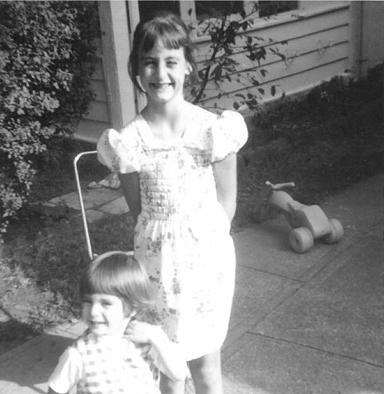
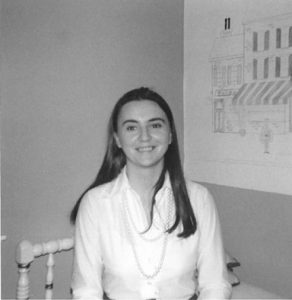
Iona’s Director of Development and Communications Susan Messina as a young girl.
Prior to joining Iona, I worked for seven years in fundraising for hospice. As a result, I feel I know a great deal about end-of-life decision making. I knew that people often needed help getting those conversations started and was a fan of Ellen Goodman’s Conversation Project and the excellent book, The Other Talk, by Tim Prosch, published by AARP. Both are top-notch resources that provide insights into how to engage family members in tough discussions about end-of-life wishes. I knew about advance directives (healthcare power of attorney and a “living will”) through the excellent resources offered by the National Healthcare Decision Day initiative and the National Hospice and Palliative Care Organization.
But, from working at Iona I also knew that for most people, death often follows years of illness, memory loss, physical frailty, or dwindling financial resources that pose significant challenges to older people themselves and, ultimately, their caregivers
So, I went to one of Iona’s geriatric care managers and asked her what else I should be prepared to discuss with my aunt, if this call were indeed the request I was anticipating. I learned that there was a lot more I needed to cover with my aunt and I needed to discuss a range of issues related to her finances. These included a general sense of her finances for long term care planning and a financial power attorney (POA).
The financial POA could be set up immediately, while my aunt is fully capable. Or, she could choose to use “springing language” in the document that would indicate that when doctors declare she no longer has the capacity to make financial decisions, the POA would go into effect.
We also discussed the value of my aunt and me potentially setting up joint accounts, so that both my name and hers would be on the accounts. In emergencies, a joint account would allow me to easily pay her bills. Down the line, I could also spot check her balances, if we felt that was necessary. I learned that one of the first capacities to be compromised by memory loss or cognitive decline is money management, and these simple changes can make a big difference.
So, armed with information and the desire to be a helpful niece, I called my aunt back, steeled for what could be an awkward conversation.
When Susan Messina received a voicemail from her aunt (pictured in this great vintage photo), she immediately jumped into action, consulting with one of Iona’s geriatric care managers.
And guess what? To my surprise, her question was NOT about whether or not I would play these crucial roles! It was about a much more mundane piece of family business. I had to laugh. But, since I was all teed up, I took the plunge. I said, “Well, I thought you were going to ask me if I would help you with financial and medical affairs down the line.”
Fortunately, my aunt was really glad I had raised the issue. She hadn’t really thought through all of those issues and was happy to have been given the opening to address them. I’m impressed with her; she immediately called her lawyer and her financial advisor to get balls rolling, and I know we will continue to talk about next steps as they come up.
I’m grateful that her mysterious “Call me back” message got me thinking and she told me she’s very glad we had the conversation. Even more so, though, I’m grateful that my time at Iona has taught me so much about the challenges—and opportunities—of aging.
By Susan A. Messina
Susan is Iona’s Director of Development and Communications. She holds three master’s degrees, including two from Bryn Mawr’s Graduate School of Social Work and Social Research, and is a Certified Fund Raising Executive.


 This month, the Consumer Health Foundation reached out to our friends at the DC Coalition on Long Term Care, which is housed at Iona, and requested their help in creating a series of blog posts for the Foundation’s website.