Bill and Sharon’s Story

“It’s been a long six years,” says Bill Schaefer. “It’s hard to believe it’s been six years, and it’s hard not to know how long it’s going to go on.” Anyone who has cared for a loved one with Alzheimer’s disease understands what Bill is talking about.

Bill and Sharon’s relationship is a story of love and loyalty. College sweethearts, married for 47 years with two grown children and two grandchildren, the Schaefers never expected that soon after they moved from their house to a condominium in a lovely, wooded neighborhood, they would learn that the agitation Sharon had been experiencing was Alzheimer’s. She was 63.

“From the start, I’ve tried to support Sharon in having the best life she can in spite of this,” Bill says. Needless to say, it hasn’t been easy. Gradually, their social world has narrowed dramatically. Friends stopped calling. One exception is Mary Lou Mcgee, an Iona Board of Associates member who walks with Sharon every week, just as they have for 30 years.

When Sharon was first diagnosed, one doctor gave Bill a book for caregivers with a title that said it all: The 36-Hour Day. “I’m tired,” he admits one morning, having been up the night before with Sharon, who also has type I diabetes. To maintain some balance in his life, he meditates for 30 minutes every morning. He recently rejoined a book club.

He has also arranged for Sharon to attend Iona’s Adult Day Health, Wellness & Arts Center two days a week, which allows him to meet friends for lunch, catch up on paperwork or just be by himself.

Prompted by Bill, Sharon—a former psychotherapist—offers her own take on the center. “I’m a booster!” she says. “it’s just got welcome all over it.” A recent New York Times article revealed that creating positive emotional experiences for Alzheimer’s patients diminishes stress and behavioral problems. The Schaefer’s son gave a copy of the article to his dad, with a note saying “that’s what you give mom.”

Bill gives Iona a lot of credit. “The center staff couldn’t be a more supportive and positive group, Bill says. “It radiates good will which, in turn, is picked up and radiated back by the participants.”

One staff member told him recently, “Even when Sharon gets agitated, she always resets to happy,” said Bill, who agrees. “After a day at Iona, she is more outgoing and has more energy. I’ve seen how the program lifts her spirits.”
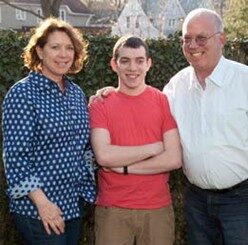

Eric’s Story

Iona’s caregivers’ support group for adult children “has been my calm in the midst of a storm,” says Eric Rosenberg, who struggles with the challenges of caring for an aging parent with dementia, navigating relationships with siblings who may not always see eye-to-eye and feelings about living far away from his mother. “While I am active in a variety of activities and organizations—from synagogue to cycling—Iona has become an unexpected yet welcome anchor in my life.”

The youngest of four, Eric grew up in Long Island. His mother was a housewife, his father a physician. He lost his dad in 1991. Then, in 2007, his mother Edith moved to Michigan to be near her oldest daughter. Not long after, she was diagnosed with dementia. “Once it starts, it’s a one-way street,” says Eric quietly.

Being 500 miles away in Washington, he felt alone and overwhelmed, with nowhere to turn. That is until the day he was driving through D.C. and saw the Iona sign outside the Isabella Breckinridge building. His curiosity led him inside, where he was greeted by two friendly staff members who listened intently to his story, handed him a copy of Iona’s Resource Guide and told him about the support group for adult children. “Their encouragement gave me hope,” says Eric. “If Iona did nothing else but give people hope and produce the resource guide, it would be enough,” he says. The book is “a goldmine of information.”

Eric rarely misses the bi-monthly support group, which is led by licensed clinical social worker Donna Tanner. (Iona also offers support groups for caregivers of spouses/partners with dementia, an Alzheimer’s Association caregivers support group, a group for people diagnosed with early stage memory loss and the people who care about them, a Parkinson’s group and one for people with low vision.) “Donna brings a quiet dignity to our group,” says Eric, adding that she validates everyone’s experience and is nonjudgmental. “The staff of Iona doesn’t care if you are Black, white, Jewish, Christian, gay, straight. Once you are there, it’s like getting a big hug. it’s a safe place to be.”

Eric says he has learned two key lessons from the support group. First “if you don’t take care of yourself, you can’t take care of someone else.” Secondly, “caregiving should start before the need becomes obvious.” In other words, don’t wait for a crisis. Reflecting back on his own experience, Eric regrets he didn’t take a more proactive role after his father died and left a large void in his mother’s life. If anything, he hopes others can learn from his experience, and from Iona.

Elaine’s Story

Elaine Kim is what you might call a late bloomer. an English major, after college she worked as a marketing and sales professional with a technology company. But she didn’t feel that job took full advantage of her skills or strengths.

“I’ve always enjoyed connecting with people one-on-one,” says Elaine, who is in her 30s. At the same time, friends have pointed out she is a good listener. At church, she was drawn to older members of the congregation. One of them in particular, a 93-year old World War II veteran, “exuded the spirit and joy of a kid,” she recalls. “I was in awe of the way he lived his life—with no regrets. He ultimately passed, but his spirit stayed with me.”

By that time, Elaine had enrolled in a social work program at the University of Maryland-Baltimore. As part of her studies, last fall she began an internship at Iona where her responsibilities include providing care management, counseling and advocacy for clients. She also helps staff Iona’s Low Vision Support Group. “Elaine is very caring,” says facilitator Elly Waters. “If she senses someone needs special attention, she will call and see how they are doing.”

Working at Iona has exposed Elaine to a model of service that balances respect for self-determination with protection of vulnerable older adults. “It’s an innovative way of thinking about geriatric care,” says Elaine who is focused both on assessing a client’s risks and needs and his or her strengths, ultimately trying to find the best way to play to those strengths.

As for Iona’s strengths, Kim says the organization “never loses sight of its mission, its vision and its goal of serving the community,” she says. “They have put and continue to put every tool in place to help staff achieve these goals. It’s obvious that every person who works here, from the bottom to the top, cares about the work they are doing. This is inspiring to me as an aspiring social worker.”

Caring for a Congregation

“Many of our members are caring for aging parents or neighbors,” says associate Pastor Steve Robertson of chevy chase Presbyterian church. “Our role is to make sure we are doing everything we can to offer the support and encouragement needed to perform these duties well.”

Steve works with the church’s deacons, whose assignments include visiting homebound congregants— from parents of newborns to frail seniors. in recent years, the pastor has worked to “strengthen the conversation with our deacons around their work with older adults.” Recognizing that these lay leaders are not formally trained as case managers, Robertson says, “my hope is they will be critical listeners and direct our members to useful resources in the community.”

One of the most valuable resources is Iona’s Deborah Rubenstein. a licensed clinical social worker and attorney, Deb has 15 years of experience as a geriatric care manager and psychotherapist. In her role as Iona’s Director of Consultation, Care Management and Counseling, Deb and her skilled staff frequently lead trainings at congregations.

In fact, Iona’s relationship with the faith community goes back to its founding 36 years ago when three local churches (St. Columba’s episcopal, St. Ann’s Roman Catholic and Eldbrooke United Methodist) joined forces to create an organization that would provide information to people in need. Soon after, Iona’s board voted to focus on older adults, regardless of their ability to pay. Today, 33 faith communities are part of the Iona family.

Increasingly, congregations are turning to Iona to learn how to support aging members and their caregivers. Paula Jennings was on hand recently when Deb spoke to a group at chevy chase Presbyterian. The discussion focused on a broad range of issues from progressive care to the emotional toll on caregivers. “Iona made it comfortable to speak openly and to ask questions—no matter how poignant they were,” said Paula. “By the end of the presentation, I was not only considering the needs of my mother and mother- in-law, but beginning to think ahead to a time when my husband and I would be facing our own issues relating to aging.”

Mildred’s Story

Mildred Howard has always worried about older sister Jessie Fulwood, who lost her sight as a child. Those worries increased when Mildred, who every day drove across town on her way to work to check on her sibling, discovered Jessie was being neglected by her caregivers. That is when Mildred invited Jessie to move in with her and husband Curtis Howard.

Soon after, Mildred enrolled her 76-year-old sister in Iona’s harry and Jeanette Weinberg Adult Day health, Wellness and arts center, which serves seniors with dementia, other chronic conditions and disabilities. Medicaid and support from Iona’s generous donors cover the cost of Jessie’s participation.

“Jessie Mae needs to be in a pro- gram rather than sitting at home all day with nothing to do,” says Mildred. “The people are real nice, she participates in activities such as art therapy and exercise which she wouldn’t have access to otherwise and two nurses monitor her blood pressure.”

“The center is good for both of us,” adds Mildred, 61. “it gives me the flexibility and independence to live my life and it’s a good fit for Jessie Mae.” how does she know? “Because she’s a chatterbox,” laughs the younger sister. “Every night at dinner, she tells us about the other participants, the staff and nurses. Clearly, she’s in good hands.”

Iona “goes above and beyond the call of duty,” adds Mildred. This winter, when they were without water for several days because of burst pipes, Iona saw to it that Jessie Mae had access to meals she normally would have had at home. “You don’t find programs like that,” adds Mildred.

Paralee’s Story

Paralee Thomas and Mary Frances McGuiness are sharing a moment—like two girlfriends spending the afternoon together. Only the moment is Paralee’s 96th birthday celebration and their relationship is so much more than friends. Paralee was Mary Frances’ childhood nanny and, before that, worked in her grandmother’s house as both maid and nanny, caring for Mary Frances’ mother and uncle.

“Paralee (pronounced ‘Pearlie’) raised us,” says Mary Frances, a member of Iona’s Board of Directors who lost track of her nanny until the two reconnected at a family funeral. By then, Mary Frances, who is from New York, had relocated to the Washington area to work in wireless telecom. Paralee moved here to continue working as a housekeeper, ultimately retiring in her mid-80s. “It’s difficult to age, no matter what the circumstances, but even harder if you lack a formal education, financial stability and the support of family,” says Mary Frances, who is helping Paralee address the many challenges of growing older.

For instance, Mary Frances, along with her husband and uncle, helped their friend navigate the complex Medicaid system, which ultimately allowed her to move from a subsidized apartment in a challenging neighborhood to a senior community at Thomas Circle. “I can understand how people die in their homes while trying to figure out how federal assistance programs work,” Mary Frances says. “You feel like a rat in a maze that has no exit. I see why people give up.”

Caring for an older loved one “can be exhausting, even depressing,” she adds. “However, there is a silver lining. I have met many people—starting with the staff of Iona—who are silent heroes of our community. Iona provides one-stop shopping, they know the city and offer personalized service. If I have to go through this experience again with a family member—or should I say when I go through this again—I will know what to expect and where to turn, thanks to Iona.”

Ruth’s Story

A mother of four sons, she has seven grandchildren and 10 great-grandchildren, all living on the West Coast. Family members call her “Dolly.” She accompanied her father when he voted for Republican Calvin Coolidge, and has supported every Democratic candidate for President since. Last year, she met with First Lady Michelle Obama to talk about healthcare reform. When she’s not writing a weekly legislative update for the Older Women’s League, serving on the Clearinghouse on Women’s Issues and the National Council of Women’s Organizations, she enjoys her friends, participates in Iona’s activities and testifies before the City Council. At 96, her mantra is: “Age is just a number, and it’s unlisted.” Meet Ruth Nadel, the face of Iona.

Or should we say, one of many faces of Iona. From active seniors like Ruth Nadel to individuals with Alzheimer’s disease or other chronic illnesses and disabilities who participate in Iona’s Weinberg Adult Day Health, Wellness & Arts Center, Iona supports men and women as they experience the challenges and opportunities of aging. We educate, advocate and provide community-based programs and services to help people age well and live well.

The many faces of Iona include caregivers concerned about or caring for an elderly relative, advocates committed to helping members of our community with unmet needs, hundreds of volunteers who assist in the Adult Day Health, Wellness & Arts Center, deliver meals on weekends and holidays, help with errands, visit homebound seniors and provide leadership and guidance to the organization. And the face of Iona includes donors who believe in our mission to age well and live well. On the following pages, we will show you one face of Iona through the story of Ruth Nadel.

An advocate by nature, Ruth started out in her mid-50s working in the U.S. Department of Labor Women’s Bureau, the only federal agency devoted exclusively to the concerns of women. Up until then, she had many years of volunteer experience, but none as a paid professional. Ruth was among the first women recruited and hired based on the value of her volunteer work—leading the way for others who followed. Not only that, but she was honored with the Department of Labor’s Distinguished Service Award for her work designing and developing the first federal childcare center. In addition, for many years she has been a member of Iona’s Citizens Advisory Council and the D.C. Coalition on Long Term Care, which advocates on behalf of the District’s older adults and people with disabilities. She’s particularly impressed with the range of occupations and interests of members of the coalition, which includes consumers, advocates and health care providers. Ruth also represents Ward 3 on the D.C. Commission on Aging, where she works to promote the challenges of the city’s aging population, and the many services provided by the Office on Aging. Well over a dozen years ago, recognizing real needs among the aging and disabled residents of her large apartment building, she organized the beginnings of the volunteer Neighbor Network (vNN), a precursor to today’s neighborhood “villages.” “Iona was a resource then, helping to develop a questionnaire of resident’s needs and assistance, and continues to be a resource today,” she says. The Citizens Advisory Council, she says, is eager to replicate the vNN model. “I’m very impressed with Iona’s leadership role in guiding today’s aging-in-place village movement,” adds Ruth.

“I am prone to ‘fall.’ But I like summer better.” Displaying her characteristic sense of humor, Ruth recounts how she took a nasty fall in the middle of the night last December. But there’s nothing funny about the damage that tumble did, requiring months of intense physical therapy.

Ruth learned a valuable lesson that night. “I didn’t want to bother anyone,” she says. So she didn’t. “I didn’t want to cause a fuss, but in the end that’s exactly what I did,” she comments. While she notified Link to Life, she didn’t ask for their help, which she now acknowledges was a mistake. Ruth finally reached out for help in the morning and went to Sibley Hospital at a friend’s urging. An Iona Care Manager was able to develop a rehabilitation plan, providing Ruth with support and her family with peace of mind. “Over the years, I have personally referred friends and acquaintances to Iona,” she says. “No one does a better job of providing older adults and their caregivers with the opportunities and resources to age well and live well. Now I have the personal experience to back that up.” Ruth is now fully recovered, enjoying life at a D.C. retirement home and back to her old habits.

“I doodle,” says Ruth. “Always have.” As a member of the Older Women’s League and the Women’s National Democratic Club, Ruth spends countless hours attending meetings where, she confesses, she frequently finds herself doodling. Many of her favorite drawings are displayed on the walls of her kitchen. She also paints and has often enrolled in a watercolor class at a local university. “It’s important to provide seniors with opportunities to be creative,” Ruth declares. Iona knows this well, she says, noting that art therapy is an important element of Iona’s Weinberg Adult Day Health, Wellness & Arts Center and the Gallery at Iona offers important recognition and inspiration for older artists and art admirers. Ruth is particularly impressed with the variety and quality of art displayed in the Gallery— “worthy of an art critic’s review,” she observes.

Before giving a lecture on volunteerism recently, Ruth looked up the word “volunteer.”

While the formal definition is “a person who undertakes or expresses a willingness to undertake a service,” Ruth declares there’s something else. “You alone make the decision and it has to give you pleasure,” she says. It’s clear she gets personal satisfaction from serving on Iona’s Citizens’ Advisory Council and the many other organizations to which she is devoted. She also points out while many people are able to volunteer their time—whether a day a week or a day a month—nonprofit organizations like Iona also largely depend upon financial contributions. Ruth was among the hundreds of supporters who attended Iona’s Art of Caring Luncheon and the benefit concert featuring the Young@Heart chorus. “Funds from events like the concert are critically needed to make our services available to people of all income levels,” she notes. “The standing-room- only crowd is evidence of how the broader Washington community values Iona.”

Your Year-End Gift Can Bring Hope to Older Neighbors—Double Your Impact Today

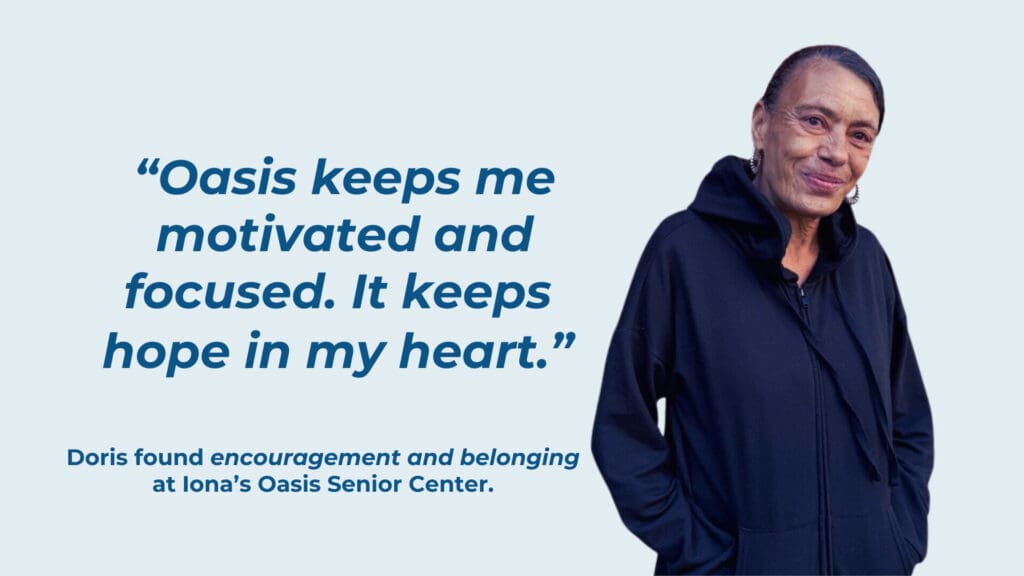
Each day at Iona’s Oasis Senior Center, you can feel the profound impact of community—a place where older adults who’ve endured homelessness or hardship rediscover belonging, purpose, and dignity. For Doris, a lifelong Washingtonian, Oasis has become a source of strength, comfort, and renewed hope for the future.

Newly retired and seeking connection, Doris followed a friend’s advice to visit Oasis—and found a welcoming community that brightened her days.

“Oasis keeps me motivated and focused,” she says. “It keeps hope in my heart. The people here are positive. They make this program special.”

At Oasis, Doris spends her days sharing meals, exercising, going on group outings, and looking for jobs. It’s more than just a place to spend time; the center gives her structure, encouragement, and the sense of belonging she needs.

“God and Oasis keep me going,” Doris says. “I have somewhere to go and something to do. I am grateful for that.”

Now, Doris is working toward new goals — paying off debt, furnishing her apartment, and securing employment. She says she would not be where she is today without the support and kindness she’s found at Oasis.

When asked what she’d tell the people who make Oasis possible, she says, “Thank you for a wonderful program, don’t ever stop. It’s the best program I’ve ever been to.”

Your generosity makes stories like Doris’ possible. Yet the need is growing: more older adults are struggling with housing insecurity, food costs, and the absence of dependable support. Your gift ensures that Iona can keep offering safe, welcoming spaces where hope is restored.

Can we count on your support with a gift to help older neighbors like Doris maintain safety, stability, and connection?

The United States has seen the highest number of people experiencing homelessness ever recorded. On a single night in 2024, 771,480 people, about 23 of every 10,000 Americans, were without stable housing.

In the D.C. region, people over 55 now make up nearly half of all individuals without housing, with single adults in that age group representing the largest share of a rapidly growing population.

At Iona’s Oasis Senior Center, we are meeting this crisis head-on. This year alone, our team has helped 18 older adults secure permanent housing, and we’re walking alongside more as they search for a safe place to call home.

Oasis provides not only nutritious meals, activities, and supportive services, but also a place of belonging. For participants like Doris, it’s a community that offers stability and the encouragement to keep moving forward.

With SNAP benefits disrupted by the recent government shutdown, 24,000 seniors in D.C. face increasing uncertainty. That is why Iona is stepping up. Through 12 community dining sites across the District, we provide warm meals, wellness programs, and social services for residents aged 60+.

Make your end-of-year gift today to double your impact through a matching gift challenge. Your generosity will go twice as far to provide safety, dignity, and hope to vulnerable neighbors.

  • $50→$100 – Helps fill four bags of nutritious groceries for an older adult
  • $100→$200 – Helps cover the cost of Iona’s Aging Solo course for four older adults
  • $250→$500 – Helps provide transportation for 10 participants to our adult day health centers
  • $500→$1,000 – Helps fund two months of support group sessions for a caregiver

As we approach the end of the year, your support is more critical than ever to ensure Oasis remains a lifeline for those, like Doris, with nowhere else to turn.

Thank you so much if you’ve already made a gift! If not, will you join us in supporting older adults in our community?

With Gratitude,

Joon Bang

CEO, Iona Senior Services

Help During the Holidays

Please note: Iona’s offices and programs will be closed on Thursday, December 25, and Friday, December 26, 2025, in observance of the holidays and to provide respite for our staff. We will also be closed on Thursday, January 1, and Friday, January 2, 2026. We will reopen on Monday, January 5, 2026. 

The holidays can be a challenging time for many reasons. Should you or someone you know need support when Iona is closed, please reach out to the following resources:

Food

Food Resource Guide: Wards 2, 3, 4, and 8

Bread for the City: Food Pantry and Free Farmers Market open Monday-Thursday 9 a.m. – 12 p.m. and 1-3 p.m. Current DC identification OR proof of DC residency (within 3 months) is required. Free Farmers Markets: Free, fresh, and seasonal produce. Fridays from 9 a.m. – 11:45 a.m. or until food runs out, whichever comes first.  

Capital Area Food Bank: To reach the Hunger Lifeline, call (202) 644-9807 or e-mail hungerlifeline@capitalareafoodbank.org. To utilize their interactive map to locate food resources in your area visit https://www.capitalareafoodbank.org/find-food-assistance/

NW Community Food: Non-profit organization dedicated to supporting individuals and families in DC with fresh produce, shelf-stable foods, household and personal hygiene items. Provides resource links to DC residents (Legal services, Immigrant Advocacy, WIC, Crisis intervention, Mutual Aid, Clothing). Open Sundays 1 p.m. – 3 p.m. 

4340 Connecticut Ave, NW 

St. Paul’s Weekly Lunches: Prime Time Center at St. Paul’s Senior ministry gathers on Wednesday for seated exercise followed by pre-plated lunch and entertainment. Welcome to those 50+ and vaccinated. Pre-registration is required. Please notify Joy Belew by 11 a.m. on the Friday prior to each week’s program to participate. Wednesdays, 11 a.m. -2 p.m. 

4900 Connecticut Ave., NW 

Phone: (202) 966-5489 

Email: joyb@stpaulslutherandc.com 

Woodley House Food Pantry: Provides food staples, frozen meat, and fresh produce to Woodley House residents and community neighbors in need. Tuesdays 1 p.m. – 2:30 p.m. Open to all DC residents. Must provide proof of residency with current photo ID, passport, or utility bill, etc. 

Valenti House 

2711 Connecticut Ave., NW 

Phone: 202-830-3508

Warming Centers

Find a list of locations that are open when DC Government activates the Cold Emergency Plan: https://snow.dc.gov/service/warming-centers-and-facilities 

Mental Health Crisis

The Community Response Team (CRT) can provide immediate assistance to individuals experiencing emotional, psychiatric or substance use challenges. Call 202-673-6495 to request an on-the-spot assessment and linkage to mental or behavioral health services or visit https://dbh.dc.gov/service/community-response-team.

Additional Support

For other resources available for older adults in the District, call the DC Department of Aging and Community Living at 202-724-5626 or visit https://dacl.dc.gov/ 

If you suspect an older adult is being abused, neglected, or exploited contact Adult Protective Services at 202-541-3950 or visit https://dacl.dc.gov/service/adult-protective-services-0 

Resources in Montgomery County: Contact the Aging and Disabilities Resource Unit at (240) 777-3000 or visit https://www.montgomerycountymd.gov/senior/ 

Resources in Other Locations:  The Eldercare Locator can provide information on aging services anywhere in the United States. Call 1-800-677-1116 or visit https://eldercare.acl.gov/home

Feedback for Iona