
How to know if it’s time to make a move? Three essential factors to consider when aging in place

Aging in Place: if you’re debating making a move or staying in your home, you’ve likely heard this phrase before. And, while the words might seem self-explanatory, there’s a lot more to “aging in place” than simply describing a person’s choice to age in their longtime home or community.

In fact, aging in place is far more than a want to remain in your preferred housing — it’s also the planning of how you want needs to be met, who will meet them, and when.

But making the necessary choices now about where you want to live to ensure your quality of life can be overwhelming and time-consuming. You need to consider your home and community preferences, finances, available services, and anticipate changes that might happen down the road. Easier said than done, right?

Here at Iona, we suggest you first think through what might be needed to age in place. Common factors include:

1. Home modifications

If you had a change in your hand strength, vision, balance, coordination, or mobility, could you still manage in your current home? Does your home have stairs or different levels? Do you have an accessible bathroom? Do you have the financial or time resources to undergo renovations? These are all questions you need to consider when deciding if you can stay in your current home.

2. Transportation

Having some kind of transportation in place is essential for maintaining your quality of life. Getting to and from appointments, running errands, or enjoying social activities become increasingly difficult without a reliable transportation option. And even if you can drive now, the reality is that you need to plan for some period of not being able to drive.

3. Meal Preparation/Grocery delivery

As you age, you may find that grocery shopping will become too difficult, whether it’s walking around a large grocery store or carrying heavy grocery bags. A grocery delivery service can be a big help.  A wide variety of healthy prepared meal delivery programs have also emerged in the DC area in recent years.

Fortunately, there are a number of services, both free and fee-based, that you can tap into to help you age in place, including:

1. In-home assistance

Many people need a home health aide or companion to help with daily tasks, if only for just a few hours. Common tasks an aide can assist with include medication reminders, food preparation, or other housework.

2. Care Management

A care manager can assess your needs, help arrange services, and monitor the services to make sure your needs are met. They can also be on-call in case of emergency.

3. Villages

Villages provide access to services that support the goal of remaining at home as long as possible. Volunteers and limited paid staff can help with transportation or simple tasks (like walking a dog), provide social support, and make referrals to vetted services.

While it may seem overwhelming, making your plan now will only help you better handle challenges that may arise in the future.  By starting today, you are giving yourself the time to think about your needs, research your options, and put together a plan that is good for you and your family.

Remember, Iona is here for you!  You can schedule a consultation with an Iona care manager for a comprehensive evaluation of your housing needs and personalized referrals by calling (202) 895-9448.

Your Commitment Restores Hope in This Caregiver Son Who Never Gives Up

“I’m a fighter. We’re going to turn this thing around or die trying. That’s just how I’m built.”

An only child, Sergio Rozzelle does everything to support his mother, Margaret. Three years ago, friends and neighbors started noticing a change in Margaret’s behavior.

“She started having symptoms of dementia and some friends reached out to me and said, ‘I think you need to come back home,’” says Sergio, who had previously lived in Atlanta, GA for 24 years. At first, Sergio commuted back and forth from Atlanta to DC every few weeks. Then, as his mother’s symptoms progressed, it became clear that a move was necessary.

“I had this decision: do I move her to Atlanta or do I move here,” Sergio recalls. A trial-run in Atlanta, however, revealed just how difficult a move would be. “I flew her down to Atlanta for Thanksgiving, and it was an ordeal,” says Sergio. “And even when she was with me, she was not happy. I could see the symptoms were much more prominent because she wasn’t in familiar surroundings. She was confused. There was no way.” So, in December 2014, Sergio left Atlanta. “I just dropped everything and moved up here,” he says. Once in DC, Sergio’s fight for his mother’s care only deepened. “I have no reverse,” he says. “I’m going to do anything I can if it helps.”

For Sergio, that meant getting his mom to Iona’s Active Wellness Program at St. Alban’s.

Sergio first learned about our program from Vivian Harris, a family friend who worked for Iona. It seemed like a great fit for his mom. The only problem — Margaret refused to go.

“Mom was not interested in coming at all,” Sergio says. “It was like pulling teeth.”

But, Vivian had the perfect solution: why not frame the program as going to work? “The whole idea was that mom would be going to work with Vivian to help others,” says Sergio.

Margaret agreed to go with Vivian, and immediately fell in love with our program, and manager Courtney Tolbert. “Mom really, really loves Courtney. Courtney is absolutely amazing. She treats everybody, every single person, with the care and personal touch and interaction that they need.”

That first visit was nearly two years ago.

Today, Margaret attends the Active Wellness Program at St. Alban’s every day. “I drive her myself and we live all the way out in Southwest DC, but she’s attached to this program. She just loves it,” says Sergio. “It’s made her feel good about herself again. She’s not just sitting around, watching TV. She’s doing things and having new experiences on a daily basis. She’s excited to go every morning.”

Despite the distance, Sergio has no hesitation about making the drive. “The conversations, the activities, the field trips. It’s all worth it. That’s why I come up here every single day. I could get her into a program closer to the house, but it wouldn’t be Iona.”

The positive effects on his mom, Sergio says, have been plenty. “She’s not as anxious anymore. She has a sense of accomplishment because she’s contributing to a community again. And we have something to talk about in the evening.”

Sergio has also noticed positive changes in himself, too. “I feel comfortable,” he says. “Mom is here. I don’t worry about her at all during the day.”

Because of your generous donation, Margaret and other older adults have a wonderful daytime program full of activities and friends. You make it possible for otherwise isolated folks to have a warm and welcoming community.

Why Do You Give to Iona?

A former Washington Home hospice volunteer, Greg Mize first met Paul Brown after Paul’s wife passed away. “Paul really went to a reclusive state,” says Greg. “The Washington Home was worried about how he was coping. They called me to see if I could be a support to him in his loneliness.”

For six months, Greg called Paul to no avail. But then, Greg had a stroke of luck. “When I visited him, I brought my labradoodle, Stella. Stella was in the backseat of the car. Paul just fell in love with her. He didn’t want to sit in the front seat with me. I said, ‘Let’s have lunch that way you can spend more time with Stella!’ And he agreed that it was a great idea.”

That marked the beginning of many lunches at Greg’s home. And, as their friendship developed, Greg began learning more and more about what Paul was doing all that time he was alone in his apartment. The answer was surprising.

Paul was making art.

“He would go into his building’s back alley to the dumpster, and he would pull out discarded cardboard,” says Greg. “He’d bring the cardboard into his apartment, and he would make cowboy pistols and musical instruments.”

The results were captivating. “I was totally amazed,” says Greg. “All that time since his wife died, he was making these beautiful things.”

Unbeknownst to Greg, others had taken notice of Paul’s artwork, too — including Iona social worker Deb Blum.

Deb had been working with Paul for a few years. She helped him tap into different benefits, and ensured he regularly received Iona’s home delivered meals. She also introduced Paul to Iona Gallery Director Patricia Dubroof. Within a year, he was exhibiting his pieces in the Lois & Richard England Gallery at Iona. The exhibit ignited something new in Paul, says Greg. “It was the blossoming of Paul Brown. He just came out! That’s where Iona made a big difference.”

To this day, Greg now intertwines his memories of Paul with Iona. “Iona made Paul feel like he had some special worth. And he did. They shared his story, and that meant so much to him.”

It meant a lot to Greg, too. After Paul passed away in 2011 — two years after his artworks were featured at Iona — Greg and his wife, Marisa, decided to show their gratitude to Iona with a gift.

Today Greg and Marisa are inspired by not only what Iona did for Paul, but what Iona does for so many other older adults, especially those facing hunger. “We learned about how many seniors don’t have food. They scrounge and they go hungry day after day. It was a total surprise and shock to us,” says Greg.

That’s why Greg and Marisa continue to make a monthly donation to Iona. “It’s easy to give and it’s lasting,” Greg continues. “And you know because Iona has been around for a long, long while that they’ve learned how to support seniors in the most effective ways.”

Learn more about Paul Brown’s Instruments with Personality exhibit at Iona. Visit www.iona.org/newsletter-paul-brown.

Why language matters: ending ageism on “Senior Citizens Day”

Seriously? It’s “Senior Citizens Day?” In 2017? Didn’t we bury that term along with disco dancing and polyester leisure suits? Sigh.

Old habits, old prejudices, old labels may be denounced but that doesn’t mean they will fade away. Does it matter? You bet it does. Is there a better way to refer to someone who is older? I hope so. Do we have a term or a name that appeals to everyone over a certain age? Not a chance.

Back in the day when I was a new employee at Iona (over 30 years ago now!) I probably used “senior citizen” just like everyone else. I know many people didn’t like the label even then. Why did we single out, or put brackets, around this amazing, diverse, and often very productive age group? Solely because older adults may face new challenges as they age? At what transition in life are you NOT faced with new challenges?

Over the years, what I’ve learned is that the names, terms, and labels we use are symptoms of something much bigger: ageism.

As many of you know, ageism is rampant in this country. Finding good jobs when you’re over 50, much less 70, is often difficult if not impossible. Just getting someone to serve you in a store when you’re older can be a challenge. There are so many big and little things. Just yesterday, I was looking at greeting cards and found (much to my anger) that there are still birthday cards with white-haired people on the front. The tag line? “I pooped today!” Not. Funny.

Unfortunately, like many other deep-rooted stereotypes, ageism can be difficult to pinpoint or acknowledge. Just recently, I read an article about ageism and realized that I’m guilty sometimes too.

For instance, I’ve said to people who I thought looked younger than their biological years of age that they look great because they look younger. That’s so wrong. If someone looks good, age shouldn’t matter. It shouldn’t be the focus of why they look good.

My mother is 94 and people are often telling her how amazing and wonderful she is. I think it’s because of her attitude towards life: her spirit and her positive approach are inspiring.

She seems to think that it is just because she has survived to 94 and is still capable of having articulate conversations, being involved in her community, and keeping up with the news of the world. The ‘compliments’ aren’t so complementary when you think about them that way.

Unfortunately, I don’t have easy solutions to many of the challenges we face today and in the future. But I do know that we have to work, in big and small ways, to change our approach to aging and the language we use.

So today on “Senior Citizens Day” (ugh), I’m making a pledge to listen to my community and older neighbors. I pledge to think carefully about the words I use when it comes to talking about and with older people.

I pledge to let businesses and individuals know that we don’t like being called ‘honey’ or considered ‘cute’ because we care about how we look when we’re in our nineties or hold hands with our partner in public.

I pledge to share stories that remind our community that we’re capable of doing good work in our sixties and seventies and beyond, and society is wasting a tremendous resource when we dismiss older people as not having value.

I pledge to continue seeking articles and conversations that encourage me to think about my own prejudices.

And, I hope you’ll join me by making these pledges too, or adding your own. Click on the button below to add your name.

Add your name: Take the pledge now to fight ageism

By Sally S. White

Sally joined Iona as an intake specialist in 1986. Since that time, she has worn many hats including deputy director of programs and services, director of Iona’s adult day health center, director of quality management and — since 2009 — executive director.  With a strong commitment to advocacy and improving the quality of life for all older residents of the District and beyond, Sally is instrumental in the leadership of the city-wide DC Senior Advisory Coalition, which she co-chairs, and the DC Coalition on Long Term Care. 

How to bond with your grandchildren using technology

“She thinks it’s the best thing since sliced bread!”

The author (far left) and her family use FaceTime and a shared photo album to stay connected, despite living in five different states. She’s pictured with her siblings and grandparents.

Those were my grandfather’s exact words when I asked him how my grandmother (who we’ve always called “Granny”) was enjoying her new tablet.

To be honest, I was surprised! My grandparents have never been tech-forward. As a child, I remember them purchasing a computer only to find it frustrating and unnecessary. A few weeks later, they had gifted it to my family. Then, my Granny tried out a special machine that sent and received email only. She enjoyed sending notes to friends and family, but that too fell by the wayside after a few months. That was probably 10 years ago.

So, when my brother first suggested purchasing them an iPad, I was skeptical. Sure, it would help us to stay better connected through video calls or shared photo albums. But, would my grandparents be able to easily navigate a touchscreen tablet?

The short answer: yes!

I soon discovered that tablets are incredibly easy to organize and display applications, or “apps” on a homescreen. They are larger than smartphones, and therefore easier to see and navigate.

For my grandparents, we decided to keep it simple: they have FaceTime, which is a video and audio calling service, and the Photos app on their homescreen. That’s it!

In Photos, we have one “shared” album between my mom, aunt, and three siblings (all who live across the country). Because we all have smartphones, we are all able to access the album and add our own photos and videos.

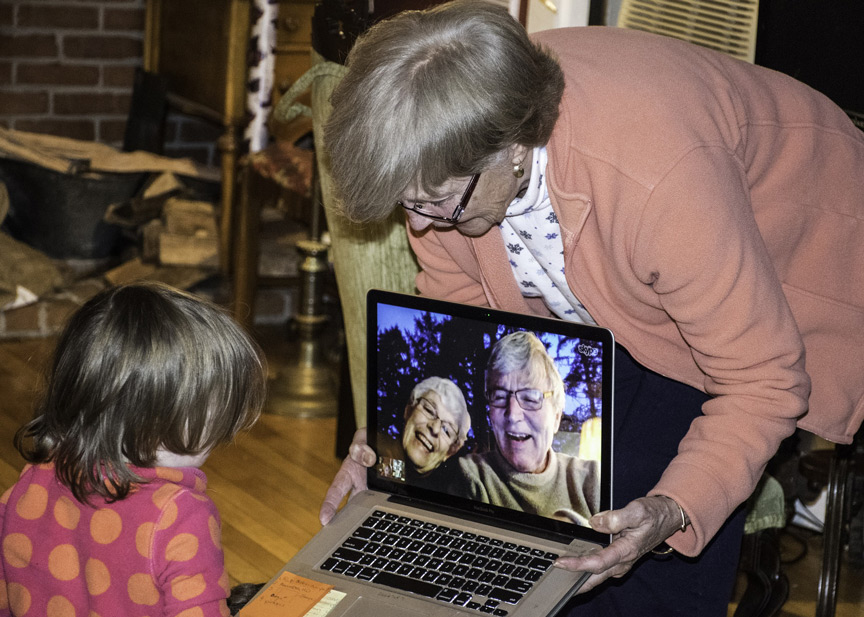
Nearly every day, there are new photos of my baby nephews, vacation snapshots, and other daily updates from our lives. Just recently, my grandparents were able to “tour” my sister’s new house in Las Vegas. In real-time, they were able to see every room of her new house and look at renovations. Without their tablet and FaceTime, they would never have had the opportunity to see it.

“I feel so much more connected to you,” my Granny says. “It’s nice to be able to see what’s happening in your lives. We don’t have to wait until your next visit home for new photos. Your telephone calls are wonderful, but now every morning, I’ll turn on the iPad and I look at everybody! I think it’s great. I like pictures.”

While for my grandparents, we only use FaceTime and a shared photo album to stay in touch, there are a number of apps for tablets that you could use to stay connected with your grandchildren. Here are some popular apps you can use to connect with your families:

Online Games:

There are a number of online games and phone apps that make playing games with your grandchildren a possibility, whether they are nearby or far away. Some popular options include “Minecraft,” “Draw Something,” “Words with Friends,” or Lego games. Or, simply ask your grandchild what their favorite game or app is already and download it to start playing! You can find applications by searching in an application store such as iTunes, Google Play, or by looking online.

Social Media:

Your grandchildren are likely using social media. In fact, they’re likely using multiple platforms. While they might seem complicated to you, to your grandkid each application has a different function: sharing stories, videos, photography, silly selfies (a photograph that one has taken of oneself), etc. Here are some popular social media applications:

  • Facebook: Facebook is a website that allows users to make profiles to connect with friends online. Users can share pictures, videos, articles, as well as their own thoughts and opinions. You might consider making a profile to connect with your grandchild, or even join a Facebook private group for all of your family members to join.
  • Instagram: Instagram is a photo-sharing app that lets you apply effects and captions to your photos. It is a curated online album.
  • Snapchat: Snapchat is very popular with young people today. It is a messaging app where users can send “Snaps,” which are photos or videos. These snaps disappear after they’re viewed by the recipient. Teens also enjoy using the app because it comes with fun filters, like animal faces or frames, for the images.
  • Pinterest: Pinterest is a visual bookmarking tool that helps you discover and save ideas for projects, parties, recipes, and more. If your grandchild enjoys do it yourself (DIY) crafts or baking, Pinterest is a great place to go for creative inspiration.

If you’re unsure of how to use any of these social media apps, ask your grandchild to give you a quick tutorial. Personally, I’ve especially enjoyed introducing my grandparents to “selfies” and have gotten a few fun photos with them! Your local library might also have classes. At Iona, we offer as-needed basic computer training at our Active Wellness Program at St. Alban’s.

Goodreads:

Goodreads is for book lovers. It helps you pick what to read next based on titles or genres you’ve enjoyed in the past. You can see what your friends are reading, and read reviews and ratings. You can also join a discussion group or start a book club.

Music apps:

Spotify, iTunes, and Pandora are some of the most popular music apps. You can listen to old favorites, find new artists, and build playlists. If your grandchild is a music-buff, connect with them by sharing your top playlists.

These are just a sampling of applications you can use to connect with your grandchildren. Have other suggestions? Let us know in the comments!

By Rosie Aquila

Rosie Aquila is Iona’s Communications and Marketing Manager. A graduate of Kenyon College, Rosie joined Iona’s team in 2014. 

Healthcare Advance Directives Explained: Understanding the legal forms

Photo: Mark Warner

We hear far too often from family caregivers that they wish they had prepared earlier, started the difficult conversations sooner, or discussed their loved one’s wishes before a health crisis.

While difficult, planning ahead and preparing now can ensure you or a loved one receives the care you want in the future. That’s why we encourage everyone to complete a healthcare advance directive.

Healthcare advance directives are legal forms where you can share your future healthcare and end-of-life care wishes with medical professionals and family members or friends. These forms may include living wills and/or powers-of-attorney (more on that below).

While health care advance directives may be completed with or without an attorney’s assistance, if you have concerns that are not addressed in basic templates, you might consider consulting with an attorney to draft something customized. An attorney can also help answer any specific legal terms or issues.

Healthcare advance directives typically include information on:

  • Specific medical preferences
  • Aging-in-place or legacy preferences
  • Your assigned trusted individual for any healthcare decision-making, in the case that you are no longer physically or cognitively able to make such decisions

Additionally, a Power of Attorney, Advance Medical Directive, and Last Will and Testament may also be part of your advance planning. All are very important to obtain while you’re in good health and sound mind.

Power of Attorney (POA)

This document appoints a specific person chosen in advance to handle someone’s financial matters if they are unable to do so. In Washington, DC POA documents do not have to be drawn up by an attorney, as the statue provides a template. However, a financial power of attorney must be notarized.

The POA is empowered to take over a person’s financial affairs – such as making sure bills are paid on time – when the person can no longer handle his or her own business matters. For older adults with no family, the POA is often a trusted friend who agrees in advance to take on this responsibility. With a POA document, a person is able to choose who will help him or her if they become incapacitated. Without a legally valid POA, a petition often is filed in court to name a Guardian to handle the incapacitated person’s affairs. The Guardian almost always is a lawyer and a stranger appointed by a judge.

Advance Medical Directive (sometimes called a Living Will, or healthcare/medical power of attorney)

This document spells out exactly what sort of medical care a person would wish to have if they were not able to speak for her or himself. If someone went into the emergency room unconscious after a fall, for example, the Advance Medical Directive would tell doctors whether or not the person wanted feeding tubes or life support measures. A healthcare power of attorney does not have to be notarized, but it must be witnessed by two adult witnesses, one of whom cannot be related to the person preparing the document.

Last Will & Testament

This document specifies a person’s wishes for what should happen to their property after they die. The District of Columbia does not require a will to be prepared by an attorney; however, in some instances using an attorney is strongly advised.

You can find advance directive forms available online:

Geriatric Care Manager or Aging Life Care Expert can also help with planning ahead.

Share your experiences with starting a conversation or planning for your healthcare in the comments!

My New Neighbor: It’s Not Who You’d Expect

My new neighbor is renting for the first time.

DC Renters ResourcesEven though we are in two different generations — I always enjoy seeing her and hearing about her world. Like many in her age group, she enjoys eating out — and is a regular with her own table at a nearby restaurant.

She is always busy, and is never without an adventure to share. A play or movie she has seen or a lecture she has heard. And her biggest adventure is yet to come…an African safari this fall!

But she is not who you think she is. She is not a millennial, not even close. She is a DC senior — and well north of my 65 —  who swapped her DC house for an apartment on Connecticut Avenue.

And you can be a renter too!

As a long-time renter and member of Iona’s Citizens Advisory Group (listed third here) I’ve gathered these resources to help current or new DC renters. Take a look below:

First, did you know that DC has an agency just for you?

The Office of the Tenant Advocate (OTA)
The Reeves Center
2000 14th Street, NW  Suite 300 North
Washington, DC  20009
(202) 719-6560
https://ota.dc.gov/ 

  • Attend a free OTA renter’s rights workshop on Wednesday, August 30 from 6-8 PM. Call or e-mail delores.anderson@dc.gov to register.
  • Make an appointment with an OTA case manager for a free lease review or get help with your rental housing questions.
Online DC Renter Handbook

Can’t make it to the OTA renters rights workshop or Summit? You can learn about your renter’s rights in the convenience of your home.

The Coalition for Non-Profit Housing has an online copy of the 2013 Washington DC Tenant Survival Guide, Eighth Edition for download. Access it here.

The Guide includes easy-to-understand sections on your renter legal rights including leases, security deposits, evictions, housing code standards, repairs and renter resources.

High-Rise Life Column in the Forest Hills Connection e-magazine

Read about living in multi-unit housing. Articles cover everything from the latest news to how-to make a balcony garden or live with pets in a high-rise building. Visit here to read the High-Rise Life Column.

Do you have other valuable renting resources? Let us know in the comments!

By Barbara B. Cline

Barbara B. Cline, CPA, is a former auditor and non-profit executive. She is a SERVEDC Commissioner, where she works on the emergency planning task force. She lives with her husband, who has some physical challenges, in an apartment in NW, DC.  Barbara is a fair housing and disability rights advocate and writes articles on housing issues — including rent-control, an often unknown and misunderstood type of affordable DC housing, for both Iona and the Forest Hills Connection. 

Watch our video: Range of Possibilities in the art therapy studio

Throughout the year in Iona’s art therapy studio, Wellness & Arts Center participants have embraced spontaneity, healing, and self-expression. They’ve made connections and shared their own stories.

This summer, in honor of these personal and artistic achievements, the Lois & Richard England Gallery at Iona featured a special Participant Art Exhibit.

Our participants were so proud to share the many ways they have used the creative process to honor their struggles, celebrate their strengths, and tap into parts of themselves they didn’t know they possessed.

Because this exhibit is so special, we wanted to make sure all of our friends had a chance to see the artworks on display.

In case you missed the exhibit, we invite you to watch the below video.

Join us in honoring your older neighbors and their artistic accomplishments! Please watch and share our 2017 Participant Art Show video. You will be so impressed and inspired by the artistic growth of participants.

In addition to artwork, the exhibit also featured poetry written by participants. One participant even shared her experiences in the art therapy studio.

She writes:

“The past, present, and future are intertwined and expressed through art. Stories are told and histories are shared. This is a place for concentration, connection, inspiration, and celebration of talents and efforts. We came together for individual expression and as a group to bring witness to our stories. This carefully crafted and designed art room is where all the possibilities inherent in pen and paper and art are freed in the meeting of emotion and expression.

The Art Therapist does not create for her students. Her magic is opening a door for adventure. I see the magic of colors flying across the room, a woman works with colors on her sheet of white paper. She is absorbed in color and design. I see a man with sunglasses singing next to his brother, smiling to the sky. He can do anything. We are nourished by the art we create, the songs we sing and the embraced hands and hugs that bring comfort to our rainy days. We are only constrained by our thoughts, our fears. We have courage here in the studio. I look around at the magic of colors flying around the table. Each one has a sheet of white paper. Each paper speaks of one individual. We are invited by color and paper to tell further of who we are. I hear the songs that remind me of love, happiness, sadness all transporting me through time and space.”

Thank you for taking a moment and honoring the accomplishments of our participants. Please share your congratulations in the comments below. We would love to share community notes with our participants!

Iona Staff Picks for National Book Lovers Day

National Book Lovers DayWhen I first joined Iona’s team in 2013, I was happy to learn so many of my colleagues are, like me, avid readers. In fact, today I get some of my best book recommendations during my lunch break, sitting around Iona’s lunchroom table and discussing favorites.

So, after I learned National Book Lovers Day is coming up on August 9th, I thought it was the perfect opportunity to poll the team and share their recommendations.

In honor of National Book Lovers Day, here are some staff picks. Happy reading!

Donna Tanner, one of our psychotherapists who also leads support groups, suggests:
  • H is for Hawk by Helen Macdonald. This memoir describes Helen’s year of working through grief after her father’s unexpected death when she was a youngish adult. She describes her experiences training a goshawk as how she is able to finally work through her debilitating grief.
  • This is a Story of a Happy Marriage by Ann Patchett. This is a collection of essays that Ann has written over the years that have appeared in magazines. They are personal and revelatory. She gives an unapologetic critique of her motivations and describes ordinary people in her life who have had a lasting influence.
  • My Name is Lucy Barton by Elizabeth Strout. Although a novel, it reads like a memoir. The narrator investigates her past in the service of trying to understand herself and why she is who she is. If you liked Olive Kitteridge, you will likely enjoy this.

Donna’s praise for these is high. She says she had read and listened to all three and wants to read them all again!

Geriatric care manager Carol Kaplun recommends:
  • Gratitude by Oliver Sacks. This is neurologist/author Sacks’ last book, written just before he died. Carol says she was surprised to discover that it’s not an end-of-life story, but a testimonial filled with gratitude and wonder for his life experiences and challenges.
Many people are talking about A Man Called Ove, by Fredrick Backman, but Deb Rubenstein, our clinical director, wants to give a shout-out to another book by Backman:
  • My Grandmother Asked Me to Tell You She’s Sorry. In this novel, a young girl named Elsa is bereft upon the death of her grandmother, her only friend, a woman who each night told Elsa amazing stories that made her feel better about being different. She discovers that her grandmother had left behind letters, letters that magically bring to life the fairy tale world of those night-time stories. Deb, and others, call this a charming and warm-hearted novel.
Finally, I offer three very different selections, each of which I enjoyed a great deal:
  • The Jersey Brothers by Sally Mott Freeman. The true story of three brothers, each of whom served in WWII. One ran FDR’s fabled Map Room – locus of war planning in the White House. Another was an officer on the U.S.S. Enterprise, a ship that was at sea during the attack on Pearl Harbor in 1941 and so was able to battle the Japanese for years. And the third, the youngest brother, was taken captive by the Japanese and held in terrible P.O.W. camps in the Philippines. The book is about the older brothers’ attempts to find their baby brother amidst the chaos and horror of the war in the Pacific.
  • Best Boy by Eli Gottlieb. Unique novel told from the perspective of a 53-year-old man with autism who has lived in a facility for 40 years and what happens when a staff member arrives that he does not trust. Gottlieb himself has an older brother with autism for whom he is the guardian, and so the book is infused with understanding of residential life for disabled adults as well as the challenges individuals and families face. It’s actually an uplifting and hopeful book.
  • A Strangeness in My Mind by Orhan Pamuk. Translated from the Turkish edition, the story follows the life of high school dropout and yogurt-seller Mevlut in Istanbul from the 1960s to present day. Mevlut spent three years writing love letters to a girl from his village, only to find out on the night they eloped, that he had been writing to her sister. One would think this would be a tragedy, but it is not. Mevlut falls in love, they marry, and have two daughters. But Mevlut’s life as a street vendor is hard and family dynamics make his life even more difficult. I loved diving in to the ever-changing world of Istanbul and came to love Mevlut.

What are you reading? If you have suggestions for books you recommend, leave them in the comments! There’s nothing better than learning about new books to read.

By Susan A. Messina

Susan is Iona’s Director of Development and Communications. She holds three master’s degrees, including two from Bryn Mawr’s Graduate School of Social Work and Social Research, and is a Certified Fund Raising Executive.

Feedback for Iona