Fran’s Story

Fran Pflieger was feeling lost. A recent retiree, she had thought that her retirement would be a welcome new phase of life. Instead, “I had this feeling of free falling,” she says.

Luckily, today Fran knows she has a net.

A self-proclaimed planner by nature, Fran thought she had checked all of the boxes before her retirement. But after only a few months, she started feeling anxious and low. “I had this creeping sense that I didn’t belong,” she says.

The feeling stemmed from Fran’s loss of connection after leaving the workforce. Additionally, divorced from her wife, with no children, and no family nearby, Fran felt alone in the world.

So she turned to Iona.

As chance would have it, at a real moment of lowness, Fran learned about a new Iona workshop for lesbian, gay, bisexual, transgender, and queer (LGBTQ) older adults, which your donations and a grant from the DC Office on Aging helped fund. It was exactly what Fran needed.

The class provided Fran with information on aging- related resources in DC, guidance on planning ahead, and—best yet—a chance to meet other LGBTQ older adults. “I’m an introvert, so those connections are harder for me to make,” she says. “The workshop made it really easy.”

Furthermore, offering the class specifically for LGBTQ older adults gave Fran a safe space to speak candidly. That outreach meant a lot to Fran, especially because she’s experienced discrimination before.

“I didn’t come out until I was 40,” she says. “So, I can’t tell you how powerful it was to be there with so many people, all of us there for the same reason, and many of us having the same fears that I had.”

Today, Fran feels less alone.

“I’m more confident. I’ve noticed that just since the workshop, I’ve gotten louder. I feel much more safe saying that I’m a lesbian in mixed company.”

Fran’s feelings of free falling are gone too. “Iona helped me feel like I’m not alone. I have something to catch me. It feels really, really good!”

John’s Story

If you’re ever visiting Iona’s Wellness & Arts Center, you might just bump into John Diggs, 75. He’ll be the man with a big smile on his face welcoming visitors and telling everyone he meets, “I love Iona!”

Give John a moment, and you’ll hear just why he’s become one of our most vocal supporters. “Iona really makes you feel good,” he says. “I’ve been telling people on the street about it!”

A longtime Washingtonian, John devoted his life to working hard and supporting his family. Over the years, he shined shoes, trained and worked as a cook, worked as a security guard for DC government, served in Vietnam, and eventually even became a secret service agent for President George H. W. Bush (among a number of other eclectic jobs).

At Iona, he’s known for his positive and optimistic presence. But, that wasn’t always the case for John, who has dementia. Before he started attending the

Wellness & Arts Center—which your donations help to sustain—John spent most of his days alone in his apartment. He’d call his niece, Debra Plummer, and son, Reggie, daily. “He was isolated, and would spend so much time thinking about his illness and what’s wrong in his life,” Debra says.

After a conversation with his doctor, John and his family agreed something needed to change. With his two sons— Reggie and Martin—and Debra, they visited several senior wellness centers in the area to find the best fit for John. He enrolled in Iona’s program in August 2018.

Today, John spends his Tuesdays and Wednesdays at Iona—exercising, making art, enjoying lively discussions, and more. Your contributions have made this program available to John, where he’s been able to make friends and learn new things—and remain independent at home.

Most noteworthy, you’ve transformed his outlook on life. “His mood is so much better,” says Debra. “Iona exposes him to exercise, drawing, and socializing. He sees more positivity in his life.”

John agrees, adding that he now has something to look forward to. “Coming here is motivating and uplifting,” he says. “If I didn’t go to church, I wish it was so I could come here on Sundays!”

Pari’s Story – Part 1

When Iona social worker Liza Chapkosvky first met Parivash “Pari” Amirshahi, Pari was isolated in her apartment, surviving on little food and company. She had no bed, and she was sleeping on her small couch. “I could never straighten my legs,” says Pari, 79. Two years later, her life looks completely different, thanks to Iona.

Pari was first connected to Iona in October 2014, after her building manager — concerned about Pari’s living environment — made a call to our Information & Referral Helpline. “Her building manager had been helping out for a while — things like driving Pari to appointments, or helping to pay bills,” says Liza. “But, it was clear the manager had reached a point where she was in over her head and needed support.” Liza set up a home visit, which revealed Pari had almost no food.

Iona’s response was immediate. First, Liza worked with our Home Delivered Meals Coordinator Jakia Muhammad so that Pari would regularly receive meals at her home. She also secured a microwave and hot plate for Pari to be able to reheat meals.

Then, she introduced Pari to Iona’s Active Wellness Program at St. Alban’s, which provides a delicious free lunch and fun conversation in the company of friends every weekday. Since then, Pari has been participating nearly every day. “I had no idea St. Alban’s existed or that you could get free food,” says Pari. “I was hungry all the time. And then Liza brought me here. Now I have hot food and coffee and tea.”

In addition to a nutritious hot lunch every weekday, Iona’s Active Wellness Program has also broadened Pari’s once-shrinking community. “At St. Alban’s I have met many nice people,” says Pari. “I found out that there are many elderly people besides me in this world.”

Pari could not have imagined anyone providing the support she has received from Iona. Now, she feels differently. “Iona is the best place for elderly people because we know we have a home here, and that somebody is taking care of us. I am glad that I could find Iona and that you wanted to help.”

Today, Pari is safe, well-fed, and content with the many new friendships in her life. She’s received cataract surgery and visited a specialist to help with her breathing. She enrolled in MetroAccess, and soon will have a home health aide to help with errands around her home, food preparation, and transportation to medical appointments.

To Pari, her connection with Liza, and Iona’s larger community, has been a true gift — and one, in her eyes, that was destined to be. “Liza is from Russia, and I am from Iran. All this time, only the Caspian Sea was between us,” she jokes. And as for her couch? A few months ago, Liza was able to provide a donated queen-sized mattress. “It’s a good mattress,” Pari says, grinning. “I can stretch my legs and I’m sleeping better. I really enjoy it.”

Pari’s Story – Part 2

Two years ago, Parivash “Pari” Amirshahi could not have imagined how much better her life could be. But thanks to your generosity, Iona opened her eyes —literally.

When Iona social worker Liza Chapkosvky first met Ms. Pari Amirshahi, she was isolated in her apartment, surviving on little food and company. She had no bed, no way to prepare food, and poor eyesight that made daily operations challenging.

Thankfully, because of our supporters, Iona was able to be her safety net. Pari now receives nutritious meal deliveries and other public benefits.

She has attended Iona’s Active Wellness Program at St. Alban’s, where she is able to enjoy a free, hot lunch and fun conversation among friends and neighbors. There’s now a microwave and hot plate in her apartment to prepare meals. And she even has a new bedframe and mattress, which generous donations helped to secure.

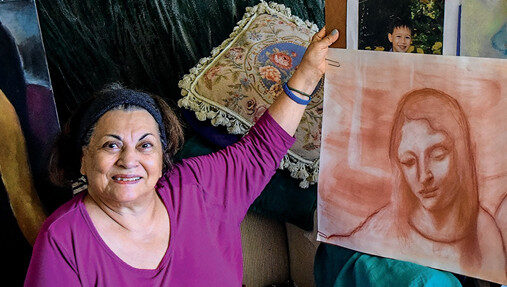
Because of the Iona community, Pari has rediscovered an old pastime—painting.

In her own words, Pari has been painting since she was “really, very young.” All that changed, however, when her poor eyesight made keeping up with her passion difficult. With Iona’s help, however, Pari received cataract surgery to improve her eyesight.

Within weeks, she was holding a paintbrush in her hand.

“I never thought I would paint again,” says Pari, with a smile. “Now, I feel so good! It is possible.” Since her surgery, Pari has been hard at work, joyously creating portraits, still lives, and more. Just recently, a neighbor even asked if she could paint something for her apartment! “It made me feel so good that somebody wanted to decorate with my painting,” says Pari.

Caroline’s Story

It’s hard enough taking care of one parent with a serious illness. Imagine taking care of two — while living in a different city.

Caroline Scully was living in Massachusetts. Her parents were living in the District’s Glover Park neighborhood, next door to her brother. Then things began to unravel.

Her mom, Bernice, was diagnosed with a rare neurological condition. At the same time, her dad, Richard, was developing memory problems.

Still in Massachusetts, Caroline began managing their medical care and overseeing their finances, along with her brother. “It became so stressful going back and forth, I decided it was better to be with them,” she said.

She left her home and partner in New England to move in with her parents. “My brother and I were focused on making sure our mother was comfortable and getting the best possible care and that our father was taking his medications and getting out.”

Looking back, Caroline realizes she didn’t understand the health care system. “It’s not set up for people to understand,” she says. “I thought my parents needed to move into assisted living. Iona’s staff convinced me they could get good care at home.”

Caroline hired Iona’s care managers to conduct a comprehensive in-home assessment and tailor solutions specific to her parents’ strengths and preferences, as well as their challenges and risks.

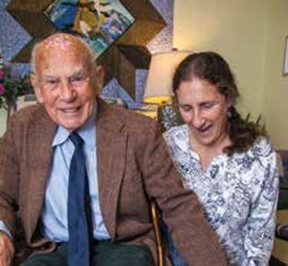
“Iona has been a hub of resources and services for us,” says Caroline who also has benefited from Iona’s social workers and support groups, and has participated in its advocacy efforts. After her mother passed away at home in October 2014, Caroline enrolled her father in the Wellness & Arts Center, Iona’s adult day health program for older adults with chronic health issues.

When Caroline picks up her father, she finds him having a conversation with a staff member, engaged in a small group activity, or in art therapy. His artwork has been displayed in several Iona exhibits. In addition, experienced nurses and nursing assistants monitor his health. Is his blood pressure high? Is he losing weight? If he needs physical therapy, it’s available at Iona.

“Team meetings are remarkable,” she adds. “My father gets wonderful feedback from the staff. They all have thoughtful things to say.”

At the end of the day, he’s energized — in contrast to when he’s home all day and tired. “That’s because two of us can’t do what Iona does,” says Caroline.

“Our family’s relationship with Iona started small with me calling every once in a while and not really understanding all that the organization has to offer,” she adds. Having tapped into most of its services and expertise, she has nothing but gratitude. So does her father who, at a recent team meeting told the staff: “As you go through life you don’t often find people interested in you. You all seem to have a secret training ground for compassion.”

Stella’s Story

Stella “Starr” Clarke, kept running into the sociable stranger in her Cleveland Park neighborhood. Each time, his message was the same: “Come check out the club.” After four invitations, she had to see this place for herself.

The “club” turned out to be Iona’s Active Wellness Program at St. Alban’s, held every weekday from 10 a.m. to 2 p.m. on the grounds of the National Cathedral. The program attracts older adults from the neighborhood and beyond who are drawn to the nutritious lunch and diverse activities — such as exercise class, a farmer’s market with free produce and field trips.

“I like the people and we have a lot to talk about, whether we are black, white, pink, or blue,” says Stella, 80, who is married and has children, grandchildren, and great-grandchildren but appreciates the opportunity to do her own thing.

She has been doing her own thing since she was three years old and fell in love with dance. A native of Guyana, South America, Stella honed her skills as an interpretive and Caribbean folk dancer and, at an early age, was crowned Carnival Queen. She founded a well-known dance school; her “Dancing Dolls” performed for presidents and other dignitaries. In Guyana she is considered a national treasure. She was recognized by the government in an official ceremony celebrating her as a national cultural icon.

When she moved to the U.S., Stella was invited to train with the prestigious Alvin Ailey Dance School. She has been teaching dance ever since, even recreating “The Dancing Dolls” with children of Caribbean heritage living in the Washington area.

Frequently asked her secret to staying “young,” Stella’s response is morning exercise — in the shower! — where she stretches, twists, and touches her toes. “The warm water loosens you up; that’s why I look and feel like a teenager,” she laughs.

At St. Alban’s, “we talk about everything from our families to our finances. It’s as if we’ve known each other for years,” says Stella, who has been participating in the program since 2013.

Courtney Tolbert, who manages the St. Alban’s program, “is one in a million,’” says Stella. “She’s constantly adding new programs. For instance, September is National Hispanic Heritage Month so we listened to Joan Baez and José Feliciano and went to the National Portrait Gallery to see an exhibition about Dolores Huerta (the farm workers’ movement leader).”

“We all have such incredible lives,” says Stella, noting that a recent event featured a discussion about a new book by Alec McRae, another St. Alban’s participant. And, in fact, Stella herself (along with granddaughter Kahina Haynes, School Director of Dance Institute of Washington) performed at St. Albans. “I plan to dance until the day I die,” she says with a twinkle in her eye.

Gilbert’s Story

Gilbert Lavine didn’t plan to retire at 61.

A native Washingtonian, Gilbert was working as a treasurer at a major company that underwent an acquisition. He stayed on for a year after the acquisition before retiring in 2012, much earlier than he had anticipated.

“My career was cut short,” he says. “I was in shock. Sixty-five seemed like the right time to retire, yet here I was in my early 60s without a plan and no idea how I was going to spend my time.”

But not for long. His 88-year-old mother-in-law’s health was failing, so the family decided to move her to the Washington area. “She became my project,” says Gilbert. “Getting her to doctors, socializing with her — that was my new phase of life, one I had not contemplated.”

Feeling overwhelmed, he contacted Iona, where he learned about its new Take Charge/Age Well Academy SM for retirees or those who are thinking about retiring. He became part of the very first group. “By listening and learning, I really began to address my retirement,” Gilbert says. “I hadn’t stopped to do that because I was going from crisis to crisis.”

The series touches upon such issues as nutrition and exercise – which Gilbert had been neglecting for years. He took up running and completed several 5K races.

One of the Academy’s themes is how to take care of your body. “What worked in the past may not work as you age,” says Gilbert, who has learned to eat small meals throughout the day instead of several large ones.

“Most importantly, Take Charge/Age Well provided me with an hour or two a week to focus on myself,” he says. “When you’re taking care of a family member, the last person you take care of is yourself.” After the series ended, he continued to meet with — and lean on — other Baby Boomers in the group.

The Academy also inspired Gilbert to volunteer. He used his skills as a treasurer for a statewide non-profit organization. Just prior to his mother-in-law passing away in 2014, he signed up to volunteer two days a week at Cashell Elementary School in Rockville, Maryland, helping students with math and reading. “I hadn’t been around little kids in a long time,” he said. “I love seeing all that energy.” So much so that he’s happily signed on for a second year in the classroom. Says Gilbert, “It’s what Lylie Fisher (who leads Take Charge/Age Well), calls an ‘encore career.’ It’s very enriching.” “The day I wandered into Iona was a good day for me,” he says. “It helped me stop the day-to-day running around and begin to understand the next stage of my life.”

Wes’ Story

Wes Morrison was living in Washington, D.C. at the height of the HIV/AIDS epidemic. In the decade from 1990 to 2000, Wes – who is a proud gay man – lost more than 100 friends. Actually, he just stopped counting at 100.

That was a low point in his life.

Another was the day in 2009 when he and 27 co-workers were laid off. Wes, who had worked as an assistant television producer at the same news station for 32 years, loved his job. He says he was “one of the lucky ones;” he had a pension and qualified for severance pay while many of his colleagues did not.

In the following months, Wes felt depressed, angry, and useless. He had planned to retire at 70. He was 62. “It felt like there was not only a hole in my life, but also a hole in my heart,” he says.

Fortunately, just as he was beginning to feel “sick and tired of being sick and tired,” Wes learned of a volunteer opportunity at AARP, which led him to Iona. “I had always thought of volunteering with youth. Why not seniors?” he thought.

Wes jumped headfirst into Iona’s Citizens Advisory Group (CAG), working to bring in speakers on everything from emergency preparedness to elder justice. Along the way, he made many friends and discovered other programs for him at Iona, including the popular Take Charge/Age Well Academy for Baby Boomers. This educational program helps retirees, or those planning to retire, think about and plan the next stage of life. Wes signed up for the introductory Take Charge of Your Aging 101 course in 2013 and never looked back.

“A lot of retirees haven’t planned for the future,” says Wes. “You wake up one day and your circumstances have changed. You  may be out of work, or facing a health challenge. There’s a new class of younger older adults, too young for social security, who are out of work and don’t have a plan. This trend is only going to increase as the population of seniors grows.”

“For me, one of the most important takeaways of Take Charge/Age Well is the value of being engaged in activities and in the community. In other words, I learned how to age gracefully.”

In addition to taking several Take Charge/Age Well classes, Wes has also helped to develop a few — he was recruited to help research a new class for Lesbian, Gay, Bisexual, and Transgender (LGBT) Baby Boomers that was offered last winter. It was one of our most popular classes to date.

Today, Wes considers Iona to be a home away from home. “I feel productive again – something I thought was taken away from me when I lost my job,” says Wes. “Having Iona in my life is a comfort to me. I have two cousins, but we’ve never been close. Plus they aren’t nearby, and I don’t have a car. It’s a comfort to know if I get sick, I can call someone at Iona. It’s a comfort that they know me. Iona is my family. There are a lot of single adults without family who need this.”

In turn, Wes has become an unofficial ambassador for Iona. He takes Iona’s Resource Guide with him wherever he goes, handing out the free publication to people who may need information about housing or legal help or are looking for social activities. Wes knows it is hard to ask for help. In 2012, thinking he had a pinched nerve he took three buses to Georgetown Hospital only to learn he had suffered a stroke. If there’s one lesson he’s learned from Iona, it’s “Age Well, Live Well,” he says, citing Iona’s tagline – “but be willing to ask for help when needed.”

Carolyn’s Story

“My name is Carolyn Barnes and I live in senior housing in Northwest Washington. This is the first time I have ever testified before the D.C. City Council, so I ask your patience if I seem a little nervous.”

With these words, Carolyn Barnes began her February 2016 testimony before the City Council’s Committee on Health and Human Services. A resident of Regency House, Mrs. Barnes was there to talk about a Medicaid program that provides free home health aides to qualified seniors and people with disabilities. Called the EPD Waiver program, its purpose is to help individuals stay in their homes rather than go into nursing homes.

In 2006, doctors put five screws in Mrs. Barnes’ back to address a spine condition. She’s been in debilitating pain ever since.

For most of the past decade, she has had a home health aide who helped with grocery shopping, picked up prescriptions, and accompanied her to doctor’s appointments, among other activities. The aides were paid by a long-term care insurance policy she purchased.

Two years ago, her Iona case manager, Randy Smith, noticed that Mrs. Barnes’ insurance money was running out and told her that the EPD Waiver program would provide her with a free aide. That aide started last February – around the time her insurance money was about to run out and she would have been on her own.

“The EPD Waiver program has worked well for me,” Mrs. Barnes, who is 69, told the City Council. “I’ve been very happy with my aide. But because of a bureaucratic scare, I nearly lost her.”

Enter Randy Smith. A journalist-turned social worker who has been working as an Iona case manager for six years, “Randy really knows how to navigate D.C. government programs,” says Iona’s Executive Director Sally White.

A former newspaper reporter, Randy doesn’t take no for an answer. “I greatly appreciate being able to use my previous experience dealing with all branches of government to get results for individuals,” he says.

With Randy’s help, Mrs. Barnes – and countless other Iona clients – have benefited from government services for which they qualify. Many didn’t know those opportunities even existed.

“Mrs. Barnes was down to her last dollar,” says Sally. “I hate to think about the outcome if she didn’t have Randy in her corner.”

While Randy frequently testifies before the City Council, it is Mrs. Barnes, he says, who was the best one to share her story. “I wasn’t there to help myself,” she says. “I testified in hopes that it will help other senior citizens who need help in order to stay in their homes.” As for her initial anxiety about speaking in public, Mrs. Barnes said it made all the difference to have Randy by her side. “Once I started, I couldn’t stop,” says the newly empowered advocate. “I just had to speak my mind.”

“I wish everyone had a Randy Smith in her life,” she adds. “Once you have all your ducks in a row, and all your questions answered, it’s smooth sailing.”

Suzanne’s Story

When Suzanne Gentes’ husband passed away in May of 2015, she had anticipated feeling the deep grief of losing a spouse. What she didn’t expect, however, was feeling an additional loss from saying goodbye to friends in Iona’s caregiver support group for spouses and partners of people with dementia.

Over several years, Suzanne had come to rely on the group as a safe space to vent, laugh, and cry with people in similar situations. “The group really helped a lot, and in a way, I had a circle of caregivers to take care of me,” says Suzanne.

After her husband died, it was difficult not to have that continued support. And, while she tried bereavement groups with other area organizations, there was always something missing, as Suzanne found that few addressed her important caregiver role. Knowing that Iona had been there during her caregiving journey, Suzanne turned to Iona again in her grief.

The timing was meant to be. Just a month prior, Iona psychotherapist and support group manager Bill Amt had surveyed former Iona caregiver support group members to learn more about their caregiving journeys and gather feedback on how Iona could better support them.

Additionally, Bill was also investigating bereavement group models. “As the support group manager, I’m always thinking, ‘What more do we need?’” says Bill. “When I looked at Iona’s menu of offerings, I saw that there was a gap.”

With Suzanne’s help, Iona was able to fill that gap.

Using feedback from Suzanne’s personal experience, along with best practices, Bill and Iona’s Director of Consultation, Care Management, and Counseling Deb Rubenstein designed Iona’s newest group: the After Caregiving Support Group. Its first meeting was in April.

Unlike other grief groups Suzanne tried, Iona’s After Caregiving Support Group focuses on not only grief, but also caregiver identity and transition, says Iona social worker Liza Chapkosvky, who co-facilitates the group with Elizabeth Buchanek, an experienced volunteer. “When you’re a longtime caregiver, your identity is so wrapped up in that experience,” says Liza. “When it’s done, you might have a wide range of emotions and you’re also trying to figure out, ‘what’s next for me.’”

The group, then, helps members process their grief, as well as think about next steps. It’s also a great space to share resources, literature, and success stories for self-care, adds Suzanne. And, of course, having a circle of caregivers is a welcome return for Suzanne. “It’s nice to have people again who care enough to listen and to share their grief with you,” she says. “It’s a wonderful reminder that despite the darkness, there is some light out there.”

Feedback for Iona