Reverse mortgages 101

You may have heard the phrase, “house rich and cash poor” before. It’s a state of affairs that means you have a roof over your head, but you’re strapped for liquid cash to pay for things such as food or medical prescriptions. Enter the reverse mortgage.

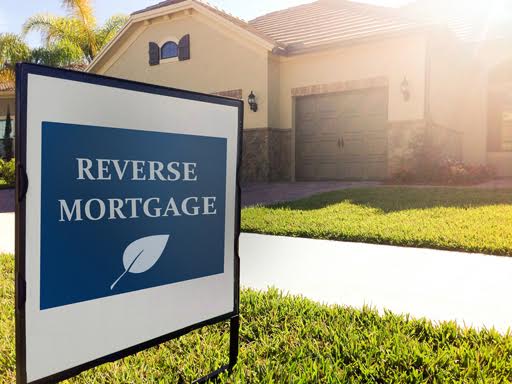
A reverse mortgage is a loan available to older homeowners as a way for them to use the accumulated wealth in their homes to cover basic living expenses or health care, including long term care. Over the years, the reverse mortgage industry has dealt with a few bad apples that soured the solution for many. However, today, the Federal Housing Administration regulates the process.

This mortgage is termed a “reverse” because in one of three ways it allows the built up home equity to be given back to the homeowner.

The three ways you can get funding from a reverse mortgage are:

1. A monthly payment for life to meet daily living expenses
2. A lump sum of cash for immediate needs or emergencies
3. Establishing an equity line of credit to address future cash needs

Unlike a traditional mortgage, when you receive these funds there is no new monthly expense or payment created. All three options are provided to homeowners who meet criteria, including:

  • Minimum of 62 years of age
  • Have sufficient home equity
  • Have enough income to cover the taxes, insurance, and maintenance of the residence

Needless to say, this information is just scratching the surface of the aspects of a reverse mortgage. It is very important to evaluate this potential financing option in relation to your entire financial picture. Its use could potentially disqualify you for some government assistance programs such as Medicaid or VA Aid and Attendance (though its use will not affect qualifications for your pension, annuity, and Social Security or Medicare benefits.)

To learn more about reverse mortgages, consider speaking with a Certified Senior Advisor®, Aging Life Care professional®, elder law attorney, or reverse mortgage specialist for more information.

[vc_row][vc_column][vc_cta h2=”Register for Iona’s free presentation on ways to afford the costs of long term care”]Join Rick Gow, a Certified Senior Advisor® and Wealth Management Advisor from Lara, May and Associates LLC, to learn about different options.

Topics covered during the presentation include:

  • How to put the pieces together for a more secure LTC financial plan for the future.
  • Medicaid: Hidden gem or fool’s gold when it comes to paying for LTC.
  • Reverse mortgage: myths and realities of using it to pay for LTC.

Learn more and register for the class here.[/vc_cta][/vc_column][/vc_row]

Finding transportation in DC: Resources and questions to consider

Transportation options in DC come in many forms. There’s low-cost (and even free) transportation to medical appointments, social service offices, and some other destinations. Depending on your needs, you can also book transportation to help you board a vehicle, or even assist you from door-to-door. Bear in mind that the more needs you have (both physically and financially), the less flexible the options are.

When choosing the right transportation option for you, consider:

Are there eligibility requirements?

Some programs have age, disability, or income criteria. You may need to provide your:

  • Age
  • Household income
  • Disability or mobility limitations
  • Veteran status

Be sure to ask the provider if there are requirements to qualify for the service.

What can I afford?

Fees vary depending on a number of factors like destination and whether you need assistance getting in and out of the vehicle. Be sure to ask the provider:

  • What’s the cost?
  • Will insurance pay for rides?
  • Is there a membership fee?

Do I need any accommodations?

Consider whether you need assistance getting on or off the vehicle, have a large motorized wheelchair, or are going to an appointment that requires you have a ride or driver to accompany you. Some specialized accommodations include:

  • Curb-to-curb. You’re picked up at the curb or driveway
  • Door-to-door. You get assistance with entering and exiting the vehicle and may get help to the door.
  • Door-through-door. You’re helped from the vehicle through the door of your residence or destination.

When booking your transportation, you’ll need to provide:

  • Whether you need an accessible vehicle that can accommodate a wheelchair, scooter, or other mobility device.
  • Whether you need assistance getting in and out of the vehicle or walking to the door.

You might also ask the provider:

  • Is assistance available to help you travel?
  • Is an aide or assistant available to stay with you during the appointment?
  • Can a personal care attendant or family member ride with you?

Thanks to a grant from the DC Office on Aging, Iona has two new Fact Sheets that outline available transportation services in DC for both independent riders and individuals who need assistance (as of June 2018).

Download, save, or print them here:

  • Transportation for Riders Needing Assistance (download)
  • Transportation for Independent Riders (download)

For additional fact sheets on critical topics like memory loss, legal services, and more, visit our Resource Library.


Beware of IRS impersonators and other important tax information

Now that it’s officially tax season, you need to beware of tax refund scams. Common scams include individuals impersonating IRS officials, whether in-person, over the phone, or via email, in order to steal your personal information. They can then file fraudulent returns electronically under your identity.

Oftentimes, scammers will make threats or send urgent messages for the purpose of stealing your social security number and birthdate. Unlike previous IRS imposters, who were calling for the purpose of gaining your personal information for identity theft, crooks are now fabricating tax documents to e-file. Their demands are often very convincing and frightening.

Remember, the IRS does not:

1. Initiate contact by email, text message, or social media to request personal or financial information. Most contact is through regular USPS mail. There are some exceptions, but even then, you would generally receive several letters from the IRS in the mail.
2. Demand immediate payment, especially by methods like a prepaid debit card, gift card, or wire transfer.
3. Demand that you pay taxes without the chance to question or appeal.
4. Threaten to bring in police or immigration officers to have you arrested for not paying.
5. Revoke your driver’s license, business licenses, or immigration status.

What the IRS will do:

If an IRS representative does visit you, they’re required to have two forms of official credentials: a pocket commission and a HSPD-12 card. You have the right to see these credentials.

Additionally, if you’re unsure about their credibility, you can ask the representative for a dedicated IRS telephone number for verifying the information on their credentials. Learn more about how to know if it’s really the IRS here.

If you receive a phone call or letter from someone claiming to be with the IRS, verify it by calling 800-829-1040.

Warning signs of tax fraud:

1. If you don’t receive your IRS refund within a month of e-filing, check its status at https://www.irs.gov/refunds.
2. If you believe more than one tax return was filed using your SSN.
3. If you’re notified that you owe additional tax, refund offset, or have had collection actions taken against you for a year you did not file a tax return.
4. If IRS records indicate you received wages or other income from an employer for whom you did not work.

What to do if you believe you’re a victim of tax fraud:

Finally, if you believe you’ve been contacted by an IRS impersonator, contact the Treasury Inspector General for Tax Administration to report a phone scam. Use their “IRS Impersonation Scam Reporting” web page. You can also call 800-366-4484. Report phone scams to the Federal Trade Commission. Use the “FTC Complaint Assistant” on FTC.gov. Please add “IRS Telephone Scam” in the notes.

For more information about tax scams and what you need to know, please visit these resources:

Tax Scams/ Consumer Alerts 
Instructions for requesting copy of fraudulent returns
How scammers try to steal your tax information
Taxpayer guide to identity theft

How to bond with your grandchildren using technology

“She thinks it’s the best thing since sliced bread!”

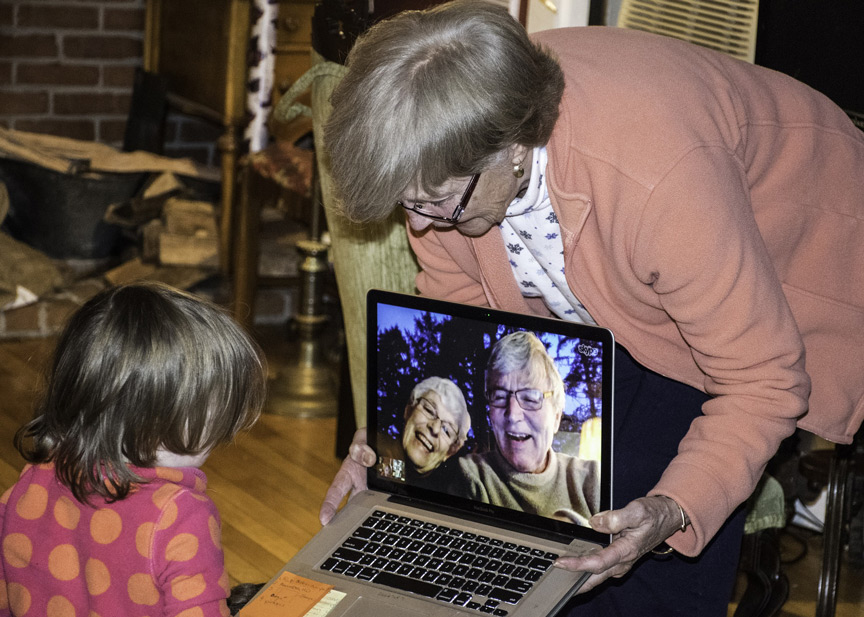
The author (far left) and her family use FaceTime and a shared photo album to stay connected, despite living in five different states. She’s pictured with her siblings and grandparents.

Those were my grandfather’s exact words when I asked him how my grandmother (who we’ve always called “Granny”) was enjoying her new tablet.

To be honest, I was surprised! My grandparents have never been tech-forward. As a child, I remember them purchasing a computer only to find it frustrating and unnecessary. A few weeks later, they had gifted it to my family. Then, my Granny tried out a special machine that sent and received email only. She enjoyed sending notes to friends and family, but that too fell by the wayside after a few months. That was probably 10 years ago.

So, when my brother first suggested purchasing them an iPad, I was skeptical. Sure, it would help us to stay better connected through video calls or shared photo albums. But, would my grandparents be able to easily navigate a touchscreen tablet?

The short answer: yes!

I soon discovered that tablets are incredibly easy to organize and display applications, or “apps” on a homescreen. They are larger than smartphones, and therefore easier to see and navigate.

For my grandparents, we decided to keep it simple: they have FaceTime, which is a video and audio calling service, and the Photos app on their homescreen. That’s it!

In Photos, we have one “shared” album between my mom, aunt, and three siblings (all who live across the country). Because we all have smartphones, we are all able to access the album and add our own photos and videos.

Nearly every day, there are new photos of my baby nephews, vacation snapshots, and other daily updates from our lives. Just recently, my grandparents were able to “tour” my sister’s new house in Las Vegas. In real-time, they were able to see every room of her new house and look at renovations. Without their tablet and FaceTime, they would never have had the opportunity to see it.

“I feel so much more connected to you,” my Granny says. “It’s nice to be able to see what’s happening in your lives. We don’t have to wait until your next visit home for new photos. Your telephone calls are wonderful, but now every morning, I’ll turn on the iPad and I look at everybody! I think it’s great. I like pictures.”

While for my grandparents, we only use FaceTime and a shared photo album to stay in touch, there are a number of apps for tablets that you could use to stay connected with your grandchildren. Here are some popular apps you can use to connect with your families:

Online Games:

There are a number of online games and phone apps that make playing games with your grandchildren a possibility, whether they are nearby or far away. Some popular options include “Minecraft,” “Draw Something,” “Words with Friends,” or Lego games. Or, simply ask your grandchild what their favorite game or app is already and download it to start playing! You can find applications by searching in an application store such as iTunes, Google Play, or by looking online.

Social Media:

Your grandchildren are likely using social media. In fact, they’re likely using multiple platforms. While they might seem complicated to you, to your grandkid each application has a different function: sharing stories, videos, photography, silly selfies (a photograph that one has taken of oneself), etc. Here are some popular social media applications:

  • Facebook: Facebook is a website that allows users to make profiles to connect with friends online. Users can share pictures, videos, articles, as well as their own thoughts and opinions. You might consider making a profile to connect with your grandchild, or even join a Facebook private group for all of your family members to join.
  • Instagram: Instagram is a photo-sharing app that lets you apply effects and captions to your photos. It is a curated online album.
  • Snapchat: Snapchat is very popular with young people today. It is a messaging app where users can send “Snaps,” which are photos or videos. These snaps disappear after they’re viewed by the recipient. Teens also enjoy using the app because it comes with fun filters, like animal faces or frames, for the images.
  • Pinterest: Pinterest is a visual bookmarking tool that helps you discover and save ideas for projects, parties, recipes, and more. If your grandchild enjoys do it yourself (DIY) crafts or baking, Pinterest is a great place to go for creative inspiration.

If you’re unsure of how to use any of these social media apps, ask your grandchild to give you a quick tutorial. Personally, I’ve especially enjoyed introducing my grandparents to “selfies” and have gotten a few fun photos with them! Your local library might also have classes. At Iona, we offer as-needed basic computer training at our Active Wellness Program at St. Alban’s.

Goodreads:

Goodreads is for book lovers. It helps you pick what to read next based on titles or genres you’ve enjoyed in the past. You can see what your friends are reading, and read reviews and ratings. You can also join a discussion group or start a book club.

Music apps:

Spotify, iTunes, and Pandora are some of the most popular music apps. You can listen to old favorites, find new artists, and build playlists. If your grandchild is a music-buff, connect with them by sharing your top playlists.

These are just a sampling of applications you can use to connect with your grandchildren. Have other suggestions? Let us know in the comments!

By Rosie Aquila

Rosie Aquila is Iona’s Communications and Marketing Manager. A graduate of Kenyon College, Rosie joined Iona’s team in 2014. 

More than Medicare & Social Security: 20 Other Federal Programs for Older Americans

federal advocacy programsMost (if not all) older Americans are familiar with Medicare and Social Security. Created in 1965, Medicare provides health coverage for more than 55 million retirees and people with disabilities. Social Security, enacted at the end of the great depression, delivers lifelong income for almost one in five Americans.

While Medicare and Social Security serve as the financial bedrock for millions of elders, they are not the only federal programs on which older adults rely.

A partial list of federal programs, beneficial to older Americans, appears below. In the coming months, Congress and the President will decide if and how to fund these programs in 2018.

1. Accountable Care Organizations (ACO): Created by the Affordable Care Act (a.k.a. Obamacare), the medical collectives receive financial incentives from Medicare to maintain the health of their patients, not just treat illnesses.

2. Affordable Care Act (a.k.a. Obamacare): The comprehensive health care act (now facing Congressional repeal) provides health coverage for retired or jobless older adults too young for Medicare, and establishes protections for individuals with pre-existing conditions. The Act also created numerous subprograms.

3. Chronic Disease Self-Management Education (CDSME): Developed by Stanford University and administered by the US Administration for Community Living, CDSME teaches adults with certain chronic diseases (including diabetes, hypertension, and arthritis) to manage and control these conditions.

4. The Community First Choice Options Program: Authorized by the Affordable Health Care Act, this optional program provides additional Medicaid funding for in-home care to states that choose to opt-in to the program.

5. The Community Services Block Grant: Administered by the US Department of Health and Human Services, this flexible grant permits states to fund a variety of community-based services including home-delivered meals, senior transportation for medical appointments, and Adult Protective Services (which help protect vulnerable older adults from abuse, neglect, and exploitation).

6. The Legal Services Corporation: This government established nonprofit provides free legal aid to low-income Americans through local offices in every US state and in DC.

7. The Low Income Home Energy Assistance Program (LIHEAP): The US Department of Health and Human Services oversees this program, which provides heating and energy assistance to low-income Americans, many of whom are older adults.

8. The Low Income Housing Tax Credit: Co-managed by the Internal Revenue Service and State Housing Finance Agencies, funds from this program repair existing low-income housing, as well as build new units.

9. Medicaid: Overseen by the US Centers for Medicare & Medicaid services, this program provides health coverage for millions of low-income Americans. For older adults also eligible for Medicare, the program covers Medicare’s cost-sharing expenses. It also pays for in-home care and long-term residency in a nursing home. According to Leading Age, two-thirds of Medicaid spending benefits older adults (age 65+).

10. Medicare’s Annual Wellness Visit: Authorized by the Affordable Health Care Act, this Medicare benefit permits older adults to receive an annual check-up to include physical-, mental-, and cognitive-health screens.

11. Medicare Savings Programs: Also known as QMB, SLMB, and QI, these Medicaid –funded programs help low- and moderate-income older adults with Medicare’s premiums and co-insurance.

12. National Center on Elder Abuse: This US Administration on Community Living program supports research, technical assistance, and training on elder abuse prevention.

13. National Institute on Aging: Part of the National Institutes of Health, the Institute sponsors research on Alzheimer’s, Arthritis, chronic pain, and other age-related health conditions.

14. Older Americans Act: First passed in 1965, and most recently reauthorized in 2016, the Older Americans Act authorizes a host of government-paid senior services including care management, nutrition, transportation, home care, and adult day services.

15. The Patient Centered Outcomes Research Institute: Created by the Affordable Health Care Act, the Institute helps fund dementia-related, patient-centered research.

16. The Prevention and Public Health Fund: Created by the Affordable Health Care Act, this program finances a variety of health programs including Alzheimer’s education, falls prevention, and chronic disease self-management.

17. Section 202 Supportive Housing for the Elderly Program: Administered by the US Housing & Urban Development Department, this program funds affordable housing and supportive services (e.g. meals, transportation, and benefits counseling) to older adults (age 62+).

18. The Senior Community Employment Program (SCSEP): This US Department of Labor program helps older Americans (age 55+) learn new job skills and find employment.

19. Senior Corps: Managed by the same government agency (the Corporation for National and Community Services) that administers AmeriCorps, Senior Corps provides volunteer and engagement opportunities for older Americans (age 55+) through three subprograms: the Foster Grandparent Program, the Senior Companion Program, and RSVP.

20. State Health Insurance Assistance Programs (SHIPs): Co-funded by the US Administration for Community Living and the US Department of Health and Human Services, these locally based agencies help Medicare recipients understand and navigate their benefits. Local SHIPs include DC’s Health Insurance Counseling Project, the Virginia Insurance Counseling & Assistance Program, and Maryland’s Senior Health Insurance Assistance Program.

Would you like to advocate on behalf or against any these programs? Learn advocacy tips via Iona’s Advocacy 101 blog post.

What federal programs beneficial to older adults matter to you? Let us know in the comments!

By Leland Kiang, LICSW

Leland Kiang, LICSW is manager of Iona’s Information & Referral Helpline, whose staff answers questions about senior services throughout the DC metro area. Leland also has written articles for BIFOCAL, Unite Virginia, and the National Resource Center on LGBT Aging.


Create the DC that You Want: Making a 311 Call

You might not be aware of it, but in addition to our crucial direct service work, Iona also engages in advocacy work designed to improve services for older adults in Washington, DC.

We host three advocacy groups, the DC Coalition on Long Term Care, the Senior Advisory Coalition, and Ward 3’s Citizens Advocacy Group. All harness the power of citizen advocates to make an impact on policy by educating community members, monitoring DC agencies, and testifying on your behalf before the City Council.

Uneven sidewalk
But you can also “advocate” for yourself — and make changes that will impact your daily life.

  • You have the ability to replace a broken or uneven sidewalk.
  • You have the ability to increase pedestrian and driver safety, and curb crime by replacing a burned out streetlight.
  • You have the ability to have tree limbs that block your driving visibility pruned.

In this article, I will show you the how: How to walk through different requests to engage your DC government to provide the repairs and services that you need.    

There are three simple steps:

1. Make the REQUEST:

Two ways:  Computer or Phone

  • Go to 311.dc.gov
  • Log in as a guest or set up an account    
  • Scroll down the request list and enter the request you want
  • Dial 311:
    • If you are more comfortable on the phone than the computer
    • If you want to put in the request without your name  

2. Provide the DETAILS:

  • Service location (know exact address and intersection, i.e., Wisconsin @ Albemarle Street)
  • Service information (will ask 3-4 questions about the request)
  • Can attach a photo   
  • Can add additional information

3. Keep on TRACK:

  • Keep your assigned request number
  • Note the estimated completion date and put on calendar
  • Can find out progress of request by computer or by phone
  • Contact your Council member’s constituent services with request number when not completed by assigned date

So, what do these steps look like in action?

Last summer my sneaker tread caught on my lobby’s carpet — and down I went.

Fortunately my fall resulted in a broken shoulder that did not require surgery, but now I walk slower and am more aware of my walking surface.

I have put in several sidewalk repair requests — some even beyond my immediate neighborhood. Last fall, for instance, I requested and got the entire sidewalk on Porter and Quebec Street NW replaced for my faith-based organization, Adas Israel Synagogue.  

And, in fact, folks were so impressed with the sidewalk repair I am now Co-chair of the building committee for the Adas Israel congregation! But of course anyone could have done this, if they knew about the 311 service.

Here’s what you need to know:  

How do I fix a broken or uneven sidewalk?

For a sidewalk repair request, you’ll need the following information:

  1. Service location
  2. Service information
  3. Type of sidewalk material (concrete = grey, brick = red, asphalt = black)
  • Is a sidewalk segment raised and now a tripping hazard?
  • Is a sidewalk segment sunken or depressed?
  • Does the sidewalk stop a wheelchair or a stroller from rolling?
  • If the sidewalk segment is raised, is it a result of tree roots?

Maximum Resolution Time: 270 Business Days

My advice is to convert the days to an approximate date on your calendar so that you can track any progress. If your request isn’t completed within that window — or your request was closed for some reason that you don’t understand or was not clear — it’s time to check in with your Council member’s constituent services staff with your request number for follow-up.

Learn more with the CAG

There are several other kinds of requests you can make on behalf of yourself and your community. For more examples and information, I encourage you to attend Ward 3 Citizens Advocacy Group’s next educational session, “911 or 311: Making the Right Call.”  

The session will cover the differences between an emergency 911 request and non-emergency 311 requests, and you’ll have the opportunity to ask Director of Office of Unified Communications Karima Holmes your questions. Call (202) 895-9442 for more information. 

Have you made a 311 service request? What advice do you have? Let us know in the comments!

By Barbara B. Cline

Barbara B. Cline, CPA, is a former auditor and non-profit executive. She is a SERVEDC Commissioner, where she works on the emergency planning task force. She lives with her husband, who has some physical challenges, in an apartment in NW, DC.  Barbara is a fair housing and disability rights advocate and writes articles on housing issues — including rent-control, an often unknown and misunderstood type of affordable DC housing, for both Iona and the Forest Hills Connection. 

On meals and more: reflections from Iona’s Executive Director

Matilda Davis worked for the DC government for 18 years. When she retired, she didn’t receive as much money as she thought she would get, so she planned to pick up some work on the side. But then she had a stroke, which left her unable to stand to cook or go to the grocery store.

Today, she gets home-delivered meals through Iona Senior Services that give her peace of mind. In her words: “I don’t have to think, ‘What if I can’t get someone to go to the store for me?’ because I have the food here.”

As a national debate rages over funding for Meals on Wheels – the popular national food delivery program – I am reminded of the many people like Matilda Davis who I have met since I began working at Iona more than 30 years ago.

home delivered meals
Angela Mejia de Lopez has trouble cooking because of her impaired eyesight. Iona’s home-delivered meals have been a safety-net for her.

People like Mrs. de Lopez, who at 88 has trouble cooking because of her impaired eyesight. Or Mr. Gaymon, who received home-delivered meals from Iona after two heart attacks and knee replacement surgery.

Many of our clients are fiercely independent.

They are people who have worked for many years, often for the government, raised their children here, entertained friends, and enjoyed all our community has to offer. The last thing they thought they’d have to do is to ask for a hot meal.

Home-delivered meals have been an integral part of our service to the community for 27 years. Through the support of the DC Office on Aging, Iona offers nutritious and well-balanced hot and cold meals to older adults 60 and over.

Last year, 220 older adults received 45,506 meals from Iona. Many recipients live alone and most make an income that places them close to if not below the poverty level. It’s not unusual for Iona’s social workers to meet with seniors who, after the rent and bills are paid, have less than $100 left to buy food – for the entire month. In fact, more than 15,000 seniors living in the District – approximately 15 percent of the senior population – are living in poverty. Thousands more struggle to cover housing costs, medical care, and still pay for food on a fixed income, according to D.C. Hunger Solutions.

Home-delivered meals is a proven way to address hunger insecurity.

They “improve diet quality and increase nutrient intakes among participants,” according to a 2014 scientific study. And home-delivered meals are proven to be cost-effective, since keeping older adults in their homes is less expensive than nursing home care.

The need will only grow as the Baby Boomers age. According to Feeding America, “In 2040, there will be 79.7 million older adults, more than twice as many as in 2000. These changing demographics will have profound impacts on the demand for social services, especially the need for adequate and culturally-appropriate nutrition services.”

Closer to home, multiple public and private agencies cite an increased demand for senior food assistance in the face of flat or declining resources of lower and middle class residents, coupled with rising food prices. Food security is an ongoing challenge for the 14.5 percent of the District’s senior population living below the federal poverty line and for many more in the next higher income tiers. Nearly 10 percent of all District seniors, regardless of their income level, were worried about food running out sometime in the preceding year, according to the 2010 U.S. Census report.

Like many isolated older adults I’ve met over the years, Ms. Davis needs home-delivered meals to survive.

There are many ways we can support our older neighbors. Providing those in need with a reliable source of nutritious food is a good place to start. It’s the least we can do.

By Sally S. White

Sally S. White is executive director of Iona Senior Services and co-chair of the D.C. Senior Advisory Coalition. 


Your Advice on Federal Help for Older Adults? Make Your Voice Heard: Advocacy 101

Influence national policy
(c) 2006 Bonnie Jacobs

Inauguration day is here, and what a ride it’s been. No matter your party affiliation, this election may have inspired you to get more involved in the political process. And why shouldn’t you? Like it or not, the federal government directly impacts each of our lives through programs as diverse as education to veterans’ benefits.

Federal laws dictate what Medicare covers, how much Social Security pays us, and what we pay in taxes. US states, on average, obtain a third of their revenue (for state services) from the federal government. The incoming congress, and the president-elect already have suggested big changes to the Affordable Care Act (aka “Obamacare) and to Medicare — programs that impact one in five Americans (for more information, click here and here). In addition, in the coming years, our elected officials also will decide on funding levels for the National Family Caregiver Support Program, the national Elder Justice Initiative (elder abuse prevention), Alzheimer’s research, senior employment assistance, and senior housing.

How does an average American influence national policy? Voting for our candidates of choice is one way. The framers of our constitution, however, also gave us opportunities to influence lawmakers in between elections. They created a government where “we the people” can advocate at any time with our elected officials to create or change laws that affect us.

How You Fit Into the Lawmaking Process

Before considering how to advocate, it’s first necessary to have a basic understanding of our legislative process, and where you might fit in. Generally speaking, lawmaking starts at Congress, and ends at the President. Any senator or representative, from either government “chamber” (i.e. the senate or the House of Representatives), may draft legislation (a.k.a. a “bill”).

In drafting a bill, legislators may use their own ideas, and/or ideas they receive from others…like us. The bill’s author (its “sponsor”) introduces the bill, which then goes to committee where lawmakers refine the bill’s language, often incorporating feedback from others…like us. After committee, the members of the chamber (where the bill was introduced) vote on the bill. In deciding how to vote, they may be persuaded by others…like us. If approved, the bill goes to the other chamber, where the process is repeated. When both chambers agree on the bill’s language, they send it to the President, who may approve or veto it, often after reflecting on input from others…like us.

Basic Advocacy

How we advocate with (or persuade) our elected officials is similar to the way we persuade anyone else. For example, imagine you want to convince a friend to donate to a charity you support. You might invite your friend to meet, or you might write a letter. In your conversation, you likely will introduce the charity and the problem it hopes to solve; and explain to your friend who the problem impacts, what the charity is doing to solve the problem, and how your friend’s donation can help. To make your case more convincing, you might describe how the charity’s work relates to your friend’s hobbies or values, mention mutual friends who already have donated, or share a personal story about how the charity’s work impacts you. If your friend donates (or even if he/she doesn’t), you might send a “thank you” note for your friend’s time.

Advocating with our legislators is not much different, although the means by which we connect might be. Because we may not personally know our elected officials, we might first participate in a town hall meeting with an official, write a letter to the local newspaper to get their attention, schedule a meeting through their staff, or first meet with their staff. Because the government intensely examines incoming mail (to check for dangerous substances) — a process that may take up to a month — we also may choose to phone or to send an email, rather than mailing a letter.

Whichever method you choose to contact your elected officials, here are some guidelines to consider:

  1. Be brief. Your lawmakers and their staff rarely have more than 30 minutes to devote to individuals. At a town hall meeting, you may have less than 10 minutes to get to your point; and in a letter or email, you may want to limit yourself to 100-150 words.
  2. Be organized. Because your time is brief, you will want to deliver your message efficiently. State the problem or issue. If you’re contacting your lawmaker about a particular bill, indicate the bill’s title or number (see Logistics). Explain specifically how the problem/issue affects you, your legislator, and/or your legislator’s constituents. If possible, provide evidence from independent sources, and show how the problem/issue relates to your elected official’s values, voting record, or campaign promises. Most importantly, identify what you want your lawmaker to do: be it drafting legislation, revising language in a bill, or voting on a bill.
  3. Be courteous. Like you, your elected officials and their staff want to make a difference; and like you, they may have time conflicts, competing responsibilities, or bad days.
  4. Leave something behind. If you meet with your elected official or your official’s staff, consider leaving literature about the issue and the position you want your legislator to take. You might leave your contact information, and offer to answer future questions. Whether you wrote to your lawmaker, or met with them in person, send a thank you note for their time; be sure to include a reminder of the issue, and what you want your lawmaker to do.

Easy Advocacy

If you’re short on time — or just seek an easier way to advocate — consider signing up for action alerts from an organization that fights for issues important to you. Typically these organizations will notify you about issues on which you can act, instruct you on how to contact relevant decision-makers, and provide sample language for your use.

Organizations that advocate on issues of concern to older adults include AARP, the National Council on Aging, the Alzheimer’s Association, the Center for Medicare Advocacy, LeadingAge, and the National Consumer Voice for Quality Long-Term Care.

Logistics

Find contact information for your senators on this US Senate’s webpage; and for your representatives, on this webpage of the US House of Representatives. To contact the President, visit the White House’s website. To find bill titles and numbers, along with text and summaries, visit the website of the Library of Congress.

For More Information

For more information on our legislative process, see the US House of Representatives website. Or, for easy-to-read information, see the House of Representative’s Kids’ page, which includes progressively more detailed descriptions for grade schoolers through high school. For more information on how the annual federal budget is determined, visit the National Priorities Project website. For more advice on advocacy, see resources from the Gerontological Society of America, the National Council on Aging, and the National Psoriasis Foundation.

By Leland Kiang

Leland Kiang, LICSW is manager of Iona’s Information & Referral Help Line, whose staff answers questions about senior services throughout the DC metro area.  Leland also has written articles for BIFOCAL, Unite Virginia, and the National Resource Center on LGBT Aging.
The Direct Care Workforce: A Series

direct careThis month, the Consumer Health Foundation reached out to our friends at the DC Coalition on Long Term Care, which is housed at Iona, and requested their help in creating a series of blog posts for the Foundation’s website.

The Consumer Health Foundation is a non-profit organization that provides funding to programs with the goal of improving the health and wellbeing of low-income communities and communities of color in the Washington, DC region. One area that the CHF focuses on is advancing the direct care workforce, whose members often struggle with low wages and poor job stability. The Consumer Health Foundation understands that direct care workers provide invaluable personal care assistance to disabled and elderly people, and that by ensuring a strong workforce, consumers in need will receive adequate care.

With the theme of “Quality Jobs, Quality Care” in mind, the DC Coalition on Long Term Care conducted interviews with three stakeholders in the direct care workforce, which were then published on the Consumer Health Foundation’s blog. We are proud of the DC Coalition on Long Term Care’s contributions, and thankful to the Consumer Health Foundation for providing this opportunity.

We invite you to view the blog posts, which are listed below:

Direct Care Workers and Quality Jobs/Quality Care

In this interview, the LTC interviews Daniel Wilson, the Director of Federal Affairs at Paraprofessional Healthcare Institute. Mr. Wilson advocates for better job quality in the direct care workforce, and tells us he supports the idea of a direct care cooperative as a way to motivate workers and enhance their skills. Read it here.

Direct Care Workers and Quality Jobs/Quality Care: Marla Lahat

In this Q&A, Marla Lahat discusses the challenges of providing direct care workers with adequate wages in a system that is not generous with reimbursements. Ms. Lahat is the Executive Director of Home Care Partners, one of DC’s longest running Home Health agencies. Read it here.

Direct Care Workers and Quality Jobs/Quality Care: Karen Skinner

In this interview with Karen Skinner, the Executive Director of the DC Board of Nursing, the LTC discusses why direct care workers are a frequently overlooked group in the healthcare field, despite their growing presence and the essential services they provide. Ms. Skinner suggests that if a national Home Health Aide association existed, there would be more lobbying efforts on behalf of this workforce. Read it here. 

By Rebecca McDermott

Rebecca McDermott is an intern for the DC Coalition on Long Term Care and the DC Senior Advisory Coalition. She is currently a junior at American University, pursuing a Bachelor of Arts in Public Health. Her interests in the public health field include policy, advocacy, and program planning, and she is passionate about health equity and supporting vulnerable populations. 

Elizabeth Fox

Making voices heard

Photo courtesy of Gerlach Graphic

With an average monthly allotment of $119 for seniors living alone, SNAP is a particularly effective tool for addressing hunger. However, thousands of eligible older residents are not enrolled in SNAP, and thousands of seniors receive only the minimum benefit, which last year was cut by the federal government to $16 monthly. This minimum is woefully inadequate for many seniors who live on fixed incomes and must contend with the rising costs of DC living. Thanks to an advocacy campaign led by D.C. Hunger Solutions, the Fair Budget Coalition, and the DC Senior Advisory Coalition, the DC City Council increased the minimum SNAP benefit to $30 — allocating $1.3 million from the DC budget.

“This step will actually keep older adults in our community in better health,” says Elizabeth Fox, coordinator of the DC Senior Advisory Coalition which is hosted by Iona. “Fixed incomes, rising food prices, and the growth in DC’s aging population translate to the current reality of more hungry and malnourished seniors.”

Elizabeth is no stranger to this work. A leader on aging issues for 35 years, she was Iona’s executive director from 1982 to 1998 (presiding over the building of our home at 4125 Albemarle St. NW), worked for Experience Corps locally and nationally, and was instrumental in the inclusion of certain provisions of the 2006 Older Americans Act. In 2011, Elizabeth, now 72, came out of retirement to lead the S.A.C. She is often found with fellow advocates making their voices heard at the District’s Wilson Building. This advocacy led the City Council to increase the D.C. Office on Aging budget for home-delivered meals, eliminating long waiting lists that had existed for years. “Our success in reaching the City Council is in large part due to Elizabeth,” says Iona’s executive director, Sally White.

In turn, Elizabeth says, “the Coalition’s positive relationships with the DC government are a tribute to Iona in general and Sally’s leadership in particular. She is at the same time respectful and fearless.”

“Today, this stage of life is better recognized and understood,” says Elizabeth. “Thanks to Iona, Emmaus Services for the Aging, AARP, and many nonprofit advocates, organizations are now working together more effectively.

Still, for Elizabeth, who is currently organizing a second city-wide forum on affordable housing, “there is much more work to be done.”

Written by Janice Kaplan

Feedback for Iona